The burial site at Konthagai, through the eyes of its bespectacled 26-year-old archaeological officer, R Kaviya is strikingly beautiful. It is where the ancient people of Keeladi (near present day Madurai) in Tamil Nadu buried their dead.
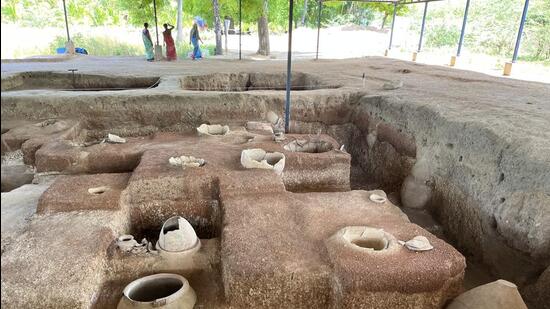
While the ninth phase of excavations are underway in Keeladi, it is season four in Konthagai. Keeladi, from where carbon dating samples were traced back to the 6th century (580 BCE), has three surrounding clusters– Agaram, Manalur and its only burial ground at Kondagai. The results of the samples from Keeladi are suggestive that the second urbanisation (when use of iron and agriculture increased) observed in the Gangetic valley in the northern part of India had also existed in the southern state.
Even though it is only a kilometre away from the Keeladi site, the Konthagai cluster is wholly different. The top layer of the soil is red while the second layer below is white. Underneath this, hundreds of burial urns bearing children and adults have been unearthed in the past three years.
“The natural soil formation here is very different from Keeladi. It is not suitable for cultivation or any other activity, so the ancient people chose this as their burial ground,” says Kaviya.
{{/usCountry}}“The natural soil formation here is very different from Keeladi. It is not suitable for cultivation or any other activity, so the ancient people chose this as their burial ground,” says Kaviya.
{{/usCountry}}On a sunny day in mid-July, workers clear soil from a trench when a white semicircle on the red structure is significantly visible. There is also a hint of an offering pot on the top red soil. “When I see a white semicircle, I know for sure that there is an urn inside,” says Kaviya.
The findings over the past seasons have revealed a pattern to the archaeologists. After burying an urn, the people of the bygone era refilled a portion of the laterite soil with the white soil. The laterite soil has a high iron content giving it the colour of red. Calcium content is high in the white soil.
Next, Kaviya needs to chalk out which side of this structure can be broken open to expose one-third of the burial urn so that it remains intact and allows further digging on other parts of the trench. Such archaeological planning makes this site, a neat display of a profile of each of the conical burial urns wrapped inside square trenches.
The Tamil Nadu State Department of Archaeology (TNSDA) began digging here from 2020 when the sixth season was on-going in Keeladi. But, before that it took an entire month for them to chop down dry thorny vegetation at Konthagai. Being a burial site in the middle of a village, meant it was a place that was left isolated by the locals out of fear. “It continued to be a burial site until 500 years ago,” the archaeology officer said.
Now this site is dominated by urns and women working around it. Watching a young Kaviya walking to the site at 5am and staying beyond ungodly hours, when she finds an interesting bone, inspired confidence among local women to be employed here as labourers. Bones which are to be sent for DNA testing can be exposed only early morning or after sundown since sunlight disturbs the DNA so the work here goes beyond midnight on some crucial days.
More than 137 burial urns varying in shape, size and variety have been unearthed so far.
So far, the findings here confirm that the ancient people of Keeladi followed only burial ritual -- squeezing the dead into a sitting position inside an urn. And then burying the urn with offering pots and grave goods made of iron implements such as a knife, dagger, axe, beads. Carnelian beads found here were not available locally and experts have concluded that it establishes trade with Gujarat and Afghanistan.
In contrast, in other excavation sites in Tamil Nadu, archaeologists have found a variety of burial and cremation rituals. The findings date back to the megalithic period such as single stone (menhir) in Kodumanal (Erode district) and the cist burial at Vadamalakunda (Krishnagiri).
In 2020, the archaeologists in Konthagai stumbled upon a child’s skeleton for the first time inside the urn. There were graffiti markings on this child’s burial urn. In another fascinating instance two people considered to be a husband and wife were found inside one urn. It matched a song from Purananuru, a collection of 400 poems from the glorious Sangam Era. “O Potter who makes Pot!..To bury him in this widespread land, shape a flared burial urn and make it wide enough for me too,” the poem translated from Tamil and the urn displayed at the Keeladi museum, says.
For the first time they discovered paddy grains inside an offering pot, in the third phase. In 2021, Kaviya found a fully intact human skeleton with its skull in a crouched position inside an urn. “And it looks like we may find two more such intact urns this year too,” she says.