
 E-Paper



K’taka House passes anti-hate speech bill
Karnataka Assembly passed a contentious bill to curb hate speech and crimes amid opposition protests, classifying them as cognisable, non-bailable offences.

 Prefer HTon Google


The Karnataka Legislative Assembly on Thursday cleared a contentious bill aimed at preventing hate speech and hate crimes, amid loud protests by the Opposition and without its participation in the final stages of debate.
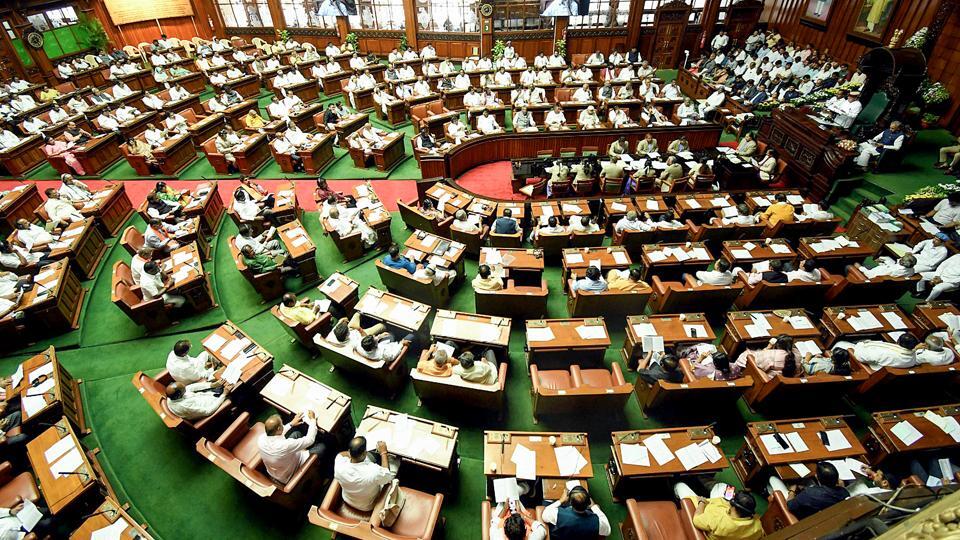
The House took up the Karnataka Hate Speech and Hate Crimes Prevention Bill after home minister G Parameshwara introduced it and outlined its objectives and provisions.
Proceedings were disrupted by Bharatiya Janata Party legislators, who were protesting remarks made earlier by urban development minister BS Suresh concerning lawmakers from the coastal region of the state.
Presenting the bill, Parameshwara said the proposed law was intended to curb the dissemination, publication and promotion of hate speech and hate crimes that generate disharmony and hatred against individuals or groups. He referred to a Supreme Court judgment delivered on May 5, which stressed on the need for stronger measures to check the spread of communal hatred through hate speech.
“In many cases, hate speeches have instigated crimes, including murders,” he said, adding that the legislation sought to prevent such incidents before they escalated. He said the law would apply to communication made in public view, whether through spoken words, printed material or electronic platforms.
Under the bill, hate speech and hate crimes are classified as cognisable and non-bailable offences, to be tried by a Judicial Magistrate First Class. “Whoever commits hate crimes shall be punished with imprisonment for a term which shall not be less than 1 year, but which may be extended to seven years, and with a fine of ₹50,000. Furthermore, for subsequent or repetitive offences, the punishment will be increased to two years and a fine of ₹1 lakh,” Parameshwara said while moving the bill.
The legislation adopts a broad definition of hate speech, covering any expression made in public view, whether spoken, written, conveyed through signs, visible representations or electronic communication, if it is intended to cause injury, enmity, hatred or ill will.
The scope extends to speech targeting individuals, groups, communities or organisations, including references to deceased persons, if such expression serves what the bill terms a prejudicial interest.
Prejudicial interest is defined to include bias or hostility linked to religion, race, caste or community, sex, gender, sexual orientation, place of birth, residence, language, disability or tribe.
At the same time, the bill provides exemptions.
Publications or expressions shown to be in the interest of science, literature, art, learning or matters of public concern are excluded from its ambit, as are materials preserved for bona fide heritage or religious purposes. Actions taken in good faith by public servants are also protected.
“In case of an organisation or institution, every person who, at the time of the offence, was in charge and was responsible shall be deemed guilty and shall be liable to be proceeded against and punished accordingly,” the bill states.
Deputy chief minister DK Shivakumar supported the legislation, saying, “Of course, hate speech prevention is part of the government’s agenda. We must maintain peace, law and order in the state.”
Opposition leaders strongly opposed the move. Leader of the Opposition R Ashoka argued that the bill was designed to target Opposition parties and the media.
“What else can we expect from the people who declared an emergency? Through this law, the State Government is taking away people’s right to speech guaranteed by the Constitution, and putting leaders of opposite parties and the media behind bars,” he said. He maintained that existing laws were sufficient to address hate speech and that no additional legislation was required.
Tensions escalated when Suresh intervened during Ashoka’s remarks to question his opposition to the bill.
BJP legislators, including Vedavyasa Kamath and S Manjunatha, objected to the intervention.
In response, Suresh made a remark about BJP legislators from the coastal region, saying Karnataka was “burning” due to hate speech and hate crime, triggering protests from the Opposition benches.
Opposition members demanded an apology and entered the well of the House. Speaker UT Khader announced that the remark would be expunged from the records, but the protest continued.
As BJP legislators remained in protest, Parameshwara sought the support of the House to pass the bill.
Senior BJP member Sunil Kumar sought a division of votes, but the Speaker proceeded with the tabling of the legislation. The bill was passed while Opposition members were still protesting. The House was later adjourned for lunch, with the Speaker declaring that the legislation had been approved.
Beyond penal provisions, the bill grants preventive powers to the executive and the police. An executive magistrate, special executive magistrate or a police officer not below the rank of deputy superintendent of police may take action if there is reason to believe that an offence under the Act is likely to be committed or has been threatened.
The legislation also establishes a state level mechanism to deal with hate content on the internet. A designated officer authorised by the state government may direct service providers, intermediaries or other entities to block or remove hate related material, operating alongside the existing framework under the Information Technology Act.


