
 E-Paper



Lack of strong regional leaders, election discourse: What BJP is discussing now
Senior party leader both at the centre and the state level said the party’s performance has underscored the need to alter the electioneering model that is heavily dependent on the central leadership


The Bharatiya Janata Party’s regional leadership; the strength of its cadre and the election discourse have come in for scrutiny within the party, post the recent round of assembly elections. Senior party leader both at the centre and the state level said the party’s performance has underscored the need to alter the electioneering model that is heavily dependent on the central leadership.
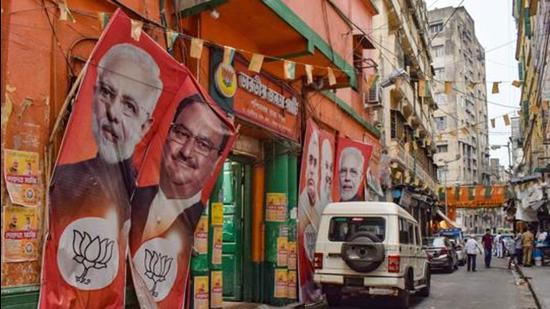
While the party managed to retain power in Assam and is part of a winning coalition in Puducherry; it emerged as the principal opposition in West Bengal and won four seats in Tamil Nadu but failed to win any seats in Kerala.
“There is a need to have strong faces on the ground to take on opponents. This has been a key takeaway from the West Bengal election. Though in the past the party has fought most of the elections without a chief ministerial candidate, there is a perception that it does not work anymore. While the BJP and the leadership of Prime Minister Narendra Modi are popular, having strong local leadership is essential,” said a senior party leader in Delhi.
In-charge of the WB election, Kailash Vijayvargia told HT in an interview last week that the absence of a face to take on Mamata Banerjee could have been a reason for the party’s loss. “…The other reason (for the loss) can be that Mamata Banerjee’s leadership was towering; and we could not project a local leader (as a challenger to her),” he said.
Also Read | For the PM, it is time to course-correct
A second leader in Delhi said in the absence of a strong cadre in Bengal, the ground situation was “misrepresented” to the party high command.
“A local leader who is invested in the state will always have a better estimate about the support at the booth level. This time it seems that was misrepresented,” the second leader said, indicating that the party misread the support on the ground.
Since it won the 2019 general election with an unprecedented 303 MPs in the Lok Sabha , the party has lost elections in Delhi and Jharkhand. In Maharashtra, even though it is emerged as the single-largest party, it could not form the government after falling out with its oldest ally, the Shiv Sena, over a power-sharing agreement. The party managed to retain power in Haryana only after getting support from the Jannayak Janta Party.
“There was a time when the BJP had a bouquet of regional stalwarts; there were Madan Lal Khuran and Sahib Singh Verma in Delhi, leaders such as Kushabhau Thakre, Kalyan Singh, Bhairav Singh Shekhwat, all of whom had considerable hold over their regions. Now, while PM Modi is the biggest vote catcher and the most popular leader, he needs strong regional leaders to retain those votes,” said a third leader.
The party’s reliance on turncoats has also been red-flagged. While some senior party leaders defend laying the red carpet for defectors from other parties as a process that is required to supplement the organic growth; there are others who feel defending a former opponent, especially those who have allegations against them weakens the party’s claims of offering an alternative.
Commenting on how the lack of strong regional leaders impacts the BJP’s ambition of a pan India presence, Sandeep Shastri, vice chancellor of the Jagran Lakecity University said, “Let’s remember post 2014, the BJP won in states that it wasn’t in power in. It does well as a contender not as much as an incumbent.”
Also Read | Stop posturing; start vaccinating
He went on to add, “Increasingly, state specificities are dictating the elections; the national leadership may help create a buzz, but unless there is credible regional leadership, the party will not benefit from the campaigns (by national leaders). The national leaders are the icing on the cake, but the base has to be the regional and local units.”
Election Issues
Another area that has come up for discussion is the party’s election discourse. Although, the party in its election manifesto released in all states focused on development, employment and economic welfare, there is a section of leaders which has pointed out that the party erred in navigating the discourse to contentious topics. They cite the example of allowing issues such as love jihad to dominate the discourse in West Bengal and the entry of women to Sabarimala in Kerala as a case in point.
In Kerala, where the dip in the vote share has set off concern, the party has set up a committee to examine the reasons for the poor showing. The BJP with zero seats saw its voteshare climb down to 11.3% from the previous election’s 15%.
“The party’s vote share is at its lowest [and that] calls for serious contemplation. Even during the Jana Sangh days, the party performed better. The inability to win even a single seat is another concern that the state leaders need to address, this when the state unit president himself contested from two constituencies,” said a senior party leader from the state.
The leader said the party failed to read the sentiment on the ground at a time when the state was fighting the pandemic. “Harping on Sabarimala when people were more concerned about healthcare and how to sustain their lives was counter intuitive. The state president went campaigning in a helicopter, this raised eyebrows in a state where extravagance in politics is frowned upon,” said the leader.
Professor of political science at the Jawaharlal Nehru University, Ajay Gudavarthy said the BJP lost in WB by not sticking to what it plans to offer people who were alienated by the TMC. He said the party needs to focus on local issues instead of trying to replicate the discourse that works in other places. “Instead of promising accountability and development, their narrative about Love Jihad that has traction maybe in the northern states, became the overwhelming part of the discourse,” he said.


