
 E-Paper



Light, sound, curtain: Cinema blooms in the Valley again
The symbolism of the moment was unmissable. The INOX multiplex — Kashmir’s first multi-screen experience, built over threeyears and with a capacity of 520 — stands just behind where the Broadway cinema hall once stood, until it was burnt down in 1991.


On Tuesday morning, a group of more than 100 people filtered into a sparkling white building with black marble interiors. Its facade was lined with marigolds, and a celebratory blue ribbon adorned its front gates. The gaggle walked into the building’s carpeted halls, with the smell of popcorn thick in the air.
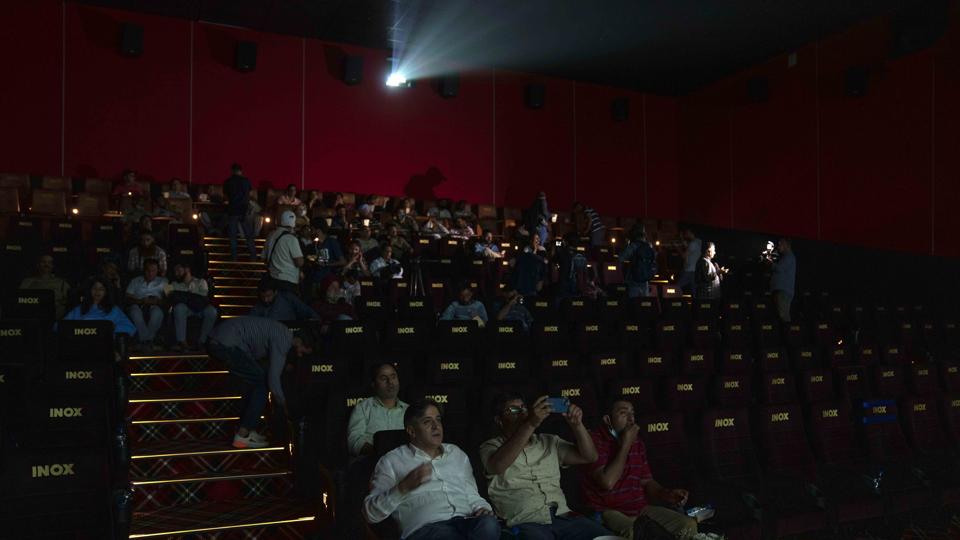
At 11am, as they eagerly sat on cushioned seats, a giant big screen in front of them burst into life. In that moment, at the start of a film nobody in the room had watched yet, the audience burst into applause. For the first time in over three decades, the movies were back in Kashmir.
Also Read| A first in 3 decades: J&K LG Manoj Sinha inaugurates Srinagar multiplex
The symbolism of the moment was unmissable. The INOX multiplex — Kashmir’s first multi-screen experience, built over threeyears and with a capacity of 520 — stands just behind where the Broadway cinema hall once stood, until it was burnt down in 1991. The Badami Bagh cantonment, home to the 15 Corps of the Indian Army, is less than 700m away.
So the weight of history was stark as Kashmir took one more tentative step into modernity, and at the same time, returned ever so slightly to what normalcy must have once felt like.
New beginnings
The show began with a message of hope emblazoned on the screen. “The beginning of a new era and Kashmir’s first multiplex,” it said, with the photo of the state’s Lieutenant Governor (LG) Manoj Sinha in the background.
Trailers of Bollywood films Vikram, Janwar, Silsila and Haider followed — each shot in Kashmir. Then, the first film Kashmir has aired on a big screen in three decades began to play — Lal Singh Chaddha; picked because of its connection to the Valley. “Lal Singh Chaddha was shot in Srinagar and some scenes were taken in the school I own (Delhi Public School). That is why we selected the film for the inaugural show,” said Vijay Dhar, a Kashmiri Pandit businessman who owns the new theatre. His father, DP Dhar, was one of the community’s tallest politicians who served first as a diplomat and then as a Union minister.
Sinha, who spoke at the inauguration on Tuesday, called the moment a symbol of a “major socioeconomic revolution” .
“At this very place was Broadway cinema and the first film shown here then was Janwar by the late Shammi Kapoor. That film was shot at the Dal Lake. Today, the lovers of cinema are back,” he said.
Sinha pointed to the opening of “multi-purpose” cinema halls in Pulwama and Shopian last week, both considered volatile south Kashmir districts, and said that this was an exercise to bring cinema to all of Kashmir. “Only two days ago, under the youth mission, two multi-purpose halls at Pulwama and Shopian were opened. Our target is to establish 100-seat cinema halls in every district. We have also selected land for a new film city. The new film policy has lots of avenues for the local youth, and if they make small films, not only will they get incentives, but employment,” Sinha said.
It was in 2018 that M/S Taksal Hospitality Private Limited, owned by the Dhars, who also owned the original Broadway theatre, first applied for permission for the multiplex. They received a no-objection certificate (NoC) in 2019, after going through rigorous safety, security, and other checks. “For us, this is akin to a dream that has come true. The decision to build the multiplex came directly from the heart,” said Vikas Dhar, who is the MD of the company while his father Vijay is the chairman.
Also Read| ‘Historic day’: J&K L-G inaugurates cinema halls in Pulwama, Shopian
Dhar said that the multiplex has three halls and will open regularly from September 30. “Today’s show was for guests and media only. From September 30, there will be morning, afternoon, and evening shows. We have installed state-of-the-art equipment, and it will be a different experience from what it was 30 years ago,” Vikas Dhar said.
What once was
Till the late 1980s, long before the era of multiplexes, there were at least 12 stand-alone cinema halls functioning in Kashmir. The streets of Srinagar at the time were full of handwritten billboards of films, and hand-drawn images of movie stars. There were Khayyam and Sheraz in downtown Srinagar, Neelam, Naaz and Regal in Civil Lines, Samad Talkies in Sopore, and Regina in Baramulla. The oldest, Palladium, was located in the heart of Lal Chowk. The Indian Army, too, set up at least two cinema halls in the Valley close to its camps in Tapper Pattan and Baramulla, named after General Zorawar Singh and General Thimmaya.
But the constant threat of militancy in the late 1980s forced all of these to shut by and by. Some like Regina, Samad Talkies, and Regal turned into shopping complexes; Khayyam metamorphosed into a nursing home; and some others became home to paramilitary camps.
There have been attempts to reopen theatres in the past, but they have been non-starters. In September 1999, when the state was governed by the Farooq Abdullah-led National Conference government, the Regal Cinema was the victim of a grenade attack the day it opened, leaving one person dead.
Ghulam Ud Din Bhar, an actor who played small roles in Haider and Bajrangi Bhaijaan, said, “The last movie I watched in a hall in Kashmir was in the late ’80s. I spend the winters in Jammu where I often go to cinema halls. It is always a different experience and it is a good decision that these are opening in Srinagar again.”
Under the shadow of the gun
Like most things in Kashmir, however, this move too is being viewed with a sense of caution, by both civilians and the security establishment. They know all it will take to derail the progress is one attack. “Things have changed since late 1980s but it remains to be seen whether people will bring their families to watch films when there is always risk of an attack. There is now the security of watching celluloid on OTT platforms. Let’s hope this works because attempts in the past have failed,” said Sheikh Wahid, a Srinagar-based entrepreneur.
Asem Mohiuddin, who runs a weekly newspaper from Srinagar, said, “The reopening is a positive sign but security across places in Kashmir will always remain a challenge for the government. Let the administration ensure that these places don’t become soft targets for militants that will not only force their closure, but will push these initiatives back.”
Dhar, however, said that besides the private agencies that the multiplex has employed, the government has ensured proper security of the multiplex.
Imtiyaz Hussain, senior superintendent of police, tweeted, “Some things are worth fighting for. It’s not just cinema back in Kashmir, but a momentous turning point in history. #INOX in Srinagar.”
The political reaction
While the BJP has inevitably viewed the opening of cinema halls in Kashmir as a big success, other political parties have responded with a sense of caution, seeking to delineate “peace” with “economic activity”.
“This is a good step and we hope it helps creating a positive impact on people but opening of cinemas halls or similar activities does not necessarily mean normalcy. It is a barometer of economic activity. Don’t forget under former chief minister, Omar Abdullah, Kashmir witnessed the biggest orchestra event where the music maestro Zubin Mehta performed at Shalimar Garden,” said Tanvir Sadiq, National Conference chief spokesman.
Peoples Democratic Party spokesperson Mohit Bhan said that the Bharatiya Janata Party was overplaying its achievements. “The two new theatres opened in Pulwama are basically two auditoriums and conference rooms fitted with projectors. These government claimed cinemas are a joke and the media must see if they really qualify as a cinema. I wish the government encourages entrepreneurs to really open one in the south and north of Kashmir on the lines of Srinagar,” Bhan said.
BJP state spokesman Altaf Thakur said that this move would open the minds of the younger generation in the Valley. “We don’t want fundamentalism here. Why shouldn’t Kashmir have spaces for entertainment? Militants will not be able to shut cinemas because their influence is on decline,” Thakur said.
Filmmakers in Kashmir said that they hoped the Srinagar multiplex would lead to a rebirth of cinema in Kashmir, and revival of what was once a thriving film culture.
“The history of cinema in Kashmir dates back to pre-partition days when the first cinema was established in the city by the name of Kashmir Talkies in 1932. This later became the Palladium cinema, which is now in ruins. For years, there was rarely a film that was produced in Bollywood that did not have a connection with Kashmir, even if it was the shooting of one song. Now we are witnessing the revival of Kashmir in Hindi cinema, and this new connection will help local artists and our economy in a big way,“ said Mushtaaq Ali Ahmed Khan, who has organised several film festivals in Srinagar.
Khan, who is also an actor, said that there were several proposals for the shooting of films and songs that were waiting for government approval. “Out of 500 such proposals since last year, more than 120 have been approved. It is mandatory for the producers to employ some local artists, which goes a long way. Everybody in our fraternity is happy with this renewed push which will expedite this environment even more,” he said.
Khan may well be one of those who visit the INOX multiplex on September 30. Most hope, with bated breath, that others in Kashmir will follow.


