
 E-Paper



Elections, cuisines, and entrepreneurship discussed on Day 2 at HTLS 2022
Uttarakhand chief minister Pushkar Singh Dhami, India's top chef Manish Mehrotra, and Nykaa founder-CEO Falguni Nayar were the guests on Day 2 of HT Leadership Summit 2022.
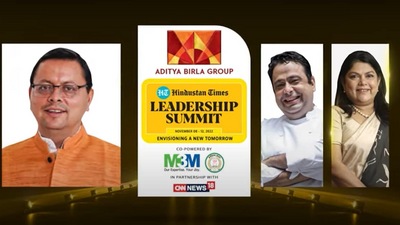
Welcome to the second day of Hindustan Times Leadership Summit 2022. Today we will have guests from field of politics, lifestyle and business to share their ideas that help envisioning a new tomorrow. The Day 2 of the summit started with a live session with Uttarakhand chief minister Pushkar Singh Dhami, who appears to have steadied BJP's ship in the hill state. Since BJP's 2022 assembly election win in Uttarakhand, Dhami has looked to cement himself even further and appears set for a long inning in power....Read More
In the second session, celebrity chef Manish Mehrotra spoke to Jamal Shaikh, Editor, HT Brunch. Mehrotra is known for reinterpreting nostalgic Indian dishes with an openness toward global techniques and influences.
The third and final session was with Falguni Nayar, founder and CEO of Nykaa, a multi-brand omnichannel beauty, fashion and lifestyle-focused retail business established in 2012.
Want Nykaa and its brands to be recognised globally: Nayar
Nykaa founder Falguni Nayar says she wants the brand and its products to be recognised globally.
There are no glass ceilings for women, says Nykaa founder Falguni Nayar
“For women there are no glass ceilings. Women need to dream for themselves. The empowerment and support has to come from home. From family, you need to be empowered to pursue your dreams than what companies do. I am a big believer that women empowerment has to begin at home
60% of beauty product demands from non-metro city: Falguni Nayar
Nykaa founder Falguni Nayar tells women, “Let the spotlight of your life be on you. For too long women have been afraid to dream about themselves. We have given them chance to be born, lets give them the chance to dream”.
Nykaa has over 5,500 brands, 128 stores in 58 cities: Nayar
Nykaa founder Falguni Nayar says the website gets a billion visits a month. There are 5,500 brands engaged with the company. There are 128 stores in 58 cities across the country.
Led 15-20 meetings a week: Falguni Nayar
“ I used to meet people daily. In a week I would attend 15-20 meetings. I used to meet a lot of people. That's how I learnt a lot”.
Recruited very young team members: Falguni Nayar
Falguni Nayar says Nykaa hired mostly young talent straight from colleges. The criteria was to judge how passionate a candidate was for Nykaa.
Millennial customers key to success: Nykaa founder Falguni Nayar
Nayar credited the millennial consumers who were exposed to social media as the key to her brand's success in early days. "Since then, consumers from the old age group are also buying beauty products, but the initial success was from millennials," she said.
Our secret sauce comes from our customers who trust us: Nykaa founder Falguni Nayar
“We are a very open organisation. We learn from our customers. They tell us to bring this particular brand or open a store here. We have been very active on social media”
Journey of an entrepreneur isn't easy: Nykaa founder Falguni Nayar
“However, I also had to admit that entrepreneurial journeys are not easy and the early days are characterised by a lot of pain points. We were a tech-enabled platform. Getting the technology right were the initial issues. Then getting proof of concept, consumer adoption of product, high quality service and keeping the customers happy are big tasks. I think the first two-three years of any startup are the hardest. The lessons and skills learnt as an organisation are very helpful in the long run.”
On three young Indian chefs who have the potential to put Indian food on the world map
"There are so many amazing chefs who are doing fantastic jobs all around the world, but if I had to take three names I would say Himanshu Saini, he is doing fantastic work. And mark my words, in five years he is going to be the most famous Indian chefs. Second is Pratik Sadhu and third is The Bombay Canteen and O Pedro's Hussain Shahzad. They are all are doing amazing jobs," Chef Manish Mehrotra said.
On plant-based eating becoming a big part of the future
"I think it was always there with out cuisine. The amount of vegetarian dishes or vegetables we consume in our homes over the years was always there. Potatoes came three hundred or so years back to India and I feel like India can definitely win an Olympics of India dishes. we just have to dig our own recipes and we will find thousand of things," celebrity chef Manish Mehrotra said.
On the perception of Indian food in the world
"Yes, I am so happy that it is changing. All of us chefs around the world, we have an ultimate goal to get real Indian food to the world. We want to tell them that India is not only about North and West frontiers, there is West, East, South, and every part of India has a unique cuisine to offer. For instance, ten years ago, no one knew what dosa was, but not everyone knows it is one of the best pancakes in the world. Things are changing and regional cuisines are coming up. Even in India a lot of perceptions are changing. L20 years back "
On what worked for Indian Accent
"When we started Indian Accent, I have seen empty restaurant, sometimes zero covers for dinners, sometimes people used to come and walk out after reading the menu. But whatever dish used to come out to the table, we used to make sure that the common word called 'tasty khana' should be there. We wanted to ensure that there is some kind of familiarity in the food. We also did unique combinations at the restaurant like the Blue Cheese Naan or Gujarati chunda with pork ribs. Then, people understood our concept and they came back."
On the idea behind Indian Accent
"I was in London [before coming to India], and London at that time was a cosmopolitan city of different cultures, nationalities, and every country's food was represented at a good level. and I thought why can't we create this in India. Because at that point of time, in the early to late 2000s I felt that the youth of India had a very big disconnect with Indian food. Young Indians had stopped going to Indian restaurants. There was a big disconnect. This became a big motivation for me - that you have to do Indian food in such a way that it reconnects the young generation, people coming from outside India can relish it, and regional cuisine can come into the limelight."
Chef Manish Mehrotra on food critics
On being asked whether he is dissing all food critics and if he takes them seriously, he adds, "No, I am not saying that. I believe that everyone is a critic because food is one such thing that can have thousands of opinion. Food is very very individual. I take them seriously in terms of what feedback they give."
On diners being the best critics
Chef Manish Mehrotra says his diners are his best critics. "Definitely, [my diners are my best critics]. I judge all my dishes, whether its taste and presentation is good and whether I will be paying that much price for this dish if I go out and eat it - it is a benchmark to see the dish."
Chef Mehrotra's time with the iconic Chef Ananda Solomon
"Chef Ananda Solomon is a legend. He is one of the finest Chefs I have ever seen, who not only knows about food but also about guests' psyche. For a chef or anyone, including a fashion designer, filmmaker or musician, you are doing it for someone else and knowing what is going on in their brain is very important. And that is what I learned from the Chef. I still believe in feedback, and one Golden rule that I learnt from him is that the plate which goes inside the restaurant is very important, but the plate which comes back from the restaurant is even more important."
On home-cooked and vegetarian food
Chef Manish Mehrotra said home-cooked food taught him vegetarian food can be tasty during the edition of Hindustan Times Leadership Summit. "At home, we used to have [daal, bhat, roti and sabzi] pure vegetarian food, mostly without onion and garlic because my father never used it eat both. Many festivals (Janamashtami, Holi, Diwali, Dussehra and more) were celebrated with food at home. And that really taught me that vegetarian food can be really tasty, you don't need onion and garlic to make food delicious, and fewer ingredients can make a delicious dish."
Chef Manish Mehrotra on his first experience in fine dining
Growing up in Patna, which did not have any fine-dining restaurants, Chef Manish Mehrotra talked about his first experience with fine dining. "My first experience with fine dining I would say was when we used to have relatives all over India and we used to go out with them. In terms of proper fine dining, the experience of going to a five-star hotel and having Indian khana there was sort of the fine-dining experience that was available when I was a kid. Whenever we used to come to Delhi, we used to encounter that kind of meal. So, I would say I encountered my first dining meal, which was not plated, in the early 80s," the Chef said.
Chef Manish Mehrotra says plated food was always there
Chef Manish Mehrotra says, "Plated food was always there and that is what I try to design - inspired from the Thali, the Satya meal or temple food, where you will have different textures, flavours and colours all prominent on a platter. This is what I do. I am reviving the old traditions which got lost somewhere in between."
Chef Manish Mehrotra on critics' claims that fine dining takes away the soul of Indian dishes
As the person who has heralded plated Indian food and fine dining, Chef Manish Mehrotra says, "I think the first plated food in the world or in India was a Thali or a Satya meal. What do you mean by plated - where everything and every part of the dish is decided and designed in such a way that we know where it should go on the plate. And in the Satya meal, every particular dish has a defined position on a banana leaf. So, we have been having plated food for many centuries. But somehow in the middle, we got lost somewhere and everything started coming in a big bowl, drowned in a brown, yellow or orangish kind of gravies."
Chef Manish Mehrotra's dishes take inspiration from the grassroots of India
Chef Manish Mehrotra's Dal Moradabadi and Beetroot and Goat Cheese Salad are "two very modern dishes inspired from the grassroots of India". He added that the country has many gems which are all right to be served in a fine dining restaurant.
Chef Manish Mehrotra's Beetroot and Goat Cheese Salad with Potato recipe
Begin by making beetroot batons using boiled beetroots and carving tube-like shapes using a cutting pipe. Add the cooked beetroot batons, a little bit of lime juice, honey, a pinch of salt and pepper, boiled ball-shaped potatoes and Kasundi (a Bengali mustard sauce), and mix it all together in a bowl. Then, plate the beetroots and potatoes nicely and garnish with goat cheese, peanut butter, pea shoots, crispy pieces of bread, raisins, and baked Manipur black rice and pistachio Chikki.
Chef Manish Mehrotra's Dal Moradabadi recipe
In a normal pan, add a little bit of ghee. Once the ghee is hot, add one or two cloves, jeera and a little bit of Hing and cook. Add Moong Dal (boiled with a little bit of haldi and salt) to the mixture (having a paste-like texture). After mixing everything, add a little bit of ginger and green chillies to the pan. Cook and add coriander and butter to the dal for the final touches. While plating the dish, garnish it with Bhuknu masala, Imli ka chutney (tamarind chutney), dhaniya (coriander) and mint chutney, a dash of lemon juice, chopped onions and tomatoes, and crispy Moong Dal.
Chef Manish Mehrotra shares the recipe for his two special dishes
Culinary Director of Indian Accent restaurants, Chef Manish Mehrotra, takes viewers into his kitchen at Indian Accent during the 20th edition of the Hindustan Times Leadership Summit. He shows how to make two dishes - Dal Moradabadi (a Moong Dal dish which everyone was against being served in a fine-dining restaurant and cost a bomb) and Beetroot and Goat Cheese Salad with Potato (inspired by the Kolkata Beetroot Chop). Popularised in the streets of Muradabad, one of the unique things about his Dal Moradabadi recipe is that it does not have onion or garlic.


