Locusts have invaded western India. The swarms, that entered the country from Pakistan, are spreading like wildfire and have so far invaded five states: Rajasthan, Gujarat, Madhya Pradesh, Maharashtra and Uttar Pradesh. There is an alert for national capital Delhi too.
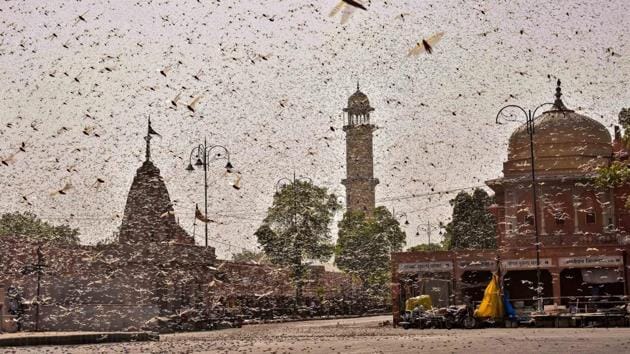
What makes locusts a concern for farmers and agriculturists is that they can eat almost every type of crop and finish an entire field in few hours.
But there are some interesting facts about the migratory pests. Here are a few of them:
• Locusts are considered halal or lawful food in Islam. According to Salafi Centre in Manchester, locusts are permissible food because it was eaten during the time of the Prophet. The pests were eaten during a military raid, said an authentic hadith, according to Salafi Centre.
• The desert locusts, the sub-species of the grasshopper-like pests, originated in Saudi Arabia and is eaten there. Even the Yemenis savour locusts during Ramzan. There are reports that some European travellers had seen people in Saudi Arabia, Egypt and Morocco selling, cooking and eating locusts.
• Locust swarms have been recorded in the Arabian peninsula and some African countries since biblical times, but unusual weather patterns exacerbated by climate change have created ideal conditions for insect numbers to surge, scientists say.
{{/usCountry}}• Locust swarms have been recorded in the Arabian peninsula and some African countries since biblical times, but unusual weather patterns exacerbated by climate change have created ideal conditions for insect numbers to surge, scientists say.
{{/usCountry}}• These warms have infested 23 countries across East Africa, the Middle East and South Asia in 2020, the biggest outbreak in 70 years, the World Bank said. Last week, the bank approved a record $500 million in grants and low-interest loans to help countries in Africa and the Middle East fight swarms of desert locusts.
• Adult desert locust swarms can fly up to 150 km a day with the wind and adult insects can consume roughly their own weight in fresh food per day. A single square kilometre swarm can eat as much food in a day as 35,000 people.
• They feed on nearly all green vegetation - leaves, flowers, bark, stems, fruit, and seeds - and crops including millet, rice, maize, sorghum, sugarcane, barley, cotton, fruit trees, date palm, vegetables, rangeland grasses, acacia, pines and banana.
• Desert locusts change their behaviour from acting as individuals to becoming part of a group, forming dense and mobile hordes. Swarms can be several hundred square kilometres and extremely dense, with up to 80 million adults in each square kilometre.
• The last major infestation was in 2003-2005 when more than 12 million hectares were treated in west and northwest Africa, costing hundreds of millions of dollars, including food aid.
Sources: Food and Agriculture Organisation of the United Nations; Government of New South Wales; Victoria State Government; University of Minnesota; Natural Earth; European Space Agency Climate Change Initiative; United States Geological Survey via Famine Early Warning Systems Network; Armed Conflict Location & Event Data Project (ACLED); Reuters