E-Paper



Long-billed Bush Warbler sighted in India after 46 years
The Long-billed Bush Warbler (Locustella major) was sighted on July 15 in dense willow thickets at over 3,200 metres altitude.

 Prefer HTon Google


A team of five birders has recorded the first confirmed Indian sighting of the elusive Long-billed Bush Warbler in 46 years, spotting the Near Threatened species in Ladakh’s Suru Valley as part of a mission to find the country’s ‘long lost birds’.
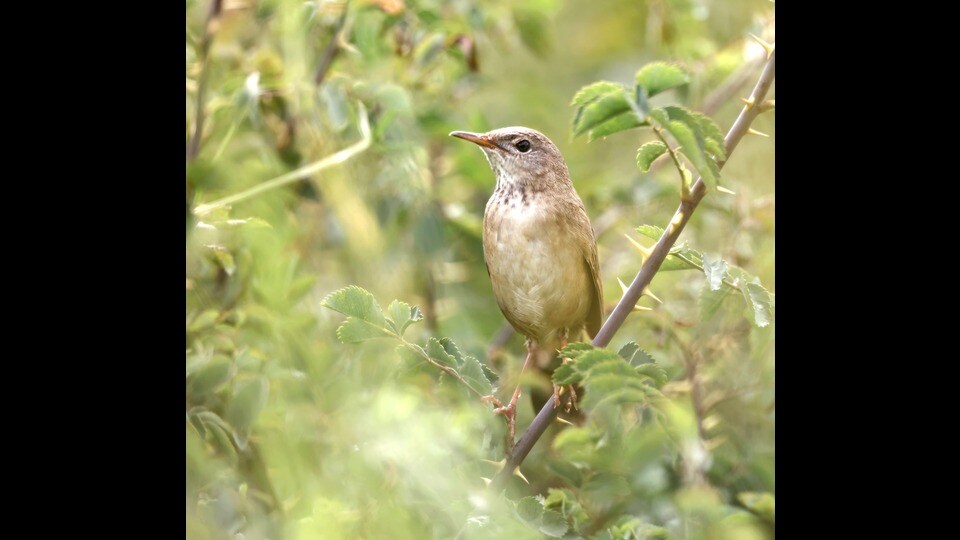
The Long-billed Bush Warbler (Locustella major) was sighted on July 15 in dense willow thickets at over 3,200 metres altitude, three days into an expedition that began on July 12. The team first detected the bird’s distinctive insect-like call before making visual confirmation.
“This is a record after 46 years for India,” said expedition member Harish Thangaraj, who recently discovered another rare species—the Sind woodpecker—in Rajasthan’s Jaisalmer.
The last confirmed Indian sighting was in 1979 when Southampton University researchers spotted the warbler near Sankoo in Kargil. The species, historically common in the Dras and Suru valleys until the 1920s, likely declined due to habitat loss as agricultural fields replaced the bushes it depends upon.
The expedition team—comprising Lt Gen Bhupesh Goyal, Manjula Desai, Rigzin Nubu, Irfan Jeelani and Thangaraj—conducted extensive research before setting out, scouring past research materials and known publications, analysing Google Earth and Google Maps for possible habitats, and consulting birders who had previously spotted or researched the species.
After initially searching the Tulail valley between 2,400-2,800 metres, the team moved to Suru valley, where their persistence paid off. The sighting altitude aligns with recent records from neighbouring Gilgit-Baltistan, where the species has been documented between 3,000-3,100 metres since 2022.
Malaysia-based birder James Eaton, who had searched for the warbler across India and Pakistan for over a decade, achieved success in Gilgit-Baltistan’s Naltar valley in 2022. This breakthrough prompted other birders to follow, resulting in multiple sightings in 2023, 2024 and 2025 across the region, including locations just 120 kilometres from the Line of Control.
The warbler typically becomes active between mid-June and mid-July, using its calls to establish territory and attract mates. It inhabits areas with short grasses and bushes including Rumex and sea buckthorn, favouring sheltered glades with thickets of Ribes Geossularia (wild gooseberry) on spruce forest edges.
“This has been a bird that has always been overlooked by birders and agencies alike,” said Bikram Grewal, author of Birds of India (2016). “Not much is known about it and its range even.”
Formerly known as the Long-billed grasshopper warbler, the species has a limited global range, with historical records from China and Tajikistan. The International Union for Conservation of Nature classifies it as Near Threatened.
Birder Shashank Dalvi is known to have spotted two individuals in 2015, however, he was unable to capture photographs as it was a brief sighting.
Grewal expects the renewed interest in locating rare species will yield more discoveries. “We will certainly see more records in Ladakh in coming years as more birders are taking upon themselves to find such species and discover more about their habitat.”