
 E-Paper



LWE-affected and Afspa areas have reduced under Modi govt: Amit Shah
The number of districts affected by left-wing extremism in central India, and the number of places under Afspa in the north-east have gone down by 70% and 66% respectively, the Union home minister said.


New Delhi: Union minister Amit Shah on Tuesday said India’s internal security situation has improved sharply during the tenure of Prime Minister Narendra Modi, pointing out that Left-wing extremism (LWE)-affected districts in central India and Afspa areas in the North-East have reduced by 70% and 66% respectively.
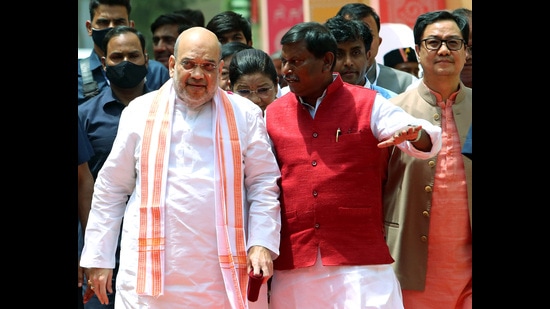
Shah also said that the number of deaths and terror incidents have gone down in the regions.
Inaugurating the National Tribal Research Institute (NTRI) in New Delhi under the aegis of the “Azadi Ka Amrit Mahotsav” celebrations, Shah spoke about the reduction in violence and death in the North-East and LWE areas, and contrasted the Modi rule with the Congress-led UPA era.
“Between 2006 and 2014, the country witnessed 8,700 incidents in North-East, which came down by 70% during PM Modi’s governance. A safe North-East and safe Left-wing extremism-prone areas of Central India will pave the way for tribal welfare.”
The home minister added that 87 security personnel lost their lives in the North-East under the Modi government as against 304 during the Congress rule. “The number of civilian deaths has come down from 1,990 to 217,” he said.
Underlining PM Modi has accorded top priority to research and education since he came to power, the home minister said: “Under the Congress government, in 2014, ₹7 crore had been set aside for this purpose. In 2022, we have kept ₹150 crore for it... Similarly, the budget for Eklavya residential schools went up from ₹278 crore to ₹1,418 crore this financial year.”
Shah also highlighted the key role that NTRI aims to play. “As per Prime Minister Narendra Modi’s vision, the National Tribal Research Institute is finally coming into existence… By the time we celebrate 100 years of Independence, this institute will the backbone for tribal communities.”
NTRI will function as a research institute to train employees and organise capacity-building for other institutes, popularise tribal festivals, and maintain the diversity of tribal museums. It will also serve the purpose of acting as a blueprint for the development of the tribal society, said Shah. The institute will also provide policy inputs to the Union government, and act as a national nodal agency.


