
 E-Paper



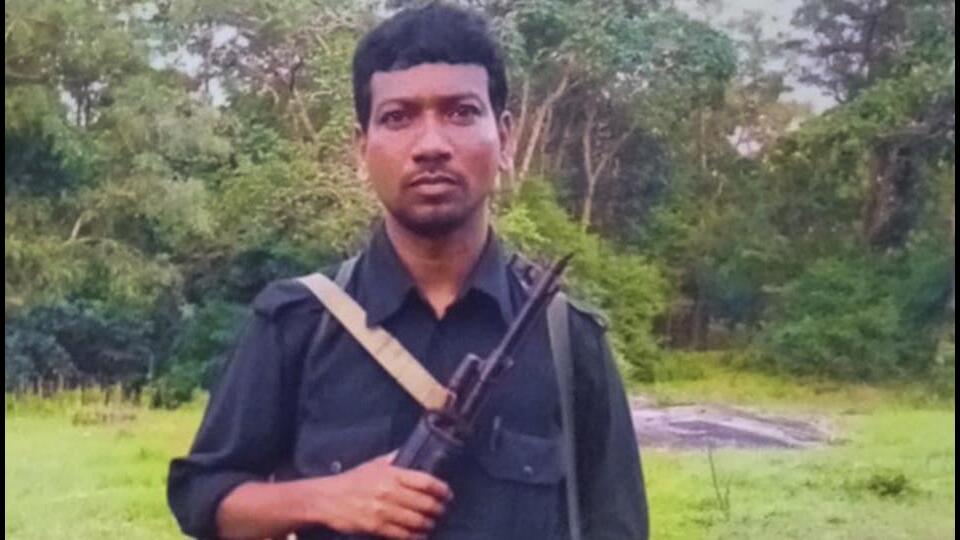
Madvi Hidma: How a tribal boy rose to become a dreaded Maoist
Officers said Madvi Hidma played a central role in recruitment networks in remote forest villages and in tactical training

 Prefer HTon Google


RAIPUR: “Hidma’s terror has ended, peace is returning to Bastar,” Chhattisgarh chief minister Vishnu Deo Sai wrote on social media on Tuesday and Inspector General of Police, Bastar Range, Sundarraj P, said that the death of 50-year-old top Maoist commander marked “one of the most decisive breakthroughs in the history of anti-Naxal operations.”
The two quotes not only highlighted the terror that Hidma, a central figure of the proscribed Communist Party of India (Maoist) military structure, had on the psyche of residents in Bastar but also summed up the significance of his death on the morale of security forces.
Hidma was killed in a gunfight with security forces in Andhra Pradesh on Tuesday. His wife, Madkam Raje, a long-serving Maoist organiser, and four other cadres were also killed in the encounter in Alluri Sitarama Raju district, close to the Chhattisgarh border, officials said.
A resident of Puvarti, a small village under the Jagargunda police station on the Sukma-Bijapur border, Hidma belonged to the Muriya tribe — a Scheduled Tribe— and had studied till class 5. He was recruited as a Bal Sangham (child) cadre of Maoists in 1991, before being absorbed into various local and area committees as the insurgency expanded its influence across the Dandakaranya region, according to intelligence records.
In early 2000s, the five-and-a-half feet tall Hidma was inducted into the People’s Liberation Guerrilla Army (PLGA) and eventually appointed the commander of PLGA Battalion Number 1, the most lethal striking unit of CPI (Maoist). The battalion of over 150 armed cadres — handpicked by Hidma — was responsible for designing attacks that combined familiarity with terrain and coordinated movement of armed columns. Investigators and field officers said Hidma developed a method of operational planning that relied on layered security, reconnaissance for dispersal after attack and the use of forest ridgelines to shield gunmen during ambushes. This approach, they added, was employed in several major attacks attributed to him.
According to police records, his name appeared as responsible for multiple major Maoist attacks, including the 2010 attack near Tadmetla in which 76 security personnel were killed, the 2013 Darbha or Jhiram Valley ambush that wiped out almost the entire Chhattisgarh Congress leadership, the 2017 Burkapal attack and connected strikes in Sukma that led to a large number of security casualties, and the 2021 encounter near Tarrem on the Sukma-Bijapur border where security forces faced heavy resistance and casualties.
Officers said Hidma played a central role in recruitment networks in remote forest villages and in tactical training that enabled Maoist squads to retain operational capability despite attrition. “For his skills, he was the youngest rebel ever to be made a member of the Central Committee of CPI (Maoist),” a police officer said, requesting anonymity.
Madkam Raje’s involvement in the organisation was less public but well documented in internal Maoist structures traced by security agencies. Like her husband, she started as a Bal Sangathan member in the mid-1990s and later held responsibilities in the Jagargunda and Kistaram areas before being moved into political and instructional roles. She was also associated with the Mobile Political School of CPI (Maoist), a training institution for its cadres.
In later years, she was part of political committees involved in cadre orientation and was regarded as a disciplined organiser who maintained operational communication during periods of pressure, the officer cited above said.
A senior officer posted in Bastar said sustained anti-Maoist operations over the last two years — the Centre has set March 2026 deadline to wipe out left wing extremism from the country — have steadily eroded the protective ring around Hidma’s unit, forcing them to abandon entrenched bases and move across the Karegutta hills and forest corridors along the Chhattisgarh-Telangana boundary.
The movement toward Andhra Pradesh had been anticipated by security planners, and coordination with AP and Telangana police was strengthened accordingly.
In parts of Sukma and Bijapur, news of the encounter travelled through markets and weekly haats, bringing a measure of relief among villagers who have been living in areas where the Maoist battalion’s presence shaped their movement, security, and economic life.
Sundarraj P said the encounter marked a moment of strategic significance. “It is a historic and decisive day for the security forces on the anti-Naxal front. Hidma’s death marks one of the most decisive breakthroughs in the history of anti-Naxal operations, not only for Chhattisgarh, Andhra Pradesh, and Telangana, but for the entire nation,” he said.
The senior officer, who has overseen several phases of coordinated counter-insurgency operations in the region, added, “The sustained pressure across the core areas of south Bastar disrupted their leadership mobility, and Hidma was increasingly pushed into unfamiliar and shrinking spaces. This outcome reflects the resolve and coordination among all security forces engaged in the region.”
The elimination of Hidma adds to a series of setbacks for the Maoist high command, which has seen at least nine members of the Central Committee being killed in operations across Chhattisgarh, Jharkhand and Andhra Pradesh in recent years, including Nambala Keshav Rao alias Basavaraju, the organisation’s former general secretary.
Surrendered Maoist, Sukhlal Jurri, who carried a reward of ₹10 lakh until his surrender on August 20 this year, said, “ Hidma’s death is a turning point now. Many others will surrender. I have worked with Hidma in 2010, 2021 and 2022. He was great at planning attacks. In the Maoist army, he was a very big name. He could not just plan attacks but also inspire and bring people together.”
Tati Gandhi, a divisional committee member, who carried a reward of ₹8 lakh until his surrender in January 2025, added, “There are two important developments this year that have led to the downfall of the Maoist army. The first was the killing of general secretary Nambala Keshava Rao (Basavaraju). He was the brain of the army. That was one big blow. You can say that Hidma was the spine of this army. This is a fatal blow to the organisation. I worked with Hidma till 2016. He was the one who taught Maoists how to make rocket launchers, lay ambushes, use weapons and planned the operations. But most importantly, he was someone who led from the front.”
Officers said while the Maoist movement has historically shown an ability to reorganise after leadership losses, the removal of a commander with deep territorial knowledge and direct command over field units as Hidma may affect its ability to execute large coordinated attacks in south Bastar.
(With inputs from Prawesh Lama)
-kW0H-U20214218012MgB-250x250%40HT-Web.jpg)


