
 E-Paper



Midday meal expands to PM-Poshan scheme
About 118 million students enrolled in classes 1-8 across 1.1 million schools will benefit under the scheme, the government said.

 Prefer HTon Google


The flagship midday meal programme at government and aided schools will be expanded into the PM-POSHAN (POshan SHAkti Nirman) scheme, additionally covering students of pre-primary classes, the government announced on Wednesday and said that over 1.1 million schools will benefit from the initiative.
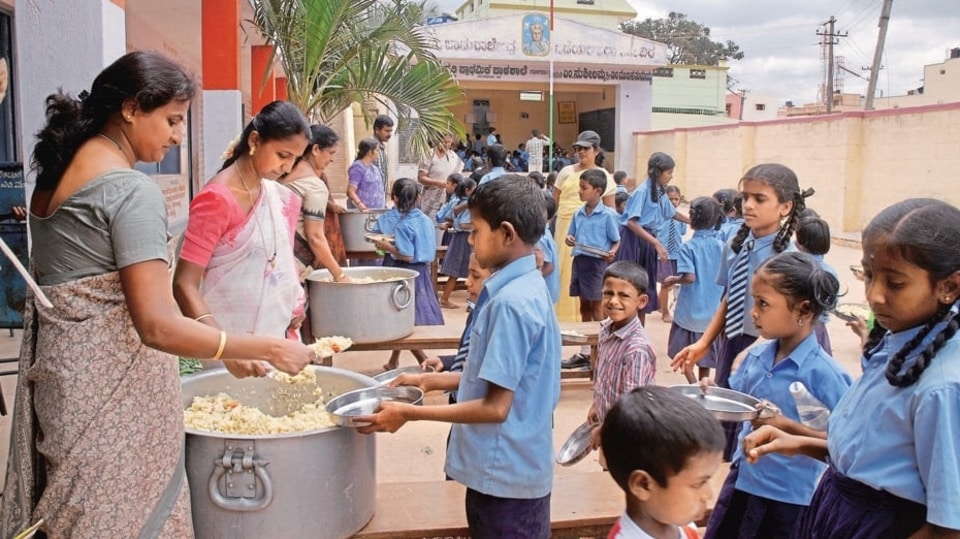
The centrally funded scheme, with an outlay of ₹1.31 lakh crore, was approved by the Cabinet Committee on Economic Affairs (CCEA), which was chaired by Prime Minister Narendra Modi on Wednesday. It will provide one cooked nutritional meal to students.
“We are committed to doing everything possible to fight the menace of malnutrition. Today’s Cabinet decision on PM-POSHAN is a crucial one, benefitting the youth of India,” the Prime Minister said in a tweet.
About 118 million students enrolled in classes 1-8 across 1.1 million schools will benefit under the scheme, the government said.
In addition, around 2.4 million students in pre-primary sections or Balvatikas – started in several government schools last year with an aim to include children younger than six years in formal education – will also be covered under the scheme.
While announcing the development, Union education minister Dharmendra Pradhan said: “To improve nutritional status, encourage education and learning, increase enrolments in schools and promote overall growth of children, Prime Minister Narendra Modi has approved the PM-POshan SHAkti Nirman scheme for the next five years with a collective outlay of ₹1,30,794 crore.”
“Under the scheme, midday meals have been extended to children of Balvatika in addition to children studying in classes 1 to 8 in government and government-aided schools in the country,” he added.
The midday meal scheme was launched in 1995 with an aim to provide at least one nutritional meal to elementary school students. It later become instrumental in improving enrolments in schools, according to experts.
Like the midday meal scheme, both the Centre and the states will bear the cost of the PM-POSHAN scheme in 60:40 ratio, with the Centre taking care of the entire cost of grains ( ₹45,000 crore) in addition. Of the ₹1,30,794 crore, ₹54,061 crore will come from the central government and ₹31,733 from the states and the Union Territories (UTs).
Explaining the structural changes in the scheme, Pradhan said that the Centre has directed the states and the UTs to switch to Direct Benefit Transfer (DBT) system for providing honorarium to the cooks and helpers working in the programme. “The government has made some structural changes to ensure transparency. Earlier, there were instances of leakages (of money)... In the coming years, the Centre may directly transfer funds to the schools according to their requirements,” Pradhan said.
Earlier, the central government would allocate the funds to the states and transfer them to the mid-day meal nodal officers at the district or tehsil level. The officers then transferred them to the schools.
The government will also make provisions for aspirational states and districts to provide supplementary nutrition items to students.
“Under the previous scheme, the focus was on providing a meal to students but now, under PM POSHAN, the focus is to ensure the nutritional aspects as well. States or districts having high prevalence of anemia can include any supplementary item. Similarly, if states want to include their local vegetable or any other nutritional food or anything else such as milk or fruit, they can do so with the Centre’s approval. However, it should fall within the allocated budget. Earlier, states had to bear the cost if they included any extra item,” a senior official at the education ministry said on condition of anonymity.
The government will promote the development of nutrition gardens in schools under the scheme and the harvest of these gardens will be used to provide additional micro-nutrients to students.
Schools will also be encouraged to organise cooking competitions to promote ethnic cuisine and innovative menus based on locally available ingredients and vegetables.
It has also included the concept of “tithi bhojan” under the PM-POSHAN scheme wherein students from private schools will be encouraged to share their meals with children from marginalised sections at least once in a month on a voluntary basis. States will also be asked to organise community programmes in which people provide special food to children.
For the first time, the social audit of the scheme has also been mandated for each school in each state to study the implementation of the scheme, according to the government. Besides, the ministry will also engage college and university students to monitor the scheme at a local level.
The government did not announce anything on the provision of adding breakfast in schools as recommended by the new National Education Policy (NEP) 2020.


