
 E-Paper





Follow the latest breaking news, major developments and agenda-setting stories from India and around the world with the newsdesk at Hindustan Times. Operating round the clock, the desk brings together experienced editors, reporters and correspondents to deliver fast, accurate and contextual reporting across subjects that influence public policy, governance, business, society and international affairs. The HT News Desk covers politics, elections, government policies, the economy, business and markets, science and technology, the environment, law and order, infrastructure, education, climate issues and geopolitics, while closely tracking developments across states, institutions and global capitals. The team also leads coverage of major breaking news events, policy announcements, court proceedings, natural disasters, public emergencies and significant international developments. Reports published by the newsdesk are based on information gathered from reporters on the ground, official statements, government agencies, court records, regulatory filings, recognised institutions and other authoritative sources. Stories undergo editorial scrutiny and verification processes to ensure accuracy, fairness and relevance, and are updated as events evolve and additional information becomes available. Whether covering a key political decision in New Delhi, an economic policy shift affecting millions, a landmark court ruling or a major global event, the HT News Desk aims to provide readers with reliable, fact-based journalism that delivers not only the latest developments but also the context and analysis needed to understand their wider implications.
PM Modi at G20 calls for crack down on fugitive economic offenders
India also resisted pressure to join the Osaka declaration on digital economy, a move launched by Japan’s Prime Minister Shinzo Abe for global rule-making for free flow of data across borders.


Prime Minister Narendra Modi’s call for a combined strategy to crack down on fugitive economic offenders found resonance with leaders of G20 states, with a joint statement on Saturday reaffirming their commitment to deny safe haven to such individuals.
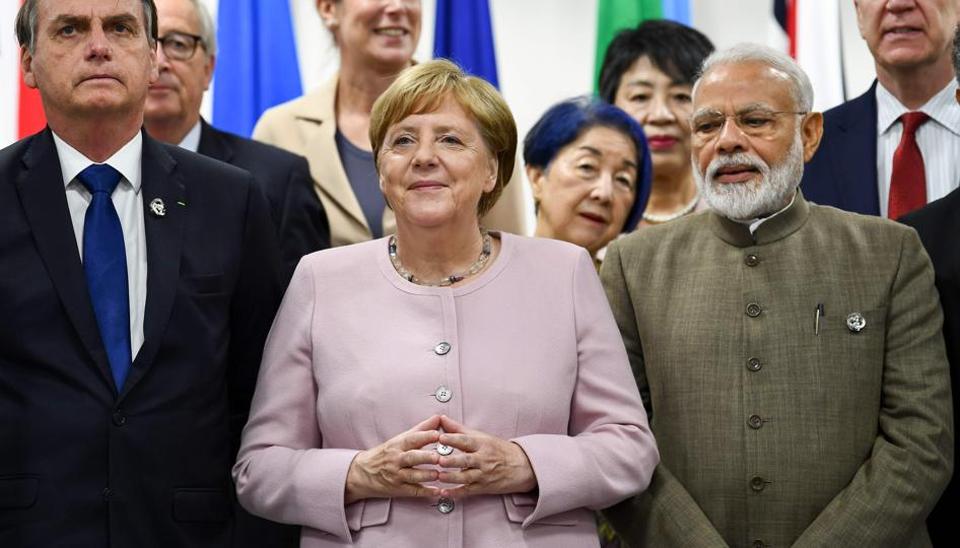
India also resisted pressure to join the Osaka declaration on digital economy, a move launched by Japan’s Prime Minister Shinzo Abe for global rule-making for free flow of data across borders. The European Union and 23 countries, including Russia, China and the US, signed off on the declaration while India, Indonesia and South Africa didn’t join the so-called “Osaka Track”.
In line with his stance at past multilateral meetings, Modi reiterated his pitch at the two-day G20 Summit in Osaka for eliminating terrorism and isolating those who perpetrate acts of terror or support terrorists. Modi told UN Secretary General Antonio Guterres to take the lead in holding a global conference on terrorism and assured him of India’s full support, people familiar with developments said.
The joint statement issued at the end of the summit noted graft is a global challenge, and said the G20 will “continue practical cooperation to fight corruption” and “deny safe haven to persons sought for corruption and their proceeds of corruption consistent with our G20 and international commitments and our domestic legal systems”.
The people cited above said Modi made a pitch for a combined strategy on fugitive economic offenders as part of efforts to ensure a corruption-free world where honest taxpayers and businessmen are protected instead of a handful of individuals who regularly default or indulge in unethical business practices.
India’s sherpa for the G20 Summit, former minister Suresh Prabhu told a news conference: “We strongly put forward the need to deal with fugitive economic offenders...We have been working on tax evasion, corruption, economic offences and fugitive offenders running away.”
Modi didn’t join deliberations on the Osaka Track, one of Abe’s main items on the agenda for the Osaka summit, as he didn’t believe it was in India’s interests, the people said.
Asked why India didn’t join the Osaka Track, Prabhu said the reasons were communicated to Abe. India, he added, strongly believes in a digital economy and has initiated several key steps to take forward its digital agenda.
“India has a very massive programme on digital transactions. We have opened bank accounts of a large number of people. Many transactions are happening through digital forms,” he said.
Among others issues raised by India at the G20 Summit were climate change, clean energy, environmental protection, agriculture, tourism and a shift towards providing social security and financial benefits to an ageing population. Prabhu said India put emphasis on building quality infrastructure for growth.
While speaking at a session on healthcare, Modi referred to India’s traditional medicine and Ayushman Bharat, the world’s largest health programme. He also called for combined efforts on disaster management and highlighted the need for gender equality.


