E-Paper



MP education dept holds workshop on yagnas, computer learning in consonance with dharma
For three days, 54 professors and assistant professors from government colleges across Madhya Pradesh assembled at the National Institute of Teachers Training and Research in Bhopal to participate in training sessions

 Prefer HTon Google


From teaching how traditional Hindu yagnas (fire rituals) can purify air to drawing civil engineering lessons from the Ramayana, there are many ways to incorporate traditional Indian knowledge in modern education according to a workshop that ended Wednesday in Bhopal and which was organised by MP Government Higher Education Department with support of National Institute of Teachers Training and Research (NITTR).
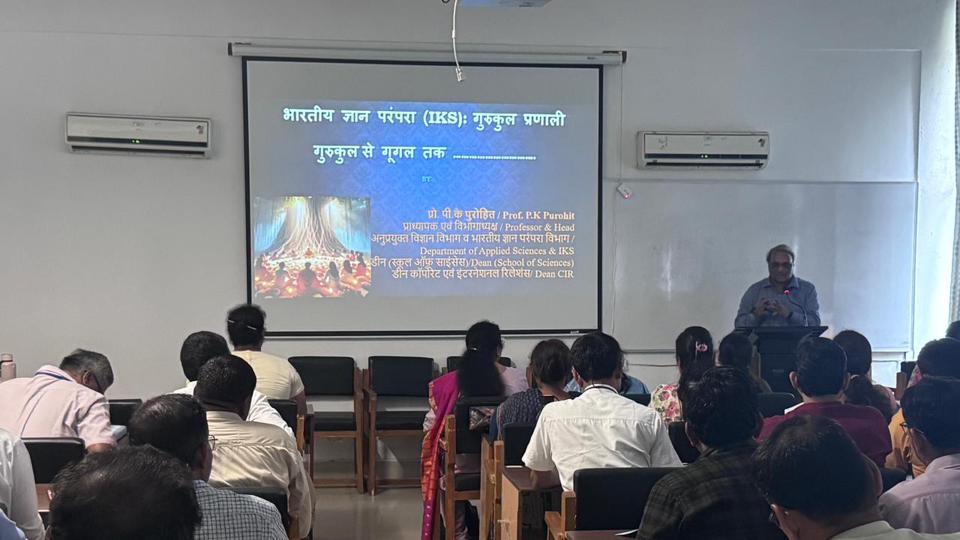
For three days, 54 professors and assistant professors from government colleges across Madhya Pradesh assembled at the National Institute of Teachers Training and Research (NITTR) in Bhopal to participate in training sessions by experts from Vijnana Bharti and Vidya Bharti Akhil Bhartiya Siksha Sansthan, organisations affiliated with the Rashtriya Swayamsewak Sangh. The Madhya Pradesh government has made Indian traditional knowledge a mandatory module for first-year undergraduate students across all streams from this academic year as part of the National Education Policy 2020.
The topics introduced include Tvasta (double helix of DNA) in biochemistry, Indian fermented food and beverages from the Vedic period in biotechnology, influence of Sanskrit on the English language, data handling, data organisation, and indexing retrieval in the Vedic period, and ethical computer learning according to dharma.
In 2024-25 , the state government set up a wing in all 570 government colleges for starting teaching traditional knowledge. The colleges were asked to purchase 88 books which included Swabhasha Lao-Angrezi Hatao (bring local language and remove English), Uccha Shiksha Bharatiya Drushti (Indian perspective in higher education) and Puja Ho Toh Aisi (Prayer should be like this) for students. But there was a problem.
Coordinators of the special Indian traditional knowledge cells had no clarity on how to integrate the syllabus about traditional knowledge with the ongoing courses. Step in Vijnanabharati, which describes itself as a “science movement with swadeshi spirit” on its website.
“We asked Vijnanabharati, Vidya Bharti Akhil Bhartiya Siksha Sansthan and other masters of Indian Knowledge system to train the coordinators so that they can become master trainers in their colleges,” said a senior education department official who asked not to be named. Shiv Kumar Sharma, National Secretary of Vijnanabharati, emphasised on the importance of integrating traditional knowledge with contemporary education.
“Scientific explanations and thousands of experiment-based evidences are documented in Sanskrit texts and ancient Indian literature. Now, 10,000 such books are being translated into Hindi and English to enlighten both the global audience and our youth,” Sharma added, urging educators to not only teach these concepts but also conduct research to further validate and explore them.
In his session, he also told the attendees that students can be taught about the traditional Indian accounting system in commerce, about Vedic algebra in mathematics, and the description of the skies in the vedas in geography. History was easier -- students can be taught the Ramayana and the Mahabharatha, he added.
Professor PK Purohit, the coordinator of the training programme, asked the attenddees to encourage students to do research on traditional Indian knowledge and linking it with modern education.
“Kautilya’s Arthashastra can be linked with contemporary economics . You can teach students on how the chemical composition of materials used in Yajnas has positive impact on environment and how to calculate time through Indian systems,” he added. “Understanding how politics influenced the economic systems during the Mauryan era and studying taxation in ancient texts like Arthashastra is essential before learning modern taxation,” he said in response to a question.
Purohit also urged the attendees to explore the role of Rishis (seers) as early scientists . But he also cknowledged the need for “more research” and said many supporting texts are now available.
“This initiative aims to reintroduce Indian knowledge systems into the curriculum, which were removed to erase our scientific and artistic heritage. We are not promoting any religion or caste—this is about reclaiming our rich intellectual history,” Purohit explained.
State higher education minister Inder Singh Parmar said that the effort is to build an India-centric education system and added that Madhya Pradesh is taking the lead in this. “From the 2025-26 session, students will benefit from new courses (on Indian Knowledge systems) developed through the dedication of our educators. These efforts will be remembered as a milestone in rebuilding India-centric education.”