
 E-Paper



Must adopt Gandhian ideal of creating nation, says former President Pranab Mukherjee
The former president said the Indian democracy and its inherent power of assimilation had successfully thwarted insurgency and separatist movements.


Indian democracy has over decades displayed an inherent strength to accommodate varied groups into the mainstream, former President Pranab Mukherjee said on Sunday as he emphasised the need to pursue the Gandhian ideal of creating a nation where the weakest get the same opportunity as the strong.
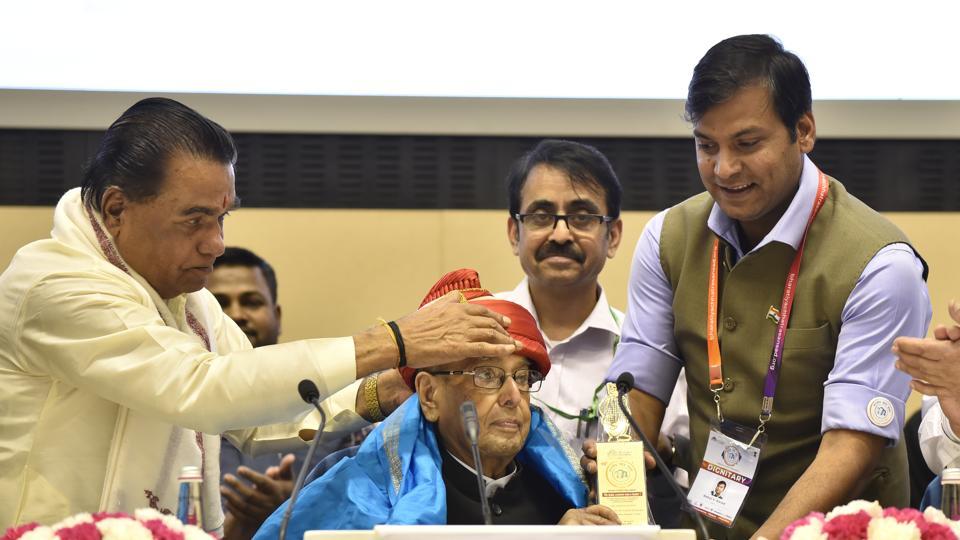
Addressing over 2,000 students from across the country at the 10th Bhartiya Chhatra Sansad organised by the MIT School of Government at Vigyan Bhawan, Mukherjee said democracy and republicanism were two values which the country must cherish and protect.
India is a vast nation practising seven major religions, speaking many languages and has diverse racial groups guided solely by the Constitution, which is a great magna carta of socioeconomic reforms, he said.
Mukherjee said the world had watched “disbelievingly” when the first general elections were held as even then it was an exercise of massive logistic proportions. The foremost achievement of first general election is that it cemented the painstakingly brought about union of India, he added.
“The participation of the communist party, who believed - yeh azaadi jhoota hai, yeh constitution jhoota hai (This independence and constitution is false) - in the constitutional process of general elections was almost dramatically a U-turn,” he said.
He said another victory of the Indian democratic principle was the successful suppression of the radical and violent rebellion in Naxalbari through the ballot papers.
The former president said the Indian democracy and its inherent power of assimilation had successfully thwarted insurgency and separatist movements. Elections have successfully co-opted varied groups into the mainstream, he said.
Mukherjee, however, added that the “deepening and diffusion of democracy” in India has not gone without its share of challenges.
“The democracy in India also gave rise to identity-based politics. Viewed from the lens of deepening democracy, I see this as a positive development because, it leads to wider representation.
However, an electoral divided on caste and community lines throws up polarized mandates which causes itself many problems,” he said.
“As the nation celebrates the 150th birth anniversary of Mahatma Gandhi, the challenge before us is to realize the guiding principle that the weakest should have the same opportunity as the strongest,” he added.
Union Sports Minister Kiren Rejiju, who was also present on the occasion, said the country had done well in many areas but the number of medals which were won by India in competitions like the Olympics was a situation which could not be accepted.
The government was working to nurture youngsters and this would lead to dividend in the area of sports, he said. Rejiju also said he was contemplating bringing a “New Adventure Policy”.
At the event, Punjab chief minister Amarinder Singh was honoured with the Ideal Chief Minister Award.
“Start with state politics, get to know your people and the problems of your state and then get into parliamentary politics,” he advised students wishing to enter public life.
Speaking about Punjab, the senior leader said the state had led the country in agrarian production but was now moving towards industrialisation. There were many challenges, he added.
“We have to watch out for our neighbour who is hostile to us. My army tenure was a great teaching experience. My colleagues have died in uniform and Punjab greatly contributes to the defence services of this nation. We have noticed that now, drugs have become a major problem for Punjab – our enemies send it across by drones and they also send fake currency and weapons by drones. Pakistan has not stopped its infiltration into our country and we have caught 100 Pakistanis who are in jails now and who often provoked gangsterism in our state. These are the things that Punjab has to deal with,” he said.
Among other key speakers at the event were Congress veteran Karan Singh, former external affairs minister K Natwar Singh, BJP leader Sudhanshu Trivedi and Rahul Karad of the MIT-School of Government.


