
 E-Paper



Avoid using word ‘nationalism’, as it may mean Hitler, Nazism, says RSS chief Mohan Bhagwat
Bhagwat’s remark came amid continued protests in several towns and cities of the country against the new citizenship law and probable pan-India NRC, moves branded by those opposing them as a reflection of “Hindutva nationalism” that is detrimental to Muslims.

 Prefer HTon Google


Rashtriya Swayamsewak Sangh (RSS) chief Mohan Bhagwat on Thursday said the word “nationalism” could lead to different interpretations and can be equated with Nazism and Fascism and advised use words such as nationality or nation, instead.
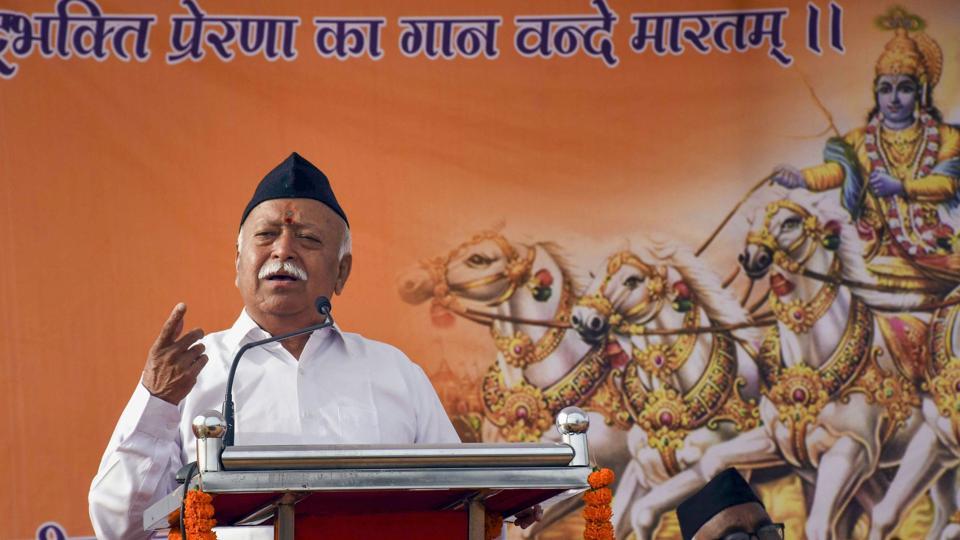
Bhagwat’s remarks came at the time when people are protesting against the new citizenship law and probable pan-India NRC, the moves branded by those opposing them as a reflection of “Hindutva nationalism” that is detrimental to Muslims. He was speaking at an RSS programme held at Shyama Prasad Mukherjee University ground on Thursday morning.
“I was on a visit to the UK. A karyakrata advised me not to used the word nationalism as English is not our language and it could have a different meaning in England…It’s okay to say nation, national and nationality but not nationalism. Because it means (alludes to) Hitler, Nazism and Fascism (in England),” he said.
Bhagwat said the RSS worker told him meaning of words may differ in a conversation. “He said don’t use the word nationalism. He said word nation is fine, national and nationality is fine, but not nationalism because it has other meaning s like Hitler, Nazism and Fascism,” Bhagwat said.
Deliberating further, Bhagwat said there is unrest across the country due to fundamentalism but every citizen of India is connected to each other despite of diversity in the country because “we are connected with the word Hindu”.
“There is unrest in the country due to fundamentalism. It has been India’s policy to neither become a slave nor make anyone a slave. India has a quality of uniting everyone. Indian culture is Hindu culture. Every citizen of India is connected to each other despite diversity because we are connected with the word Hindu,” said Bhagwat during the event.
Sharing an anecdote, he said, a Muslim intellectual from the country once went for Haj and was sent to jail on blasphemy charges for wearing a ‘locket’.
The then foreign minister Sushma Swaraj intervened and got him released within eight days, he said, apparently suggesting that everyone from India is considered a Hindu outside the country.
“....because Bharatiya sanskriti (Indian culture) is also known as Hindu sanskriti, reflecting its values, ethos and culture,” he said. He invoked Yudhishthir, the Pandava prince of epic
‘Mahabharat’, to say India does not believe in subjugating other countries. “Its policy is we will neither enslave anybody, nor will be slaves ourselves,” he said.
He also said problems like radicalism and climate change were disturbing world peace and only India, with its ethos of thinking holistically, can offer a solution. “Problems of radicalism, environment and the belief that one is right while the rest are wrong are the basic issues disturbing world peace,” he said.
(With PTI Inputs)


