E-Paper



National Conference MP files ‘allegiance’ affidavit after SC nudge
The MP filed his affidavit a day after the top court directed him to submit a categorical affidavit pledging allegiance to the country’s sovereignty

 Prefer HTon Google


New Delhi National Conference (NC) parliamentarian Akbar Lone on Tuesday filed a two-paragraph affidavit in the Supreme Court, choosing to refrain from stating that Jammu & Kashmir is an integral part of India even as he reiterated his oath as a member of Parliament to preserve and uphold the provisions of the Constitution of India and to protect the territorial integrity of the nation.
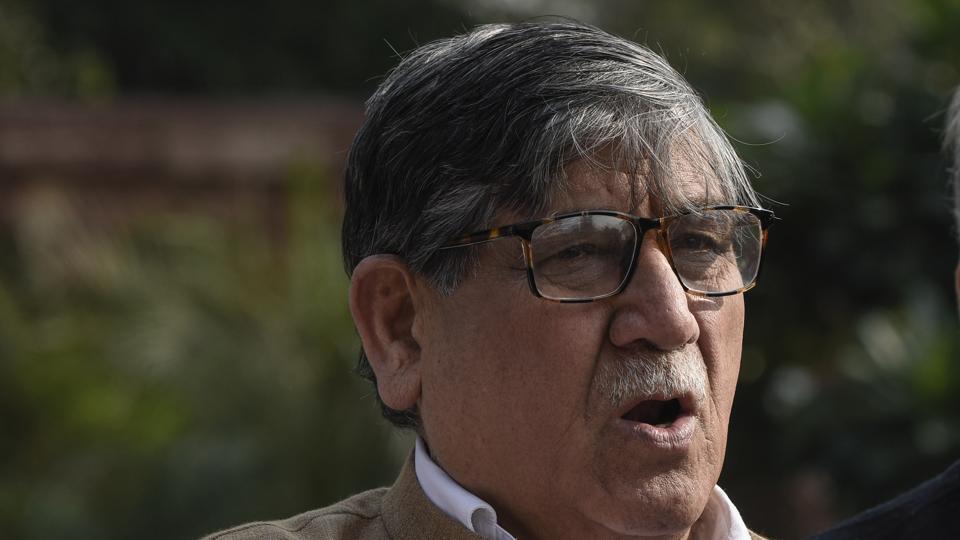
Lone filed his affidavit a day after the top court directed him to submit a categorical affidavit pledging allegiance to the country’s sovereignty after it received complaints that Lone in 2018 raised “Pakistan zindabad” slogans in the Jammu & Kashmir assembly.
The NC MP is one of the chief petitioners before the Constitution bench, which is hearing a clutch of petitions against the 2019 abrogation of Article 370 that granted J&K special status and restructured the state into two Union territories.
On Monday, the five-judge bench, headed by Chief Justice of India (CJI) Dhananjaya Y Chandrachud, demanded an affidavit from Lone endorsing that he unconditionally accepts the sovereignty of India and that J&K is an integral part of India, emphasising that a person seeking to assert constitutional rights must be unequivocal about his allegiance to the Constitution and sovereignty of the people of India.
The bench, which included justices Sanjay Kishan Kaul, Sanjiv Khanna, Bhushan R Gavai and Surya Kant, said it wants Lone to file his personal affidavit within 24 hours in deference to the Constitution and integrity of the nation, besides acknowledging J&K as an integral part of the country.
However, Lone’s affidavit on Tuesday read: “I am a responsible and dutiful citizen of the Union of India. I have exercised my right to approach this Hon’ble Court through Article 32 of the Constitution...I reiterate the oath taken while being sworn in as Member of Parliament to preserve and uphold the provisions of the Constitution of India and to protect the territorial integrity of the Nation.”
Solicitor general (SG) Tushar Mehta, who had on Monday opposed Lone’s intervention in the case arguing that somebody who does not owe his allegiance to India does not deserve an audience from the Supreme Court, called this affidavit “inadequate”. He urged the bench to “read what is not written in the affidavit” and “what Lone chose not to say” despite the court’s exhortation on Monday.
The bench said that it would look into the affidavit, as it closed the arguments in the matter and reserved it for judgment.
The complaint against Lone was made by Roots in Kashmir, an organisation of Kashmiri Pandit youth that filed an application on Saturday, contending that Lone is a known protagonist for secessionist forces in J&K that support Pakistan and that in February 2018, he had raised pro-Pakistan slogans on the floor of the assembly.
On Monday, Mehta requested the bench to direct Lone to file an affidavit saying he owes allegiance to the Union of India and the Indian Constitution and that he is against the secessionist forces. Attorney general R Venkataramani supported Mehta.
Responding, the bench enquired from senior counsel Kapil Sibal, Lone’s lawyer, about what he has to say on this. At the outset, Sibal said that nobody on the petitioner’s side challenged the sovereignty of India and that he would rather want to focus on the legal arguments.
“I am not standing for him or what he said, if he said it. If he has said it, in what circumstances, is it recorded, you ask him for an affidavit...He is a member of Parliament today. He has sworn to the Constitution of India. He is a citizen of India. How can he say otherwise? And if anyone has said it, at my level, I deprecate it,” Sibal said on Monday.
The issue was again raised on Tuesday when the NGO brought on records some more statements reportedly made by Lone, as the SG said Lone must be asked to file an affidavit and disown the statements that were against the sovereignty of the country.
At this point, senior counsel Gopal Sankaranarayanan stood up to object, saying filing a petition to challenge the abrogation of Article 370 is being dubbed as a “separatist agenda” by the central government.
The bench, however, disagreed. “This is uncalled for. Up to this point, nobody has said that the filing of the petition constitutes a separatist agenda. Access to our court for ventilating grievances of citizens within the framework of the Constitution is a constitutional right in itself. Anyone who accesses justice under Article 32 cannot be turned out on the ground that you are following this agenda or that agenda,” it retorted.
The bench pointed out that the Centre has so far argued the matter on merits and did not press for dismissal of a petition on any other ground. “It has been argued on constitutional terms. We have said that we will resolve on these terms...Sometimes when intervenors come before this court, there is an anguish...we as judges know how to deal with it,” it added.