E-Paper



NCST member Anant Nayak’s visit to Sambalpur ignites a political row
Fifteen people including police personnel were hurt in incidents after stones were thrown at a Hanuman Jayanti Samanwaya Samiti procession in Sambalpur


BHUBANESWAR: National Commission for Scheduled Tribes (NCST) member Anant Nayak on Tuesday travelled to Sambalpur to meet the family of the tribal man who was killed after clashes in the town on April 12.
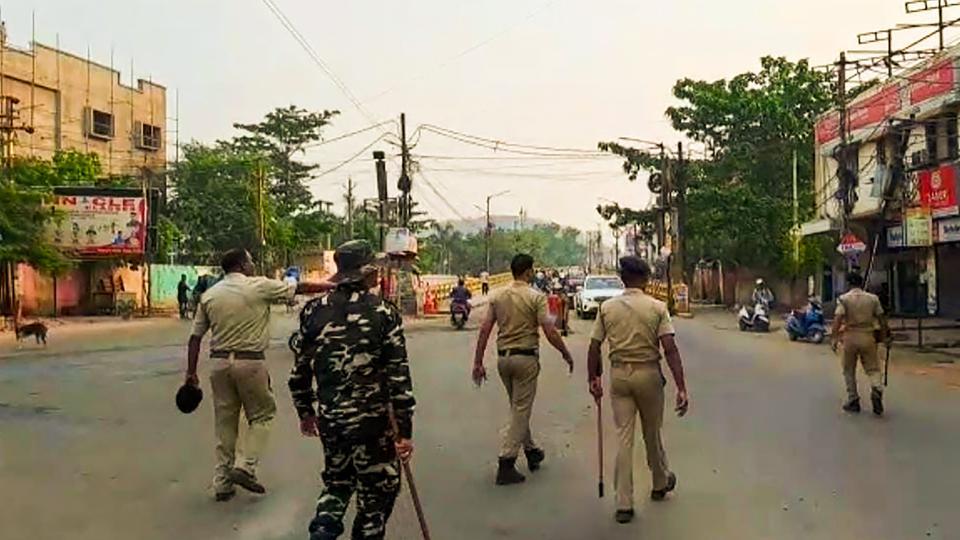
Fifteen people including police personnel were hurt in incidents after stones were thrown at a Hanuman Jayanti Samanwaya Samiti procession that was on its way to Durga Mandir Golbazar via minority-dominated areas of Motijharan, Bhutpada, Raza Nagar, Sumapalli, Kumbharpada and Daleipada.
Two days later, Chitamani Mirdha, 30, of Kisan tribe from Sanasinghari village on the outskirts of Sambalpur town was stabbed to death in the city. Police later insisted that the death was not linked to the violence on Hanuman Jayanti and that “personal enmity” was the provocation. The incidents, however, led to arson and the subsequent imposition of a curfew in the town.
The Bharatiya Janata Party (BJP) has blamed the ruling Biju Janata Dal (BJD) government for the violence, accusing the administration of not acting on intelligence inputs that the Hanuman Jayanti procession would be attacked.
NCST member Anant Nayak’s visit to Sambalpur on Tuesday led to a war of words between the two parties. Nayak visited Mirdha’s village but could not meet his family as they were away. He, however, met Kalia Sika who was injured and said that he will return to Sambalpur for another visit if required.
BJD leaders alleged that the visit was part of the BJP’s gameplan to derive political mileage out of the communal clash. “The visit of NCST member to the town could have been delayed. Peace has not been fully restored and curfew is still there. The visit of an NCST member is purely politically motivated,” said BJD legislator Parsuram Dhada.
Former BJD MP Prasanna Acharya said no one should try to politicise the situation. “It has always been BJD’s principle to have a peaceful atmosphere. The visit could have been delayed,” he said.
BJP MP from Bargarh, Suresh Pujari said instead of lecturing the BJP and trying to fault the NCST member’s visit, the BJD should ask why the government failed to prevent the communal clash and why anti-India slogans were raised.
“The NHRC has also sent notice to the state government on the Sambalpur issue. Will the BJD say that the NHRC notice is also politically motivated? However, the most important question is why the CM failed to visit Sambalpur while he found time to visit Japan,” asked Pujari.
Meanwhile, the Odisha government has lifted a curfew during the daytime and withdrew a ban on internet services in Sambalpur city following a “significant improvement of the law and order situation” in the western Odisha city.
Internet services were suspended on April 13, while the curfew was imposed the next day in the wake of a clash between two groups during the Hanuman Jayanti celebrations. The police arrested over 100 people in connection with violence and the tribal man’s death.