E-Paper



A report card for NEP as it turns six: Curriculum moved, reforms for regulator and education funding didn't
NEP's six year-mark comes at a time when widespread protests over NEET paper leak forced the resignation of Union education minister Dharmendra Pradhan.

 Prefer HTon Google


Six years after the Union Cabinet cleared the National Education Policy (NEP) 2020, India’s ambitious rewrite of its education system since 1986 has moved from paper into classrooms in patches — deep in some areas, barely at all in others.
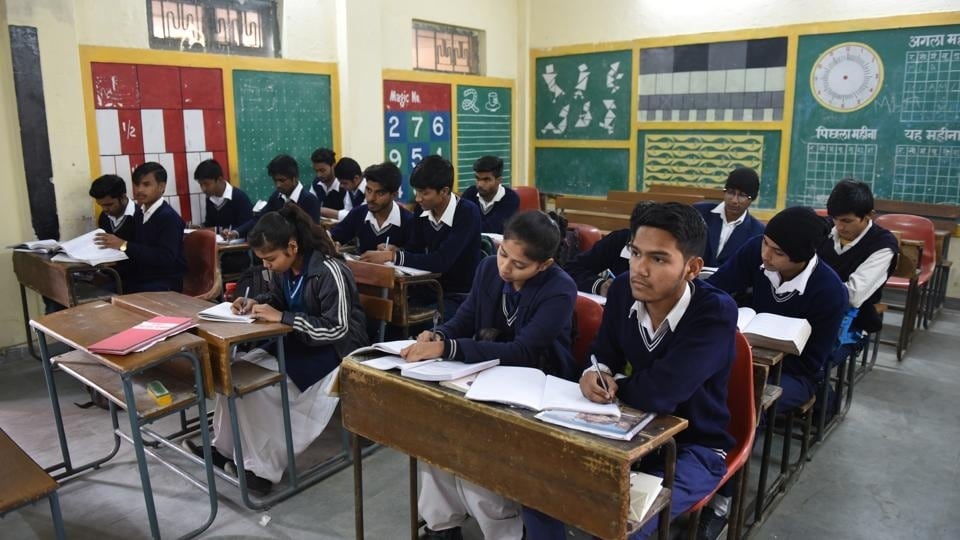
Starting with pre-school, the 5+3+3+4 school structure replaced the decades-old 10+2 model, with early childhood education officially being folded into formal schooling. Undergraduate students can bank credits and exit degrees midway. Foreign universities have started operating in India, and Indian institutes have opened campuses abroad.
But the higher education regulator meant to replace the University Grants Commission (UGC), All India Council for Technical Education (AICTE) and the National Council for Teachers Education (NCTE) has been pushed back again. Teacher-education reforms are only half done, examination reform is running into leaks and botched rollouts, and the funding target that underwrites every other promise remains unmet.
The policy, which replaced the 1986 framework, was cleared by the Cabinet on July 29, 2020, with the aim of building a system “rooted in Indianness” while preparing students for the future.
Also read: 'Not acceptable': CJP claims Supreme Court order on student FIRs contradicts govt promises
The changes
Curriculum has seen the most visible movement.
The National Council of Educational Research and Training (NCERT) released new textbooks for classes 1 to 9 ,and those for classes 10 to 12 are next in line.
For early education, Jaadui Pitara kits – a learning programme for children aged 3 to 8 years that includes books, posters and toys – have been rolled out across states. The women and child development ministry also introduced the national Early Childhood Care and Education (ECCE) framework to promote play- and competency-driven learnings across anganwadi centres and playschools.
Across the country, states and Union territories have moved to six years as the minimum age for Class 1 enrollment, compared to five before.
To ease schooling, the central government has also issued guidelines for co-locating anganwadi centres with primary schools, though training the workers who run them remains a gap.
The National Initiative for Proficiency in Reading with Understanding and Numeracy (NIPUN) Bharat initiative was launched in 2021 to improve foundational literacy levels.
The latest PARAKH Rashtriya Sarvekshan 2024, a nationwide survey by the education ministry, tested 2.1 million students across the country. It found that Class 3 students scored an average of 64% in language skills, and 60% in mathematics.
This marked an improvement over 2021, when the corresponding scores were 62% and 57%, but remained below the pre-pandemic 2017 levels of 66.7% in language and 63% in mathematics.
Digital records scaled faster than almost any other parameter. More than 20 crore APAAR (Automated Permanent Academic Account Registry) IDs, a unique 12-digit code for students, were issued though the rollout drew criticism over privacy concerns. The matter reached the courts, with some parents arguing against the scheme’s constitutional validity and expressing concerns about protection, storage and processing of students’ data. The Supreme Court, while hearing the petitions, said it will direct the Central Board of Secondary Education (CBSE) to provide an option for parents to withhold or refuse consent for APAAR.
“Six years into NEP, its ideas have begun taking root in classrooms. The focus has shifted towards conceptual learning and curiosity. The next phase, however, must invest in teacher capacity and assessments that reward understanding over rote learning,” said Manisha Malhotra, director-principal of Satya School, Gurugram.
Higher education has changed too. The Academic Bank of Credits and the National Credit Framework let students move credits between institutions and pause and resume degrees.
The Common University Entrance Test (CUET), introduced in 2022, is now the main gateway to undergraduate seats in central universities, though that has run into criticism over format issues and loss of autonomy for varsities.
Internationalisation has moved on from a talking point to campuses. IIT Madras now runs a campus in Zanzibar (Tanzania), IIT Delhi in Abu Dhabi (UAE) and IIM Ahmedabad in Dubai (UAE); and IIT Bombay has announced one in Japan.
Five foreign universities have UGC approval to set up in India, with the University of Southampton already operational and others due to admit students.
“The real impact of NEP will be measured not by compliance but by how effectively institutions embrace its spirit of innovation," said Keyoor Purani, vice-chancellor of Prestige University in Indore, Madhya Pradesh.
The Central Board of Secondary Education’s (CBSE’s) move to on-screen marking (OSM) — one of NEP’s flagship exam-reform pieces — has been more troubled. The board took OSM nationwide for all Class 12 subjects this year, replacing manual evaluation of nearly 99 lakh answer scripts. But students and teachers have since reported blurred scans, wrong marks entered, unchecked answers and technical glitches.
HT reported that an internal dry-run at five Delhi schools in January 2026 had flagged at least 36 technical, operational and evaluation-related problems that were not addressed before the national rollout.
Also read: 10 years' jail, ₹50 lakh fine, two-month probes: How 2026 bill will rewrite the anti-paper leak law
Half-implemented
Several NEP planks have moved past the policy paper but remain works in progress.
From the 2026 academic session, CBSE introduced twice-a-year board examinations for Class 10, cutting the weight placed on a single annual test. CBSE announced the results of the second board exam held this year, and students’ performances improved.
Adding to it, PARAKH has designed holistic progress cards that assess communication, creativity and collaboration alongside academic marks, but most school boards have not adopted them yet.
The push for mother-tongue instruction till Class 5 is uneven. CBSE asked affiliated schools to move to home-language teaching in the foundational years, and NCERT is preparing textbooks in more Indian languages, but classrooms are often multilingual and the politics of language complicates such implementation.
Called the three-language formula, southern states such as Tamil Nadu have been the most vocal critics of the move, arguing that it indirectly imposes Hindi language on non-Hindi speaking regions. Some others have pointed out that restricting English learning in the foundational years may not benefit children in global job markets, and that the Indian education system currently doesn’t have textbooks in diverse local dialects and languages.
In colleges, the four-year undergraduate programme (FYUP) with multiple entry and exit points is still spreading. Central universities have largely adopted it and Kerala has taken it across its state universities, but several other states such as Karnataka and Tamil Nadu are moving slowly, citing faculty shortages and infrastructure gaps.
Teacher education has been slow too. The Integrated Teacher Education Programme (ITEP) has expanded since 2023–24 and will be the minimum qualification for teacher recruitment from 2030, but the national framework for it to set uniform standards for the profession is still pending.
“NEP got the diagnosis right. Where reforms required structural change, progress has been visible. Where they required sustained funding, teacher capacity and political consensus, implementation has been much slower,” said Praneet Mungali, trustee of the Sanskriti Group of Schools.
And the stalled
Some of the most ambitious NEP proposals have seen little movement.
The single higher education regulator meant to replace the UGC has been repeatedly deferred. The proposed Higher Education Commission of India, recast as the Viksit Bharat Shiksha Adhishthan (VBSA), was introduced in Parliament in 2025, but has since been referred to a parliamentary joint committee amidst concerns that it centralises power from the states to the Union government.
Examination reform, one of NEP’s signature promises, is far from a finish line.
The credibility of public examinations has taken repeated hits. After multiple CUET disruptions and the NEET-UG 2024 paper leak, the cancellation and re-conduct of NEET-UG 2026 prompted widespread protests and forced the resignation of education minister Dharmendra Pradhan last week.
A separate recommendation — a breakfast alongside mid-day meals — has gone nowhere since the finance ministry turned it down in 2021.
Still, some consider funding to be the biggest unfinished piece.
NEP restated the long-standing target of raising public spending on education to 6% of India’s gross domestic product (GDP). As yet, combined Centre and state spending is still around 4.1%, and every other reform runs into that ceiling.
“NEP has shifted the focus from qualifications to capabilities. Its success will ultimately depend on whether graduates leave universities with adaptability, judgement and the ability to keep learning," said Aseem Chauhan, chancellor of Amity University.
The Union education ministry did not respond to requests for comment till Tuesday evening.