
 E-Paper



Netanyahu closes doors for peace, promises intensified attacks in Gaza, Lebanon
Netanyahu vowed to intensify military operations against Hezbollah and Hamas, dismissing peace proposals and criticizing the UN as anti-Semitic.


Israel’s Prime Minister Benjamin Netanyahu shut down prospects for peace in both the theatres of war in West Asia on Friday as he declared to the United Nations General Assembly that his country will intensify operations against Hezbollah in Lebanon until the group’s capacities are degraded and continue its offensive against Hamas in Gaza until achieving “total victory.”
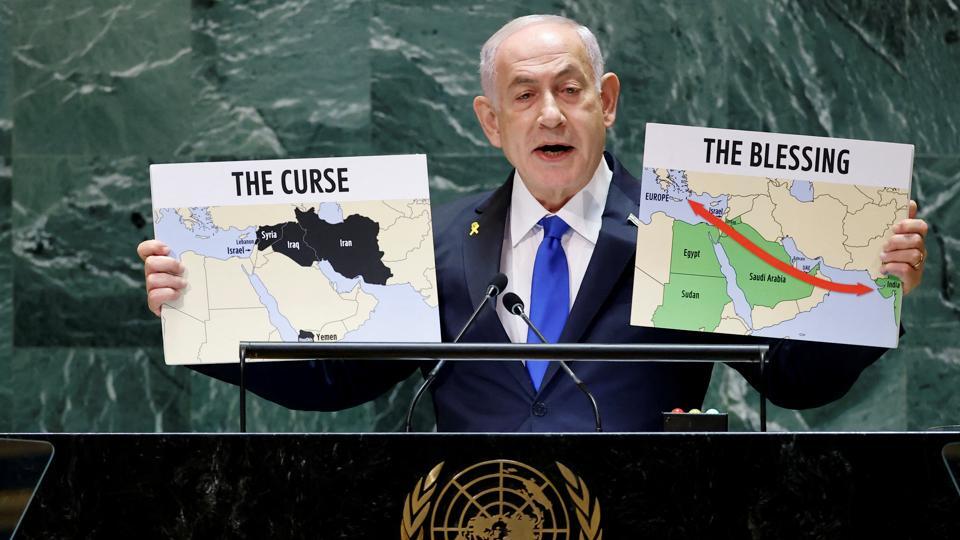
Minutes after his speech in New York, Israel bombed Hezbollah’s underground headquarters in Beirut.
Netanyahu’s address came amid overwhelming criticism of Israel at the UN, which he derided as a “swamp of anti-Semitic bile” and a “house of darkness”. As he took the podium, delegates from several countries walked out, leaving the hall mostly empty — a stark contrast to the solidarity and pro-Palestinian sentiment displayed during Palestinian President Mahmoud Abbas’s speech the previous day.
In a belligerent and angry speech, Netanyahu accused Iran of triggering a “seven-front war” against Israel and recounted Hamas’s October 7, 2023 terror attacks that left 1,200 dead and over 250 hostages abducted.
Disregarding global public opinion and peace proposals pushed by Israel’s closest ally, the US, Netanyahu made no mention of the thousands of lives lost and humanitarian suffering caused by Israel’s offensive in Gaza. He also ignored the three-step ceasefire proposal mediated by Egypt and Qatar, and the recent US-French 21-day ceasefire proposal amid escalating conflict with Lebanon.
Instead, Netanyahu framed the moment as a choice between blessing and curse. The blessing, he said, was the possibility of historic reconciliation between Jews and Arabs, Judaism and Islam, Mecca and Jerusalem—specifically referencing potential normalisation between Israel and Saudi Arabia. He highlighted opportunities presented by the India-Middle East-Europe corridor with a map. The curse, illustrated with a darker map, was what he called Iran’s “arc of terror,” encompassing Shia militias in Iraq and Syria, Hezbollah in Lebanon, Hamas in Gaza, and Houthis in Yemen.
Addressing Iran, his main target, Netanyahu warned, “If you strike us, we will strike you. There is no place in Iran that the long arm of Israel can’t reach.” He urged the world to end what he termed the “appeasement of Iran” and vowed that Israel would do everything to stop Iran’s nuclear ambitions.
Regarding Gaza, where over 40,000 have died and two million displaced due to Israel’s year-long offensive, Netanyahu claimed success in weakening Hamas but insisted, “We are focused on mopping up Hamas’s remaining terror capabilities and infrastructure. We remain focused on the sacred mission of bringing hostages home. Hamas has got to go.” Drawing an analogy with World War II, he argued that just as Nazis couldn’t be allowed to rebuild Germany, Hamas couldn’t have a role in post-war Gaza.
On Hezbollah, Netanyahu blamed the Lebanon-based group for an unprovoked assault against Israel on October 8 last year, displacing over 60,000 Israelis from northern towns. Asking if the US would tolerate such a situation, he declared, “Israel must defeat Hezbollah in Lebanon. It is a quintessential terror organisation. And it has killed more Americans and Frenchmen than any group except bin Laden”—an indirect reference to Washington and Paris’s push for peace.
Netanyahu reserved harsh words for the UN itself, where Israel has faced fierce condemnation. He claimed the body had remained “contemptible” since his first speech there in 1984. He attacked the International Criminal Court for issuing an arrest warrant against him and holding Israel responsible for war crimes, calling it absurd and accusing it of ignoring “real war criminals” in Iran, Gaza, Yemen, Syria, and elsewhere.
He alleged that progressives criticizing Israel’s actions as genocide were funded by Iran, turning a blind eye to Iranian dictatorship while attacking a democracy. Netanyahu slammed all those who didn’t support Israel as victims of moral confusion and declared, “Israel will win this battle because we don’t have a choice.”


