
 E-Paper



New B.1.618 variants now among most sequenced
The variant has been reported in Bengal from where some of the highest numbers of sequencing have been carried out.

 Prefer HTon Google


A previously unknown Sars-Cov-2 variant has now started to emerge in samples analysed in India by scientists to check for mutations, according to experts and new analyses that show one of these changes is the same one found in the Brazilian and South African variants of the coronavirus.
This particular change is known as E484K, and it has been strongly linked with the virus becoming more resistant to antibodies created by vaccines or a past infection. It has been found in a variant now labelled as B.1.618, which has been reported in West Bengal, from where some of the highest numbers of sequencing has been carried out.
Also read| Boost testing, hospital infrastructure for next 3 weeks: Centre to UTs
Details about its spread come days after genome sequencing data indicated a large presence of another known variant first found in India, the B.1.617, often referred to as the “double mutant”.
Both these variants are now considered variants of interests (VOIs), and scientists are studying whether it can make the coronavirus more transmissible, more lethal, or more resistant – clues that are crucial to determine whether the intensity of India’s current wave of infections is because of these.
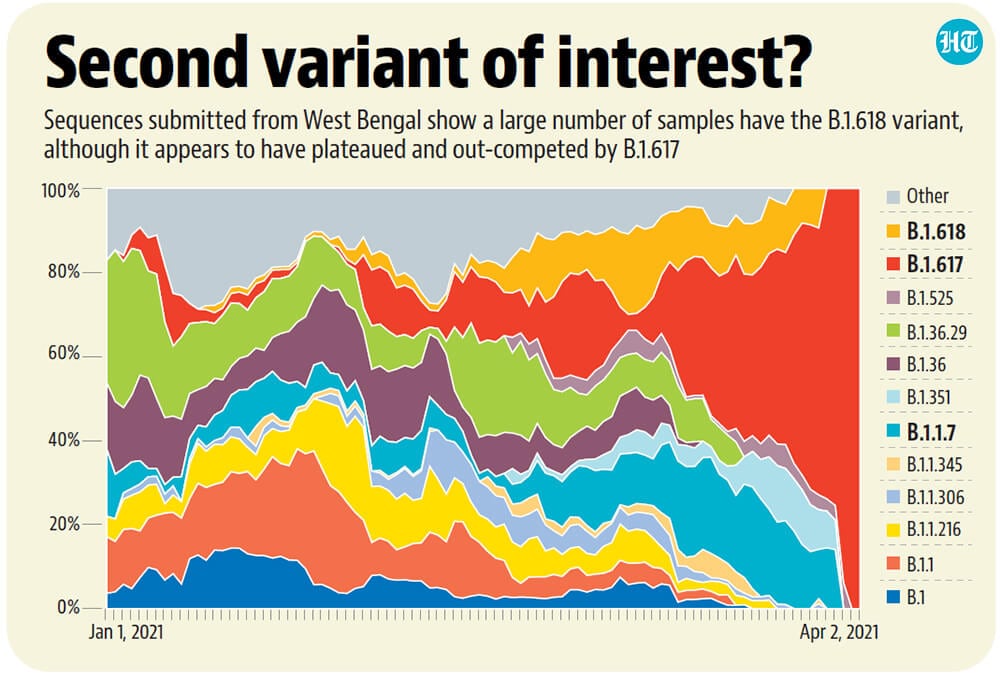
Data submitted from India to the global repository GISAID shows the B.1.618, at 12%, is the third most common variant sequenced in the last 60 days. The B.1.617, at 28%, is the most common among sequences, followed by B.1.1.7 (the UK variant), the India Mutation Report by Scripps Research showed, citing the GISAID data.
“The particular variant had appeared some time ago in West Bengal, however we did not study the mutations and its clinical significance in detail as the so-called double mutant variant (B.1.617) out-competed it. The B1.618 variant has plateaued at about 25% of the total mutations reported from Bengal; B1.617 has become predominant. Across the country, there are some districts in states such as Maharashtra where the prevalence of the variant in as many as 80% samples,” said Dr Saumitra Das, director, National Institute of Biomedical Genomics, which is one of the 10 laboratories in India’s consortium on Sars-CoV-2 genome sequencing (INSACOG).
“What the impact of this variant or B1.617 would be on the vaccine efficacy etc. is all a matter of predictions. It is thought to evade the immune response because it contains the E484K mutation. We will be able to tell the clinical significance of these mutations only when we test it in animal system,” he said.
The institute is currently in the process of collecting and growing in laboratory samples of the mutated variants of the virus to establish whether they actually aid the virus in escaping the immune response from vaccines and previous natural infection.
A variant can contain multiple mutations, which are not unusual – particularly for RNA viruses such as Sars-Cov-2 – but since late last year, some of them have made the virus “fitter” – particularly the UK variant, which spreads much more readily than its ancestor – and the South African variant, which appears to cause more repeat infections and make vaccines less effective.
According to the analysis at outbreak.info, 129 of the 130 B.1.618 sequences in India were in samples from West Bengal. India accounts for 62.5% of the B.1.618 variants reported in the world. The variant was first found in a sample outside of India on April 22, 2020.
Experts tracking India’s genomic surveillance said that while specific tests are required to determine the implications of the virus, India needs to sequence and share details of more samples.
“India has 8,455 publicly available genomes and around 14 million cases so far. That is 0.06% of cases sequenced. Ideally, we’d want that number to be between 2%-5%, which is in line with successful genomic surveillance programs in other countries,” said G Karthik, researcher at Scripps Research Institute, which has put together the mutations tracker at outbreak.info.


