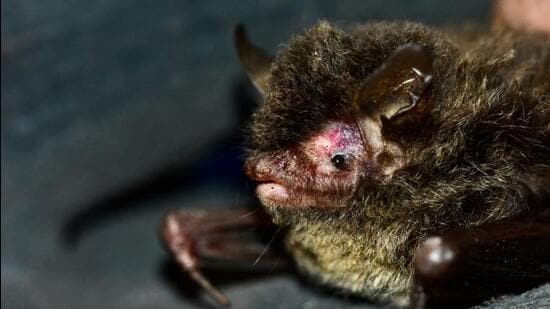
Guwahati: The latest edition of the scientific journal Zootaxa reports the discovery of a new bat species — the Himalayan long-tailed Myotis (Myotis himalaicus) — in the Himalayan region, and corrects a long-standing error in Indian scientific literature by confirming that the East Asian free-tailed bat (Tadarida insignis), not the European species, is found in India.
The tally of Indian bat species currently stands at 135 species, according to the journal published on Thursday.
The Himalayan long-tailed Myotis belongs to the Myotis frater complex — a group of morphologically similar bats found across a wide range, including eastern China, Taiwan, central and southeastern Siberia, Korea, Japan, Tajikistan, and Uzbekistan, the journal said.
Scientists — Uttam Saikia from the Zoological Survey of India (Shillong), Rohit Chakravarty of the Nature Conservation Foundation (Mysuru), Gabor Csorba from the Hungarian Natural History Museum (Budapest), MA Laskar from St. Anthony’s College (Shillong), and Manuel Ruedi of the Natural History Museum of Geneva — had collected the sample in May 2021, as part of a fresh reassessment of India’s high-altitude bat diversity.
After analysing the DNA of the species and correlating it with other known species for four years, a statement issued by the scientists read, “This new bat named Himalayan long-tailed Myotis (Myotis himalaicus) was described based on specimens collected from higher elevation areas of Uttarakhand and Khyber Pakhtunkhwa province of Pakistan.”
{{/usCountry}}After analysing the DNA of the species and correlating it with other known species for four years, a statement issued by the scientists read, “This new bat named Himalayan long-tailed Myotis (Myotis himalaicus) was described based on specimens collected from higher elevation areas of Uttarakhand and Khyber Pakhtunkhwa province of Pakistan.”
{{/usCountry}}Also Read: Fish species Moringua hodgarti rediscovered after a century in Arunachal Pradesh
Believed to be native to the southern slopes of the Himalayas, this species has so far been spotted in Deodar, Pine, and Cedar forests, where it appears to be relatively uncommon.
The journal added the East Asian free-tailed bat to the bat fauna of India. Based on detailed study of the specimen collected from Uttarakhand and genetic analysis, the researchers revealed that the globally Data Deficient East Asian free-tailed bat had been mistakenly identified as the European free-tailed bat (Tadarida teniotis).
This species is distributed in the Himalayan region of India, as well as China, Taiwan, Japan, and the Korean Peninsula.
The journal also sheds light on Babu’s Pipistrelle (Pipistrellus babu), a species first discovered over a century ago in the Murree Hills of Pakistan and apparently common in the western and central Himalayas. Due to its morphological similarities with the Javan Pipistrelle (Pipistrellus javanicus), a species native to Southeast Asia, subsequent researchers had mistakenly considered it a synonym. However, the study confirms that Babu’s Pipistrelle is a distinct species, with a distribution spanning Pakistan, the western Himalayas of India, and Nepal.
Also Read: Scientists discover new species of cricket frog in Western Ghats
The study also provided the first specimen-based confirmation of the presence of a few other bat species — Savi’s Pipistrelle (Hypsugo savii) and the Japanese greater horseshoe bat (Rhinolophus nippon) — in India, which had so far only been mentioned based on either doubtful specimens or zoogeographic grounds.
“The study is expected to have significant implications in documentation and conservation of small mammalian fauna of India and also give a boost to further studies in the Indian Himalayas. With this revisionary study, the confirmed tally of Indian bat species currently stands at 135 species which is likely to go up as studies continue,” Zoological Survey of India director Dhriti Banerjee said.