E-Paper



New satellite images show damage caused to Pakistan air bases under Operation Sindoor
The high-resolution, before and after satellite images provided by Maxar show the destruction and damage caused to Pakistan air bases under Operation Sindoor.

 Prefer HTon Google


New satellite imagery has revealed the extent of damage caused by India’s military strikes of May 10 at Pakistan’s Murid and Nur Khan airbases, which are among the country’s frontline facilities.
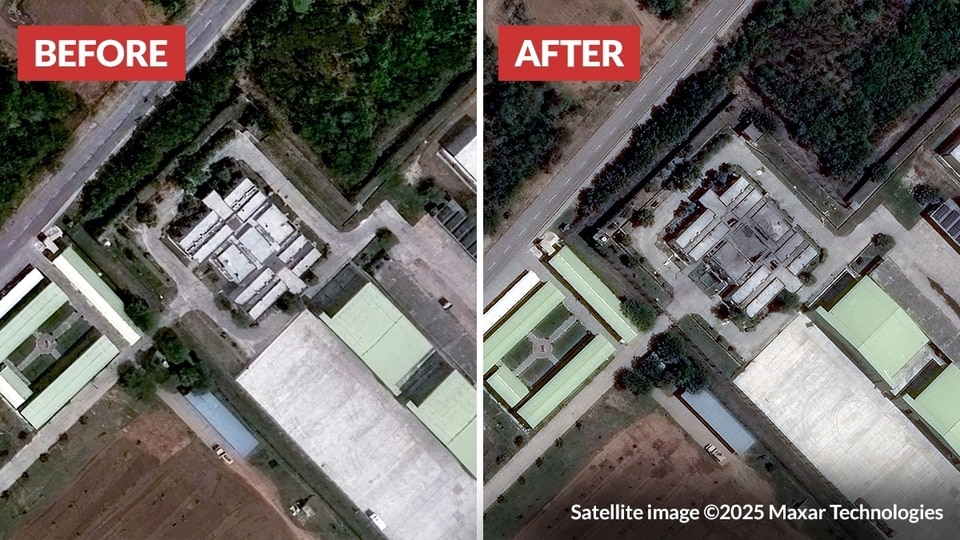
The high-resolution, before and after satellite images provided by Maxar show the destruction of two large trucks, thought to be command and control vehicles, and the demolition of a nearly 7,000 sq ft structure at Nur Khan Airbase located in Rawalpindi.
This airbase is located close to both the Pakistan Army’s General Headquarters and the Strategic Plans Division, which is responsible for overseeing the nuclear arsenal.
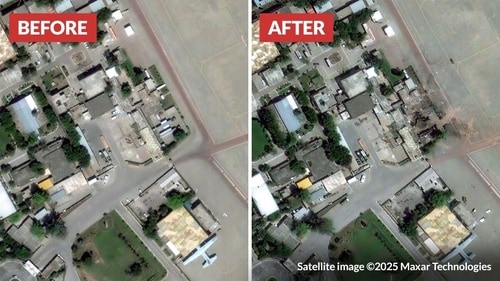
India’s military conducted strikes on eight Pakistani airbases, including Murid and Nur Khan airbases, on May 10 in retaliation for Pakistani attacks on a range of military facilities earlier the same day. Hours after the Indian strikes, the two sides reached an understanding on halting firing and military actions late in the afternoon of May 10.
The images of Murid airbase, located at Chakwal in Pakistan’s Punjab province and about 150 km from the Line of Control (LoC), show a nearly three-metre-wide crater caused by the strike at a short distance from what appears to be an underground facility and damage to another structure.
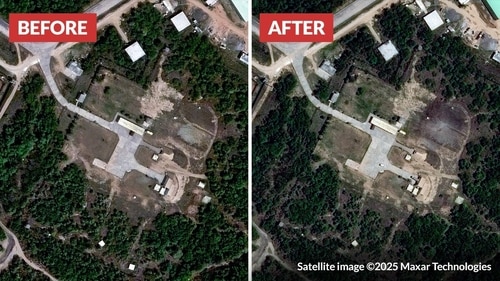
The underground facility is heavily fortified, suggesting that the location serves as a storage site for specialised equipment or as a shelter for personnel, according to experts who have examined the images.
Murid airbase plays a crucial role in the operations of the Pakistan Air Force's unmanned aerial vehicles (UAVs).