The southern bench of the National Green Tribunal (NGT) has formed a high-level committee to ensure the arrest the spread of an oil spill and prevent it from entering the sea.
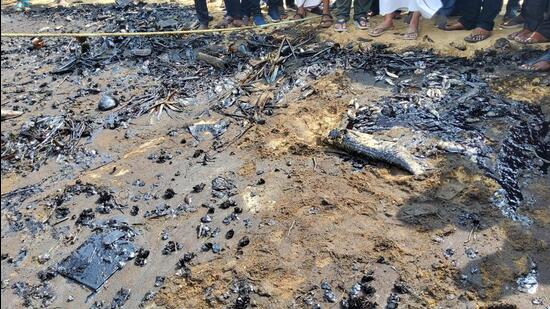
The nine-member committee has been instructed to meet on Monday to review steps being taken to prevent the spread of the crude oil into the Ennore creek and further into the sea, recover the oil floating on the water in the aftermath of Cyclone Michaung that brought torrential rain to the city, ensure that the health of the people in the area is protected, assess damage to compensate those affected financially and also suggest measures for strengthening the emergency response system.
“Incessant rain, due to the Michaung Cyclone, has caused the tragedy of oil spillage on the Buckingham Canal leading to substantial damage to marine life. There were several video clippings surfacing on the media, where the public really expressed their concern and safety, as the oil spillage has caused health hazards,” said judicial member, justice Pushpa Sathyanarayana, and expert member Satyagopal Korlapati of the NGT in the order.
“Even going with the report of the WRD (water resources department), the oil has travelled already for 5 kms, it cannot be short of reaching the sea, in which event, it will be absolutely difficult to remove the oil from the water. Therefore, the learned counsel for the CPCL (Chennai Petroleum Corporation Limited) suggested that the operations can start from the mouth of the river,” they added.
{{/usCountry}}“Even going with the report of the WRD (water resources department), the oil has travelled already for 5 kms, it cannot be short of reaching the sea, in which event, it will be absolutely difficult to remove the oil from the water. Therefore, the learned counsel for the CPCL (Chennai Petroleum Corporation Limited) suggested that the operations can start from the mouth of the river,” they added.
{{/usCountry}}Both Cyclone Michaung and the oil spill hit the city on December 4. The waste oil spills, authorities said, originated and travelled 5 kilometres from CPCL in the city’s northern region. As heavy rainfall had submerged several parts of the city, the CPCL began pumping out the flood water through a storm outlet (culvert). Some oil appears to have entered the storm outlet while water was being pumped out, authorities said.
NGT took the case suo moto (on its own accord) on December 7 after videos and photos of the oil spill spreading to the Buckingham Canal, a residential area in Thiruvotriyur, and the sea in Nettukuppam and Ennorekuppam area.
Noting that there is a serious threat to the life of people and marine organisms in the area, the state’s water resources department, which is a respondent in the case, submitted on December 9: “The top of the water surface was filled with a thick oily substance and it is visible all along the Buckingham Canal for more than 5 Kms and also spread to Ennore Creek and Kosasthalaiyar River Mouth and Bay of Bengal.”
There is serious threat “by loads of chemical effluents and waste oil spills which are clandestinely discharged into the Buckingham Canal”, the department said in its report.
The court has directed the high-level committee to immediately act on four aspects.” Between the creek area and the North Gate, as there is a backwater flow, the Buckingham Canal area also, has to be addressed immediately to remove the oil and Other affected areas,” the order said.
“Oil spread has to be arrested by taking necessary measures particularly in the water flowing towards the North Gate of the Ennore Creek area where spread of oil has to be arrested by the methods as suggested by the Tamil Nadu Pollution Control Board,” the court said.
The pollution control board also submitted a report to the court on December 9 and said that the heavy rainfall resulted in the inundation of Chennai’s industrial area in Manali area, including the Chennai Petroleum Corporation Limited (CPCL). So stagnant storm water along with oil, adjoining a storm outlet in CPCL contributed to traces of oil. The CPCL pumped out the stagnant storm water to safeguard their refinery.
The pollution control board has sent oil samples from various points for analysis and is awaiting the results.
The CPCL and Indian Oil Corporation Limited (IOCL) submitted to the court that the unit was run only to cater the fuel for rescue operations. They said following directions from the state government they started using absorbent pads, boomers, oil scrubbers, skimmers, to prevent the oil from travelling further and to retrieve the oil mixed with the water.
The next hearing is slated for December 12.