
 E-Paper



No Red wave, slim edge to GOP in US midterm races
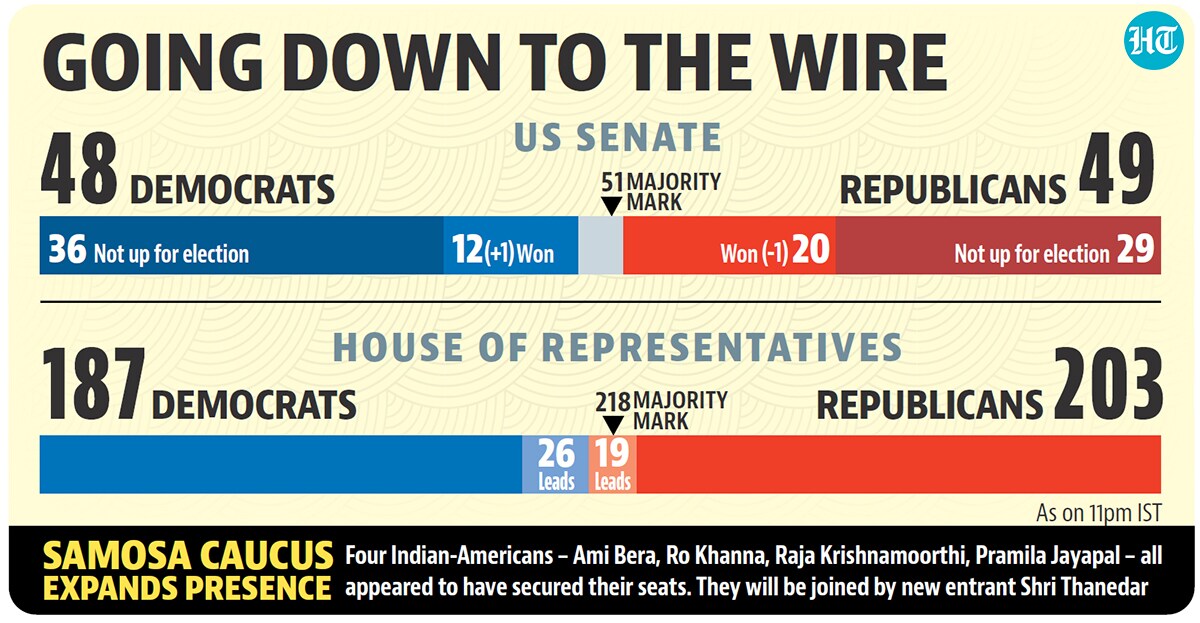
While the final outcome was not out at the time of going to press late on Wednesday night (India time), the US appeared to be heading towards a divided government, with Republicans poised to take control of the House of Representatives by a narrow margin.


In a contest dominated by both economic anxieties around inflation and political concerns about abortion rights and democracy, American voters delivered a mixed mandate in the midterm elections held on Tuesday — giving an edge to Republicans in the Congress, but bucking predictions of a “red wave” by ensuring that Democrats continue to retain key levers of power across different levels of government.
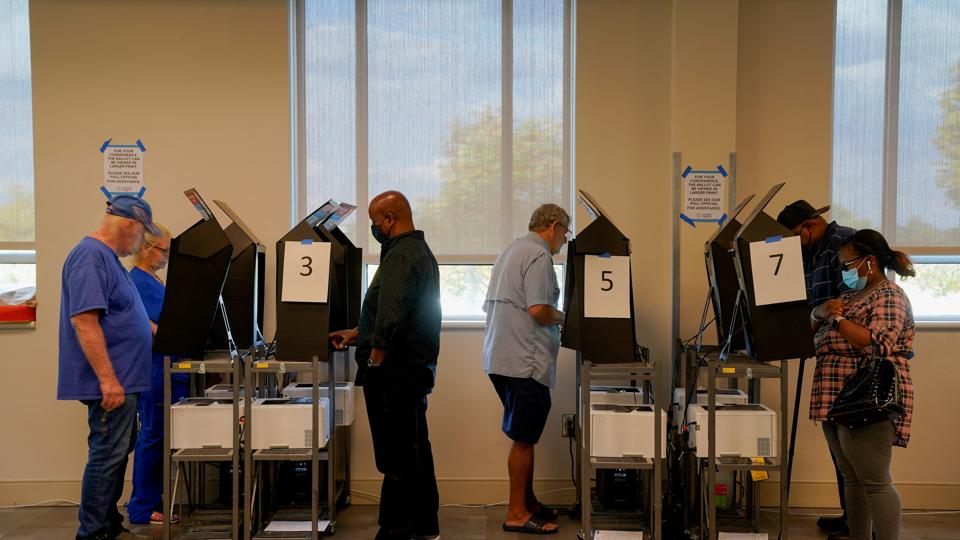
While the final outcome was not out at the time of going to press late on Wednesday night (India time), the US appeared to be heading towards a divided government, with Republicans poised to take control of the House of Representatives by a narrow margin. If the Grand Old Party (GOP) wins, Kevin McCarthy is expected to be the new Speaker of the House.
The race for the Senate majority — the Senate has been tied 50-50 since 2020, and 35 seats were up for grabs in this cycle — was too close to call. While Democratic candidate John Fetterman won a Republican-held seat in Pennsylvania, the party faces a challenge in Georgia, a seat it held and which may be headed for a run-off in December with no candidate possibly getting 50% of the votes. Besides Georgia, the results in Arizona and Nevada — where Democrats are defending their seats — were not been officially declared, and would determine the composition of the chamber.
Voters also chose governors in 36 states, largely along expected lines with Democrats winning New York, Pennsylvania, Michigan, and Wisconsin, while Republicans held on to Georgia and Texas among other states. But the big winner of the gubernatorial race was Ron DeSantis, the governor of Florida who swept the state with a 20-point margin and is now widely billed as a possible Republican presidential nominee for 2024.
In Washington DC, among both political operatives and observers, the big message from the election was that Democrats had done better than expected, giving President Joe Biden a breather — the party in White House historically loses in the midterms — and the results have marked a setback for Donald Trump, who is gearing up to announce his own GOP presidential run for 2024 this month.
A Democratic strategist, on the condition of anonymity, said, “We had an unpopular president and high inflation. That is a recipe for defeat. But pollsters did not take into account for the fact that along with these issues, voters are concerned about personal freedoms and democracy. The abortion verdict was a big turning point in showing voters what was at stake in this election.”
The Supreme Court, this summer, had overturned Roe v Wade, and with it, the national legal protection to abortion, handing over the decision to each states. In the midterms, voters in California, Michigan, Vermont backed a constitutional amendment proposal on the ballot to protect abortion rights while voters in Kentucky rejected an amendment proposal which would have allowed the state to restrict abortion rights constitutionally. A CNN exit poll said that for 27% of the voters, abortion was a top issue. Democrats believe that the attack on abortion led to a higher turnout of women and young voters for Democratic candidates.
A Republican strategist and lawyer, who spoke on the condition of anonymity, first emphasised the key positive takeaways for the party. “We will win. And even it is a slim win, the President will have a tough time when the House is not with him. We have also expanded our social coalition; look at the Hispanic support. And DeSantis has emerged as a key leader.” House Republicans have pushed to begin investigations and commence hearings on various elements of Biden’s presidency, from corruption allegations against his son, Hunter Biden, to the manner of the US exit from Afghanistan. But Democrats believe that a slim majority will constrain the Republican space to be politically belligerent beyond a point.
But the Republican strategist acknowledged that the mood was also one of disappointment in party ranks. “We should have done better. The House majority should have been bigger and the Senate should have been ours to take. Candidate quality hampered us, as did Donald Trump.”
For Trump, the midterms have come as a setback as a majority of the high-profile candidates he supported have either lost or are struggling to defeat Democrats. Trump backed Mehmet Oz for the Senate and Doug Mastriano for governor in Pennsylvania; both lost.
His candidate for the Senate seat in Georgia, former football star Herschel Walker, underperformed compared to the Republican governor in the state, Brian Kemp, who won his seat comfortably. Trump-supported candidates in different races in Michigan, Arizona, New Hampshire are also struggling or have lost. While 200 “election deniers” — the term used for those among Trump supporters who question the legitimacy of the 2020 election — have won across the country at different levels, vocal “election deniers” have mostly been rejected at the top of the ticket for positions of governor and senators.


