E-Paper



Number Theory: A look at urban migration amid language riots in India
Is fear of migrants taking over the most lucrative segments of Karnataka’s economy fuelling such violence in India’s biggest urban centres?

 Prefer HTon Google


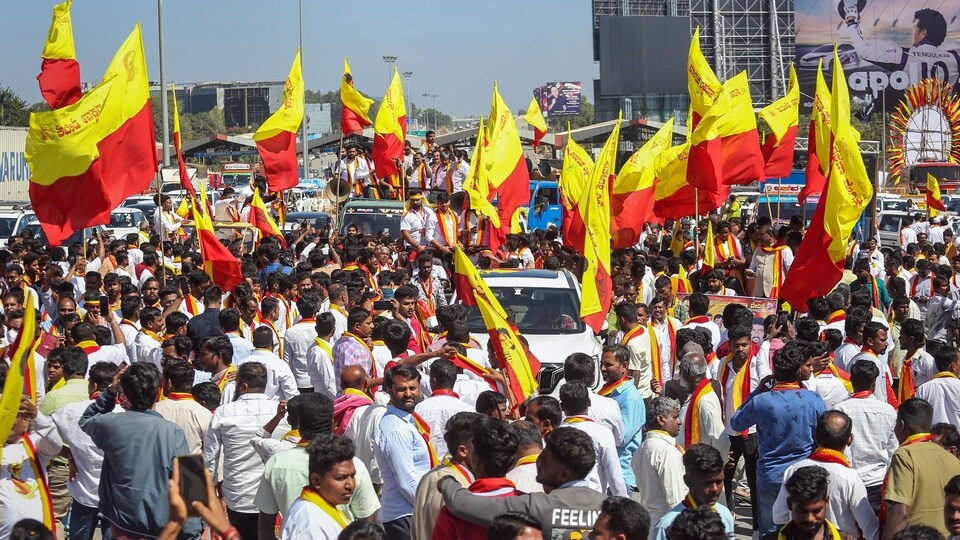
The last week of December 2023 saw pro-Kannada groups running riot in Bengaluru. While language riots are not new in India and have erupted from time to time in various parts of the country, the latest violence in Bengaluru was, in a way, unique. It was more pro-Kannada than anti-anything such as the anti-Hindi violence in Tamil Nadu or anti-Bengali violence in Assam that rocked these respective states in the 1950s and 1960s.
 Migrants are half the population in India’s 10 largest citiesHT has used urban population in absolute terms to list India’s biggest urban centres. Our analysis looked at 11 urban centres, Delhi, Mumbai and Mumbai Suburban, Bengaluru, Thane, Ahmadabad, Pune, North 24 Parganas, Surat, Chennai, Kolkata and Hyderabad. All nine administrative districts in the National Capital Territory of Delhi have been taken as one. A comparison of 1991, 2001 and 2011 census data on share of migrants (by place of last residence) in the total population of these cities shows that it has increased from 30.6% in 1991 to 42.2% in 2001 and 49.8% in 2011. To be sure, the extent of share of migrant population and its increase between 1991 to 2011 varies significantly across cities. Bengaluru, for example, has seen its share of migrant population increase from 30% in 1991 to 53.4% in 2011. It is fair to expect that the share of migrants in these cities would be higher than what it was in 2011. In fact, there is good reason to believe that even the 2011 numbers are an underestimate. The 2016-17 Economic Survey published by the ministry of finance used rail travel data to argue that the number of migrants in India was significantly higher than what the census numbers showed.
- But inter-state migration is just a fraction of the overall migration in these citiesTo be sure, not all migration might lead to linguistic or native unrest. This is because of a simple reason. It is natural for a big urban centre in a state to attract migrants from its own less developed regions in search of better opportunities. Census data allows us to overcome this problem by classifying inter-state migrants from all migrants in these cities. Data shows that the share of inter-state migrants in these cities has increased from 13.5% to 18.8% between 1991 and 2011. The urban centre with the largest share of inter-state migrants is Delhi, where it accounts for more than one-third of the population. Mumbai and Surat are ranked a close second and third, while this number is 17.8% for Bengaluru.
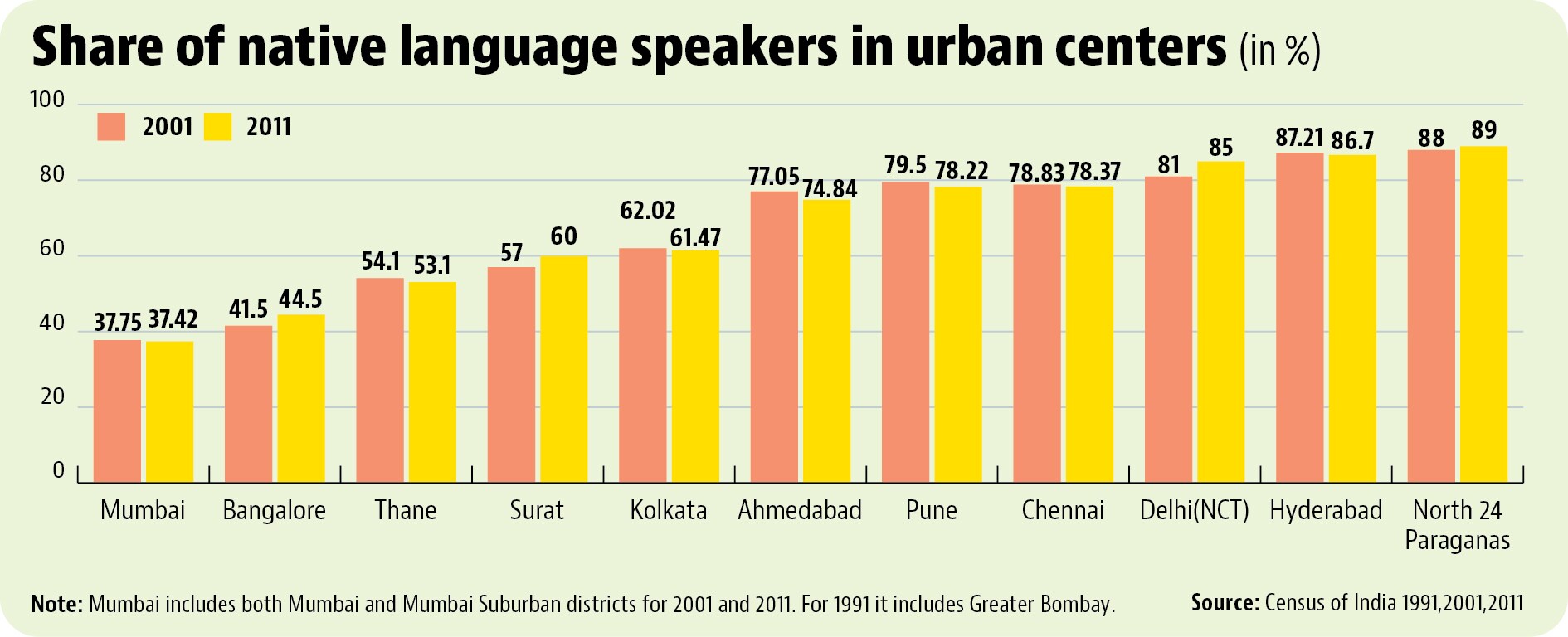
- What has migration done to the linguistic balance in these cities?Once again, the data is dated, but it’s there – mother tongue data for the 2001 and 2011 census at the district level. These numbers show that Mumbai and Bengaluru are the only two urban centres where the share of native language speakers (Marathi in Mumbai and Kannada in Bengaluru) has fallen below the half-way mark. What is interesting is that this holds true not just for the 2011 census but also the 2001 census. While this seems intuitively true for Mumbai, given the long history of growth and migration in the city, it is a bit surprising for Bengaluru. To be sure, the share of native language speakers actually increased in Bengaluru between 2001 and 2011. Also, a large majority of non-Kannada speakers in Bengaluru are Tamil and Telugu speakers and not Hindi speakers.
- What this data does not tell usThe numbers used in this story being dated because of the 2021 census numbers not being available is only part of the problem. Local unrest or heartburn against migrants can often be driven by their economic clout rather than absolute numbers. With the political economy of these cities having undergone a drastic change due to the inflow of foreign and domestic capital, it is very likely that such changes would have taken place. While there is every reason to criticise miscreants who violate law and order in the name of language or native sentiments, it is important that there is adequate focus on understanding the interplay of migration and political economy in India’s biggest urban centres.


The fact that the riots were concentrated in the most urban part of Karnataka, raises another interesting question. Is fear of migrants taking over the most lucrative segments of the state’s economy fuelling such violence in India’s biggest urban centres? While the absence of latest census data – the 2021 census has been indefinitely delayed by the Union government – makes this a difficult question to answer, data till 2011 does show a large increase in share of migrants in some of India’s largest cities. Here are three charts which explain this in detail.