The National Statistical Office (NSO) will release the June numbers for Consumer Price Index (CPI), India’s benchmark retail inflation measure, on Monday. A Reuters forecast of economists expects CPI to grow at 6.58% on a year-on-year basis in the month of June. If true, this will be the highest inflation number since the November 2020 value of 6.9%. This will also make June the second consecutive month when retail inflation will be higher than the upper limit of the Reserve
A Reuters forecast of economists expects CPI to grow at 6.58% on a year-on-year basis in the month of June. (Mint Photo)
Core inflation in May was at 6.5% and the non-core component was at 6%.
2. The other oil which is driving India’s food inflation
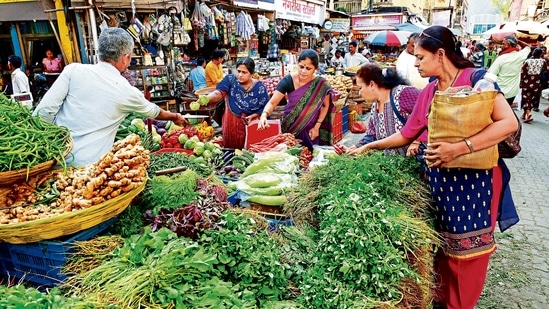
What was remarkable about the May inflation numbers was the sharp spike in food inflation, which increased from 2% in April 2021 to 5% in May. It needs to be kept in mind that these numbers come on a high base. Food inflation was 9.2% in May 2020. However, what has changed between May 2020 and May 2021 are the factors which are driving food inflation. The contribution of cereals, milk and products and vegetables, the three most important sub-components of the CPI food basket, has gone down in May 2021 compared to May 2020. But the role of edible oil in fuelling food inflation has increased significantly. Because India is a net importer of edible oils, and international edible oil prices are at an all-time high, any immediate relief is unlikely on this front. To be sure, international inflation for edible oil seems to have peaked in May 2021. However, heavy rain in parts of the country during June could add to a spike in vegetable prices, generating additional tailwinds for food inflation.
To be sure, international inflation for edible oil seems to have peaked in May 2021.
3. Services inflation could increase as the economy unlocks and demand picks up
The miscellaneous category of CPI has a weight of 28.3% in the CPI basket. This largely includes the prices of services and includes the sub-categories of household goods and services, health, transport and communication, recreation and amusement, education, stationery, etc., and personal care and effects. The inflation for the miscellaneous category grew at 7.5% in the month of May 2021, the highest value since March 2013. As the economy unlocks and demand picks up for these categories, there could be additional inflationary pressures going forward.
The inflation for the miscellaneous category grew at 7.5% in the month of May 2021, the highest value since March 2013.
4. The role of global commodity prices
Retail inflation also depends on what is happening to producer prices, which are captured in a better way by the Wholesale Price Index (WPI). The WPI will be released later this week. It crossed the 10% mark in the month of May 2021 to reach 12.94%.
The sharp spike in WPI is also a result of the rise in commodity prices in the international market as demand picks up with revival of growth in advanced countries. A look at the Bloomberg Commodity Index (BCOM), however, shows that international prices peaked in the month of June. The BCOM, which is a weighted index of energy, grain, industrial metal, precious metal, livestock and sugar, coffee and cotton prices, reached a value of 95.02 on June 10, 2021, the highest since July 23, 2015. It was valued at 93.06 on July 9. The question is whether prices will stay at present levels, which are quite high compared to historical standards, or come down further. A stickiness or reversal in the declining trend in the last one week could generate additional headwinds on the domestic inflation numbers.
A stickiness or reversal in the declining trend in the last one week could generate additional headwinds on the domestic inflation numbers.
“A closer look revealed a faster rise in the (May) CPI inflation momentum compared to WPI inflation, likely led by more pass-through of higher input costs, higher oil prices and logistical disruptions due to the lockdowns. As the lockdowns ease, these disruptions will likely abate, pushing CPI inflation back below 6% (by July/August). That is the likely story of 1HFY22”, said a research note by Pranjul Bhandari and Aayushi Chaudhary at HSBC Capital Markets and Research. However, the note warned that upside risks to inflation could re-emerge in the second half of the fiscal year, likely driven by two factors: corporates likely feeling more confident about passing on higher prices to consumers as vaccination reached critical mass and demand side pressures fuelling service inflation.