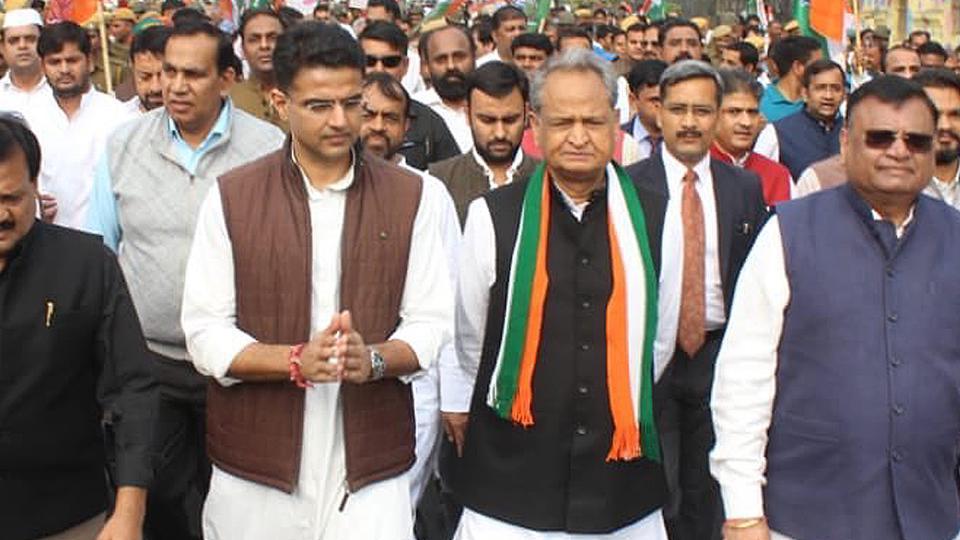
Numbers behind Rajasthan story
The situation in Rajasthan could change if some MLAs who attended the CLP meeting decide to switch to Pilot’s side. There is no indication at the moment that this could happen.
Rajasthan chief minister Ashok Gehlot’s government enjoys a wafer-thin majority. Here is how all the numbers stack up:

200 Total MLAs in the Rajasthan assembly
107 Number of Congress legislators, including the Speaker
101 The majority mark in the assembly. Also, the number of legislators who attended the Congress legislative party meeting at the Fairmont Hotel in Jaipur on Tuesday, although only 88 of these (including Gehlot) were from the Congress. There were 10 independent legislators, two from the Bharatiya Tribal Party (BTP), and one from the Communist Party of India (Marxist).
104 Legislators whose support Gehlot claimed in a meeting with the governor later in the day, according to the party.
2 BTP legislators who attended the Fairmont meeting but left for their homes, saying they would take a call on support at an “appropriate” time.
4 Legislators who left the Sachin Pilot camp on Sunday, and signalled their support for Gehlot.
19 Congress MLAs (including Pilot) supporting Sachin Pilot.
3 Independents supporting Pilot
1 Legislator who seems to be counted by both sides (likely Bhanwarlal Meghwal).
181 Reduced strength of the assembly, if Gehlot decides to disqualify the 19 Congress MLAs supporting Pilot.
91 Majority mark in a 181-member assembly
92 MLAs BJP could hypothetically muster, if it can convince the three independents with Pilot, and all the 10 other independents, two CPI(M) members and two BTP members, to support it. The BJP and its ally Rashtriya Loktantrik Party have 75 MLAs
X-Factor: The situation could change if some MLAs who attended the CLP meeting decide to switch to Pilot’s side. There is no indication at the moment that this could happen. Although Gehlot claims to have a majority, “the numbers are not very comfortable for him,” said Jaipur-based analyst Narayan Bareth
ABOUT THE AUTHORChetan ChauhanChetan Chauhan is the National Affairs Editor looking into all aspects of news and features from across India. A Chevening scholar with over three decades of experience in reporting and news management, Chetan has extensively covered all important aspects of the social sector, political economy, environment and climate change nationally and internationally. He did a journalism course at the Reuters Institute of Journalism in Oxford and Digital Media training at Nanyang Technological University in Singapore. He started as a reporter with The Statesman in 1996 and joined the Hindustan Times in 2000 in the metro bureau covering environment, crime and Delhi politics. He covered hot local news, from the Jessica Lal murder case to the rebellion of Delhi Congress MLAs against then Chief Minister Sheila Dikshit, to the replacement of toxic vehicle fuel with cleaner compressed natural gas (CNG) in the national capital. Some of his stories on air pollution became part of the Supreme Court’s landmark MC Mehta versus Government of India case in the National Capital Region (NCR), forcing the government to take corrective measures. As part of the national political bureau since 2004, he covered important central sectors such as environment, education, social justice, labour, rural development, water resources, renewable energy, agriculture, broadcasting and the Planning Commission for more than a decade producing several exclusive and investigative breaking stories. His specialisation is the environment, having covered at least a dozen United Nations global conferences on climate change, biodiversity and wildlife including climate summits in Paris, Copenhagen and Bali. He also covered India’s two five-year plans ---11th and 12th and reported on drafting and execution of right based laws such as Right to Education, Right to Information and rural job guarantee law, MG-NREGA, now being introduced in new format as VG-RAM-G Act. He has in-depth knowledge of social sector issues. He was one of the first to report on tigers vanishing from Sariska and Panna wildlife reserves in 2004 and 2008, respectively, leading to the setting up of the National Tiger Conservation Authority (NTCA) and the introduction of stringent penal provisions for poaching. He has written extensively on the rising human-animal conflict in India and the degradation of India’s biodiversity hotspots because of mining and other activities. Since 2004, Chetan has covered Parliament comprehensively and participated in training on the nuanced coverage of Parliament proceedings. He has travelled extensively across India to cover national and provincial elections since 1998, especially in the Hindi heartland states, considered India’s road to power. He writes a regular column for Hindustan Times, Ecostani, on important national politics, economy, Himalayan ecology and environmental issues. His other responsibilities include providing inputs for edits and edit page articles for the publication, apart from managing news flow from across India.Read More

E-Paper