E-Paper



Odisha cut 1.85 crore trees to widen roads in 10 years, planted only 29 lakh
The Odisha government on Tuesday said that it has cut over 1


The Odisha government on Tuesday said that it has cut over 1.85 crore trees in the last 10 years for widening of roads.
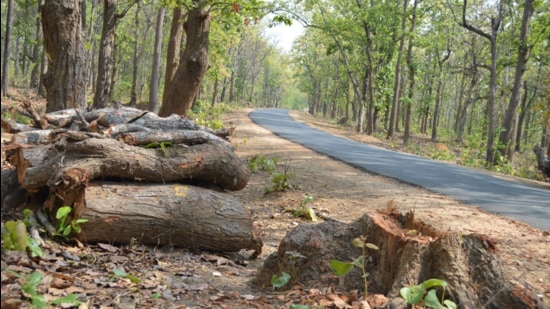
Replying to a question of BJP MLA Mohan Majhi in the assembly, on the number of trees felled for widening of roads in Odisha between 2010 and 2020, forest and environment minister Bikram Keshari Arukh said the trees were cut for widening of national highways such as the Sambalpur-Chhatisgarh section of NH-6, four-laning of Bhubaneswar-Puri road, Panikoili-Remuli section and Remuli Rajamunda section.
However, just about 29 lakh trees were planted in place of the felled trees at an expenditure of ₹66.17 crore. The total number of trees planted were about 16 per cent of the trees that were cut down. The Ministry of Environment, Forests & Climate Change has authorized the state governments to grant General Approval under Section 2 of Forest (Conservation) Act, 1980 for diversion of forest land up to 5 hectare in each case for creation of critical public utility infrastructure by government departments involving felling of trees not exceeding 50 number of trees per hectare in Maoist-affected districts. As per Forest Conservation Act, 1980, for every tree cut on non-forest land for any developmental project, two trees have to be planted while the same for forest lands is 10.
Expressing shock over the huge loss of trees due to road widening, environmental activists said the losses are irreversible. “The trees that were felled must be at least 20-30 years old. The trees were not just giving shades to pedestrians, but also sheltered a lot of birds and reptiles. Recouping the losses is a near impossible task. The government may have planted around 30 lakh trees to recoup the losses, but I doubt if more than 5 per cent trees would have survived. The government should have looked at alternatives rather than simply sawing the trees,” said noted environmental activist Hemant Sahu.
Last month, while hearing a plea related to the cutting of more than 350 trees for the construction of road over bridges (ROBs) as well as widening of national highway in West Bengal, a Supreme Court bench headed by chief justice SA Bobde had said the top court may introduce a protocol so that there is minimum damage to the environment.
Hearing another plea on cutting of trees for a road project in Uttar Pradesh, the Supreme Court in December last year had wondered why trees need to be cut more often than needed for the widening of roads. “Why do roads have to be laid in a straight line by cutting trees? Keep roads zigzag. It will reduce speed, lessen accidents on roads and save many lives,” a bench presided over by chief justice S A Bobde had said.
But despite the SC glare on cutting of trees for road widening, several such projects are operational in Odisha. In Ganjam district of Odisha, at least 1,720 fully-grown and old trees of different species will be cut for the widening of a 40 kilometre stretch of the National Highway 59 there. The ₹126-crore project would widen the road to 12 metres from 7 metres between Ratanpur near Berhampur city and Mundamarai near Aska.
“Phailin cyclone in 2013 uprooted several trees in Ganjam. But now all roadside trees will be wiped out to widen the road,” said Sudhir Rout, founder of Aryabhatta Foundation, an organisation fighting against tree felling.
The large scale felling of trees have taken their toll on the forest cover of the state. As per the FSI-2011 report, Odisha had a forest cover of 58,136 sq km which came down to 51, 619 sq km in FSI-2019 report. The loss of forest cover has happened not just due to road widening, but due to successive natural disasters as well as several industrial projects.
Cyclone Phailin, that struck the districts of Ganjam and Khurda in 2013, led to loss of 15400 trees while tree cover in 29 sq km area in reserve forest and protected areas were damaged. Cyclone Fani in 2019 uprooted 22 lakh trees, most of them fruit bearing trees in Puri and Khurda districts.
In one of the largest-ever tree-felling exercises for an industrial project in recent times, over 17,000 trees were cut in December 2019 in Sambalpur district. An opencast coal mining project of central government-owned Neyveli Lignite Corporation coming up at Talabira area of Sambalpur district would result in diversion of 1,038.187 hectares of prime forest land, having trees like Sal, Mahul, Asan, Dhaura, Jamun, Mango and Char. By a conservative estimate, at least 1.3 lakh trees would be cut to make way for the Talabira coal blocks.
“Talabira coal block would be among the projects in recent times when a large number of trees were cut. In case of highway expansion, the government could plant only 16 per cent of the trees cut and no one knows how many of the saplings survived. Talabira has one of the best Sal forests in Odisha and once 1.3 lakh trees are cut no one knows how many years it will take to regenerate the same tree cover,” said Sankar Pani, environmental lawyer.