E-Paper



Odisha train accident: Unclaimed bodies pileup crunch in morgues
With the Odisha train accident taking place on Friday evening, Saturday brought with it the challenge of rigor mortis, and the decomposition of bodies.

 Prefer HTon Google


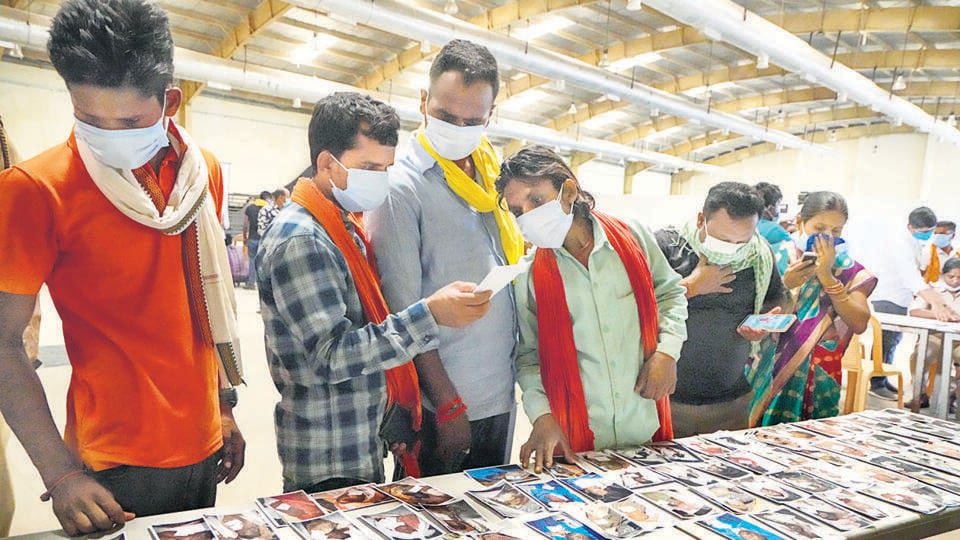
A photograph of his son clutched tightly to his chest on Sunday afternoon, Krushna Chandra Sahoo grew increasingly frantic as the day wore on. Twice now, he had walked through the morbid air-conditioned business conventional hall turned into a makeshift morgue in Balasore town. He tried to look closely at the mangled bodies, lying in white shrouds in geometrical, motionless lines, but his 38 year old son Jagdish Sahoo was not to be found.
Read here: Ashwini Vaishnaw prays as train movement at Odisha crash site resumes| 10 points
The body of my sons friend was found at the spot, but I haven’t been able to find him so far. I do not know if he is alive or dead, a haggard Sahoo said. Two days after the Chennai bound Coromandel Express crashed into a goods train, and its derailed bogeys then careened into a passing superfast express train leaving 275 dead, Odisha now faces a grim challenge; identifying the dead.
With the accident taking place on Friday evening, Saturday brought with it the challenge of rigor mortis, and the decomposition of bodies under the summer sun. Soon after the tragedy, we first took the bodies to a high school near the accident site. But as the bodies started decomposing, we moved them into the air-conditioned hall with ice slabs in Balasore town. But the decomposition is still happening, and we have started moving some bodies to the mortuary at AIIMS Bhubaneswar, a senior government official at the spot, who did not want to be identified, said.
Ranjit Nayak, deputy superintendent of police of Government Railway Police in Balasore said that even those families that were arrived in the city, were being stymied by the damage to the bodies. Faces of many are badly smashed. There are bodies with only a torso, a burnt face and no other visible identity markers left. There were some travelers who were in the general compartment, traveling short distances, without a ticket which is another challenge, he said.
How Coromandel Express derailed, set off triple-train collision, explains Railway Board
Chief Secretary Pradip Jena said that of the government’s revised figure of 275 dead, only 88 bodies have been identified thus far. We have uploaded the pictures of the dead on the websites https://srcodisha.nic.in, https://www.bmc.gov.in, and https://www.osdma.org. If someone can identify the body of their family member, they can contact the helpline number 18003450061 1929 (24A-7). The list of injured has also been uploaded to these websites. DNA profiling will also be done Jena said.