E-Paper



Op Sindoor reflected new strategic thinking, Rajnath Singh tells army commanders
Rajnath Singh and the army’s top brass took stock of the situation along the borders with China and Pakistan and reviewed the force’s operational preparedness

 Prefer HTon Google


NEW DELHI: Operation Sindoor reflected India’s new strategic thinking for responding to any terrorist attack on its own terms and a defence doctrine that embodies “resolve and courage”, defence minister Rajnath Singh told the army’s top commanders during a meeting on Friday to review the regional security situation.
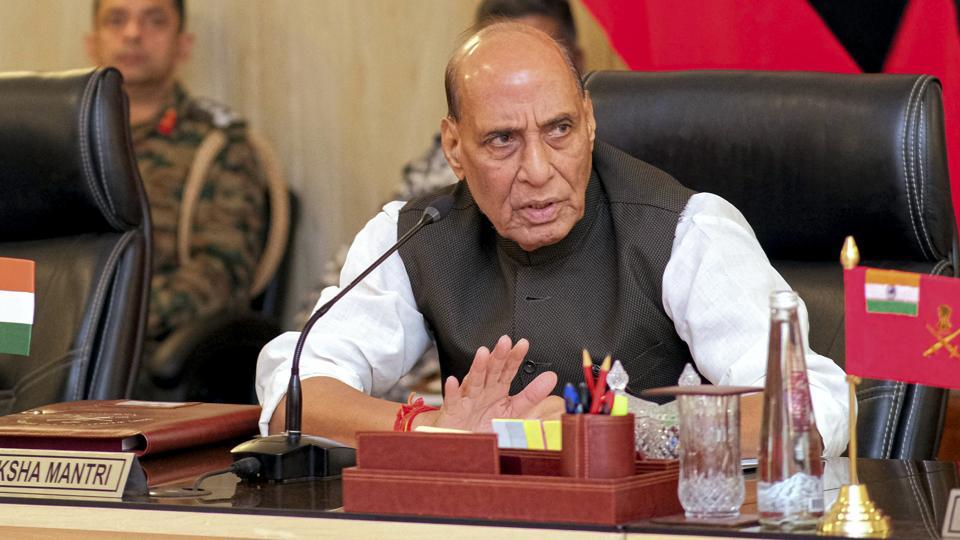
Singh and the Indian Army’s top brass took stock of the situation along the borders with China and Pakistan and reviewed the force’s operational preparedness during the Army Commanders Conference in Jaisalmer.
Singh also visited the forward areas of Tanot and Laungewala in Rajasthan, located close to the Pakistan border.
The defence minister urged the military to never underestimate adversaries and to focus on information warfare, the development of modern defence infrastructure, and the modernisation of the force to effectively deal with future challenges. The commanders’ conference is an annual event that brings together the top brass to brainstorm key security challenges and identify crucial tasks to modernise the army.
Operation Sindoor, which was launched by India in May in retaliation for the Pahalgam terror attack, has “given rise to a new strategic thinking that India responds to any terrorist activity on its own terms”, Singh said. “This is New India’s Defence Doctrine, which embodies both resolve and courage.”
He added, “Operation Sindoor will go down in history as not just a military operation, but also a symbol of the nation’s courage and restraint. The action taken by our forces against terrorists was in keeping with both policy precision and human dignity.
“The operation isn’t over. Our mission for peace will continue as long as even a single terrorist mindset remains alive.”
Singh noted that Operation Sindoor also reflected India’s military prowess and national character, and demonstrated that the strength of soldiers lies not only in weapons, but in their “ethical discipline and strategic clarity”.
Operation Sindoor targeted terrorist infrastructure in Pakistan about a fortnight after the Pahalgam terror attack, which was carried out by The Resistance Front, a proxy for Pakistan-based Lashkar-e-Taiba (LeT), and resulted in the death of 26 civilians. This triggered four days of intense hostilities that ended when Indian and Pakistani military officials reached an understanding on ending military actions on May 10.
Singh exhorted soldiers to “never underestimate” adversaries while urging the commanders to focus on defence diplomacy, self-reliance, information warfare, defence infrastructure and force modernisation, according to a statement from the defence ministry. He reiterated the government’s commitment to provide state-of-the-art technology, infrastructure and support to maintain the highest levels of operational preparedness.
The defence minister also praised the Indian Army’s significant role in ensuring peace and development in Jammu and Kashmir following the abrogation of Article 370 in August 2019. “The abrogation of Article 370 was historic. Today, the streets there are filled with hope and not unrest. People are confident about their future,” he said. “Most importantly, the decision-making system is now in the hands of the local people. The Indian Army has played a crucial role in this endeavour.”
Referring to the situation on the border with China, Singh said, “ongoing talks and de-escalation steps have demonstrated a balanced and firm foreign policy of India”. He added, “Our policy is clear that there will be dialogue and our readiness on the border will remain intact.”
India and China reached an understanding in October 2024 to end a military standoff in the Ladakh sector of the Line of Actual Control (LAC) in April-May 2020. The face-off took bilateral ties to their lowest point in six decades, and the two sides have revived several mechanisms to both address the boundary dispute and normalise the overall relationship. However, both sides have continued to deploy about 50,000 troops each in the Ladakh sector.
The Army Commanders Conference, which was attended by Chief of Defence Staff Gen Anil Chauhan, army chief Gen Upendra Dwivedi, defence secretary Rajesh Kumar Singh, army vice chief Lt Gen Pushpendra Singh, also witnessed detailed discussions on “grey zone warfare” and the roadmap for jointness, self-reliance and innovation, the statement said.
Singh said the Indian military is “one of the most adaptable forces in the world” in view of its ability to operate in the freezing terrain of Siachen, the scorching heat of the Rajasthan desert, and counter-insurgency operations in dense forests. “Despite the tough conditions and diverse challenges, they adapt to the changes and further strengthen national security,” he said.
While contemporary warfare is technology-driven, soldiers remain the country’s greatest assets and while machines multiply strength, the human spirit possesses the power to deliver results, Singh said. Modern warfare is fought in invisible domains such as cyberspace, information, electronic disruption and space control, and adapting to the latest technological advancements, quick decision-making and willpower of soldiers remain key factors, he said.
As part of the conference, Singh carried out the virtual inauguration of technology enablers, including Edge Data Centres for the Konark and Fire & Fury Corps of the army. By next year, all corps across the nation will have Edge Data Centres.
He launched an equipment helpline for the army, the “Sainik Yatri Mitra” app and released the “Defence Millet Dishes Compendium” compiled by the Army Service Corps Centre and College in Bengaluru. He also inaugurated Naman Centres to facilitate veterans and the next-of-kin of troops.
Singh also laid a wreath at the Laungewala Yudh Sthal and paid homage to the Indian Army troops. He inaugurated Chandpuri Hall, an audio-visual room dedicated to the memory of Major (later Brigadier) Kuldip Singh Chandpuri, who led the defence during the Battle of Laungewala in the 1971 war with Pakistan. He also felicitated the veterans who participated in that battle.
Singh reviewed several infrastructure projects to develop the historical site as an icon of national pride, showcasing the army’s valour and resilience.
He also witnessed a “capability demonstration exercise” that showcased integrated use of new organisations such as the Bhairav Battalion and Ashni Platoon, along with the latest technological assets inducted into the army. The display symbolised the blend of legacy and innovation, highlighting the army’s thrust on capability development and force modernisation, the statement said.