
 E-Paper



Op Sindoor’s lessons will find place in theatre plan: CDS General Anil Chauhan
Jointness and integration were on full display during Operation Sindoor and there was need for a formalised structure for synergised operations.


The lessons learnt from Operation Sindoor, the four-day military confrontation with Pakistan in May, are being incorporated into the theaterisation model currently under consideration, with specific focus on the role of service chiefs during operations, chief of defence staff General Anil Chauhan said on Tuesday.
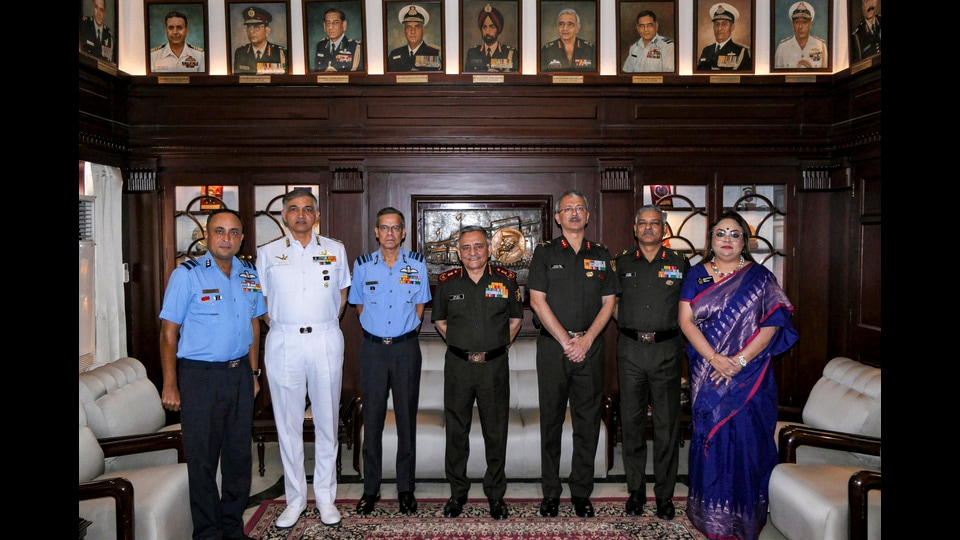
Almost 90% work on the proposed creation of theatre commands has been done, he said.
Also, chief of the air staff Air Chief Marshal AP Singh said that the Indian military may need another joint structure but it cannot adopt a model that exists somewhere else and say that it will fit, adding that jointness and integration were on full display during Operation Sindoor and there was need for a formalised structure for synergised operations.
“What has happened is that post Operation Sindoor, there are some more lessons that we have learnt. I need to incorporate that into this (theaterisation) model which we have worked out. In the earlier model, we were saying force generation and force application will be different and a theatre commander will be responsible for force application, and a service chief only for force generation…and we gave him the responsibility of only ‘raise, train and sustain’ forces,” Chauhan said at Bharat Shakti’s India Defence Conclave.
However, during Operation Sindoor, he said, it came to the fore that the service chiefs also had a major role not only as part of the chiefs of staff committee (COSC) but also directly.
“So we can’t deny this role (of chiefs) in the Indian context, at least for some more time. We need to rework that thing out… the role of COSC, that is one big lesson. The second big lesson is how we interact with the higher leadership, the higher defence organisation….and strategic decision making. Now we have a lot of experience of Uri, Balakot, Sindoor, Galwan and Doklam. We need to amalgamate that particular experience and come to an organisational structure which will be for all seasons,” the CDS said.
“We need to finalise the structure for war…for (operations) less than war, and 90% of the work is done. Some more debate is on the basis of things we have learnt from ongoing operations.”
Chauhan explained the developments on theaterisation that took place two to three years before Operation Sindoor.
“We continued with some kind of strategic discussions between the three chiefs and myself for about 26 days spread over two-three years. When the then three chiefs retired, we compiled those discussions in a booklet and submitted it to the government. At that point of time there were still some issues left in Operation Tiranga (likely name for the theaterisation drive), though discussions continued further. That’s where we were before Operation Sindoor.”
The comments come at a critical moment when there are some differences within the three services on theaterisation, a long-awaited reform for the best use of the military’s resources to fight future wars. Theaterisation refers to placing specific units of the army, the navy and the air force under a theatre commander. Such commands are led by an officer from any of the three services, depending on the roles assigned to them. The air force strongly feels it should not be confined to a theatre.
Operation Sindoor, the IAF chief said at the same conclave, demonstrated synergy between political leadership, various agencies involved, and the three services, with the national security adviser and CDS playing a key role in getting everybody together and orchestrating the whole thing as a synergised operation, and not fighting the war individually.
It was a very good example of synergy that needs to be taken forward, he said.
“I am not saying that we don’t need another structure. We may need another joint structure but my way of looking at it is let’s not go by some structure that exists somewhere else and say that this will fit us. Let’s look at what we have today...where did we falter? Did we falter? If we did not, then what did we do good? Let’s make it more formalised... Maybe this time it was our own personal equation with each other that worked. Tomorrow it may not be so because we are all humans. There will be people with differences of opinion but if there is a formalised structure it will help us,” Singh said.
Singh raised questions about what should the structure be and how deep should be the so-called reforms. “If it is hurting me somewhere, I should only reform that first. What should the model be? Should I go stepwise or should I do it in one go...This is something that is under discussion...The nation comes first...Whatever decision is finally taken will be for the good of the nation,” he said.
In September, defence minister Rajnath Singh said jointness in the military --- a prerequisite to the creation of theatre commands --- cannot be achieved through structural reforms alone but will also require a change in mindset and the challenges involved will have to be tackled through dialogue and understanding, stressing that tri-service integration is a must for survival in a fast-changing security environment.
The primacy of air power, the IAF chief said, came to the fore during Operation Sindoor, New Delhi’s direct military response to the April 22 Pahalgam terror attack in which 26 people were killed. It led to a four-day confrontation with Pakistan that showcased the Indian military’s synergy.
“There was no doubt in anybody’s mind about what air power can do. This is one element of power that has the flexibility, the reach, the precision that you need and the punch...You again realise what saved us the day was air power. And when I say air power it’s not just the air force, it’s the medium of air that we are talking about...comprehensive air power. I think this is the future, the fastest growing arm of defence that we have seen. And it is going to continue,” the IAF chief said.


