
 E-Paper



Open to refer ex-post facto environmental clearance to Constitution Bench: Supreme Court
The court was convinced that the same issue decided by a three-judge bench in November last year requires reconsideration.

 Prefer HTon Google


The Supreme Court on Wednesday said it is open to refer the issue of grant of ex-post facto environmental clearance (EC) for mining and development projects to a five-judge Constitution Bench on being convinced that the same issue decided by a three-judge bench in November last year requires reconsideration.
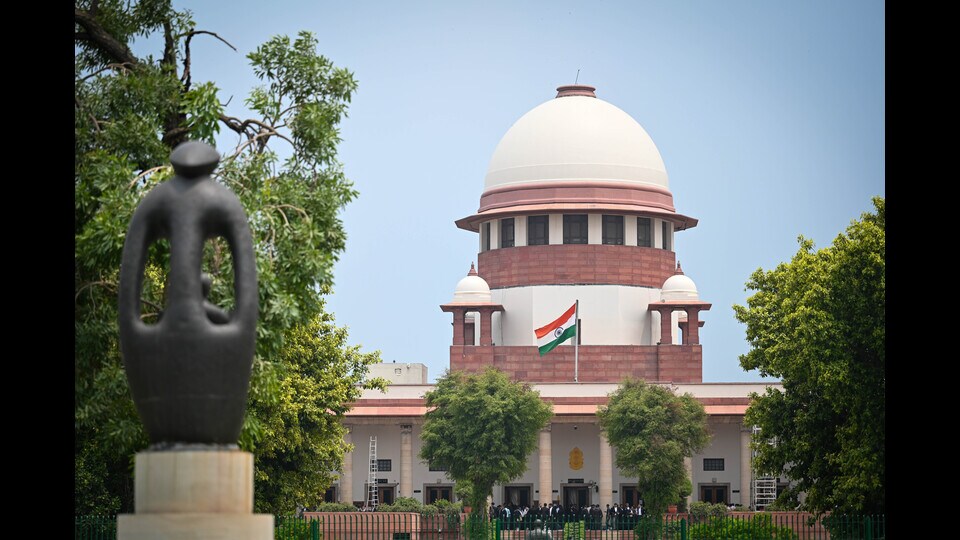
A bench headed by Chief Justice of India (CJI) Surya Kant made the observations while hearing a batch of petitions challenging the 2017 and 2021 notifications of the Ministry of Environment, Forests and Climate Change (MoEFCC) which allowed project proponents to obtain EC long after they had commenced work.
A set of petitions filed by NGOs and other individuals claimed that such directives goes contrary to the legal regime of prior EC provided by the Environment Impact Assessment (EIA) 2006 notification and will adversely impact the environment.
Last year, on May 16 a two-judge bench struck down the two notifications as unconstitutional paving the way for the demolition of all projects which applied for ex-post facto EC. On a review petition decided by a three-judge bench on November 18, this decision was set aside and the challenge to the notifications stood revived, which were heard on Wednesday.
The bench, also comprising justices Joymalya Bagchi and Vipul M Pancholi said, “The question of referring the matter to a five-judge bench will arise if we doubt the 3-judge bench ruling of November 18.”
The court was responding to arguments by petitioners - non-profit organisations Vanashakti and One Earth One Life - which demanded that pursuant to the November ruling, the judgments relied by them before the two-judge bench stood overruled. While the review judgment set aside the earlier verdict and directed the matter to be placed for fresh consideration, the petitioners led by senior advocates Gopal Sankaranarayanan and Sanjay Parikh argued that any effective hearing will require the matter to be placed before a five-judge bench.
“The judgments of this court which held ex-post facto EC to be bad in law have been held by this judgment (of November 18) to be of no precedential value. This ruling is a hurdle in my way as those judicial precedents are not available to me anymore,” Sankaranarayanan said.
Supporting this view, Parikh said, “The three-judge bench has been little enthusiastic in laying down the law which it could not do in a review proceeding. The review judgment has virtually given a finding in favour of the two notifications. It naturally becomes a hurdle and that is why a larger bench must consider this case.”
The court assured the petitioners, “We are not stopping you from arguing on merits. We will respond with a composite judgment on all issues.” The court posted the matter for Thursday to continue hearing submissions by petitioners.
Additional solicitor general (ASG) Aishwarya Bhati representing MoEFCC said that even the Centre is prepared to argue on merits. Though the Centre did not file a review petition against the May 16 judgment scrapping its two notifications, the three-judge bench had heard the Union, certain states and public sector entities before giving the order.
Parikh said that the issue is of utmost importance as any dilution of environmental norms will have a catastrophic impact on people and their health. “The three-judge bench decision has gone against several judgments by this court that strengthen environmental jurisprudence. It is even against the rule of law as it benefits violators of the law at the cost of those who obtained prior EC under the prescribed regime,” Parikh said.
Advocate Vanshdeep Dalmia who also appeared for Vanashakti said that if ex-post facto EC is permitted there will be no deterrent against violators as the Jan Vishwas (Amendment of Provisions) Act 2023 has de-criminalised violations under the Environment Protection Act 1986 allowing defaulters to escape with minor penalties.
The November 18 judgment was by a 2:1 majority comprising then CJI BR Gavai and justice K Vinod Chandran with the third member, justice Ujjal Bhuyan writing a separate dissenting view supporting the May 16 judgment of which he was a part.
The majority view said that if the judgment under review is allowed to operate, public infrastructure involving hospitals, airports, effluent treatment plants and other public works worth ₹20,000 crore would require demolition.


