E-Paper



Orissa HC rejects plea on raising height of Durga idol to 4 feet, says move will not affect sanctity
The court said the puja committee could not justify if the height of the idol is restricted to 4 feet, then somehow the sanctity of the occasion, the devotion and fervour associated with the festival, and the religious sentiments of the people would be interfered with in a manner contrary to tradition.


The Orissa High Court on Friday rejected the petition filed by a puja committee of Cuttack town seeking relaxation in capping of the height of Durga idol at 4 feet observing that the height despite being an essential aspect of a tradition would not lower the sanctity as well as the devotion and fervour associated with the popular festival.
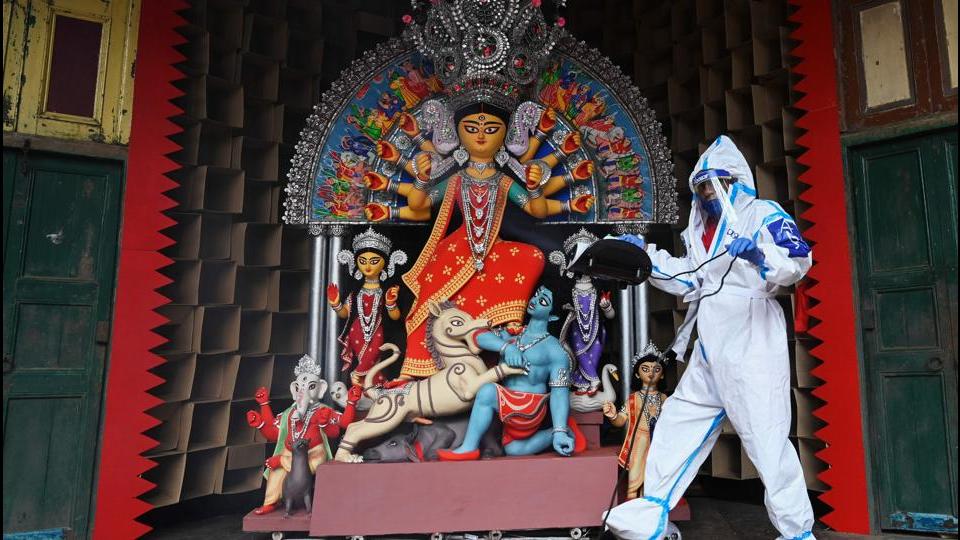
Balubazar Puja committee, one of the 150-odd organisers of the Durga Puja festivities had approached the Orissa High Court last week seeking that the state government order on capping the height of all idols of Durga as well as other subsequent festivals at 4 feet be lifted. The committee contested the order of the state government issued last month which said the height of all idols of Gods and Goddesses such as Ganesh, Durga, Kali and Laxmi should be capped at 4 feet.
The HC bench of Chief Justice S Muralidhar and Justice BP Routray said Durga Puja festival itself was a combination of several elements of celebration, and the idol is but one important component. “In respect of these many elements there has had to be some amount of restriction on the scale and size. It is in that context that the restriction on the height of the idol has to be viewed. It cannot be singled out as an ‘essential’ aspect of a tradition or practice without which, the festival itself may not have significance,” the HC said.
The court said the puja committee could not justify if the height of the idol is restricted to 4 feet, then somehow the sanctity of the occasion, the devotion and fervour associated with the festival, and the religious sentiments of the people would be interfered with in a manner contrary to tradition.
The HC bench however made an exception for Balubazar puja committee and 8 other committees in Cuttack town that have already started construction of the idols and exceeded the 4 feet limit. It said the rest of the puja committees that have not started construction would have to keep the idol at 4 feet.
Since last month, politics has escalated over the height of the Durga idols with opposition BJP calling for a Cuttack bandh on September 13 against the government order. BJD MP Bhartruhari Mahtab had also opposed the state government decision on capping of idol height.
The deities of Maa Durga have been worshiped in Cuttack since 1509. It is believed that Netaji Subhas Chandra Bose, who was born in Cuttack, started Durga Puja in the city to organize youngsters against the British like Balagangadhar Tilak had started Ganesh Utsav in Maharashtra. The first recorded Sarvajanin (public) Durga Puja in the state started in Kazi Bazaar area of Cuttack in 1832.
While capping the idol heights, last month, the special relief commissioner of Odisha had said congregations for celebration of Ganesh Puja, Durga Puja, Laxmi Puja, Kali Puja and other festivals would not be allowed in public throughout the state.
The state government said puja pandals would need to be covered on three sides while the 4th side would be covered in a way so as not to allow any public view of the idols. It also barred the use of the public address systems at puja pandals and said the immersion processions would not be allowed.
Apart from Odisha, states like Maharashtra, Karnataka and Gujarat have capped the height of idols at 4 feet, but the neighbouring state of Bengal has not put in place any such restrictions. Assam too has also not put any such restrictions.