Pakistan Prime Minister Shehbaz Sharif again raised the Kashmir issue while addressing the United Nations General Assembly (UNGA) on Friday, saying that it needs a “just and fair solution”.
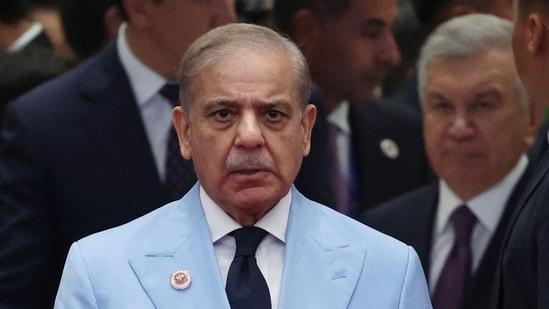
Sharif claimed the Kashmiri people had been waiting for the United Nations to fulfil its commitment to a “free and impartial plebiscite” under its auspices.
He alleged that generations of Kashmiris had endured “illegal occupation, arbitrary detention, extrajudicial killings, enforced disappearance, sexual violence, and collective punishment".
Deep Dive
What did Shehbaz Sharif say about the Kashmir issue at the UN General Assembly?
Why does Pakistan consider the Kashmir issue important in its UN speeches?
How did India respond to Pakistan's claims on terrorism at the UNGA?
“But this requires a just and fair solution to the Kashmir dispute. For eight decades, the Kashmiri people have waited for the United Nations to fulfil its solemn commitment to a free and impartial plebiscite under its auspices. Generations have endured illegal occupation, arbitrary detention, extrajudicial killings, enforced disappearance, sexual violence, and collective punishment,” Sharif said.
India's reply
In India's right to reply, the first secretary in New Delhi's Permanent Mission to the UN, Petal Gahlot, accused Pakistan of pursuing a long-standing policy of cross-border terrorism and warned that such acts will have consequences.
{{/usCountry}}In India's right to reply, the first secretary in New Delhi's Permanent Mission to the UN, Petal Gahlot, accused Pakistan of pursuing a long-standing policy of cross-border terrorism and warned that such acts will have consequences.
{{/usCountry}}“At the heart of the issue is the long-standing practice of cross-border terrorism by Pakistan. We demonstrated last year that terrorists will have nowhere to run and nowhere to hide. Our right to defend ourselves against terrorism will be exercised and continued. Terrorism by Pakistan will have consequences...We are confident that this Assembly will recognise Pakistan and its policies for what they really are, not what its representative mendaciously projects it to be. Reiterating falsehoods year after year does not make them true. Pakistan's terrorism, deceit and duplicity will neither benefit it nor the world," Gehlot said.
India has repeatedly rejected Pakistan's assertions on Kashmir made at the UNGA forum as well as on other UN platforms in the past, saying that the Union Territory of Jammu and Kashmir has been, is, and will always remain an integral and inalienable part of India.
Shehbaz Sharif on the Indus Waters Treaty issue
In his UNGA address, Shehbaz Sharif warned that any attempt to stop, impede or divert Pakistan’s share of the Indus River waters would be treated as an “act of war”, as he criticised India’s decision to hold the Indus Waters Treaty in abeyance.
India decided to put the Indus Waters Treaty of 1960 in abeyance as part of a series of punitive diplomatic and economic measures unveiled soon after last year's Pahalgam terror attack that had killed 26 civilians.
Sharif also used the UN General Assembly podium to credit US President Donald Trump for his "timely intervention" in the 2025 conflict with India.
New Delhi had launched Operation Sindoor on May 7 last year, targeting terror infrastructure in Pakistan and Pakistan-occupied Kashmir in retaliation for the Pahalgam attack. US President Trump has repeatedly claimed, as recently as in his address to the UN General Assembly this week, that he stopped the war between India and Pakistan.
India has consistently denied any third-party intervention in the ceasefire understanding reached on May 10 of last year.