E-Paper



Pakistan thanks Trump for 'timely intervention' in Op Sindoor, renews Indus Waters Treaty warning
Shehbaz Sharif warned that any attempt to stop, impede or divert Pakistan’s share of the Indus River waters would be treated as an “act of war”,

 Prefer HTon Google


Pakistan Prime Minister Shehbaz Sharif on Friday (local time) credited US President Donald Trump for his “timely intervention” during the four-day military confrontation between India and Pakistan in May 2025, which followed India’s Operation Sindoor, while also warning that any attempt to stop, impede or divert Pakistan’s share of the Indus River waters would be treated as an “act of war”.
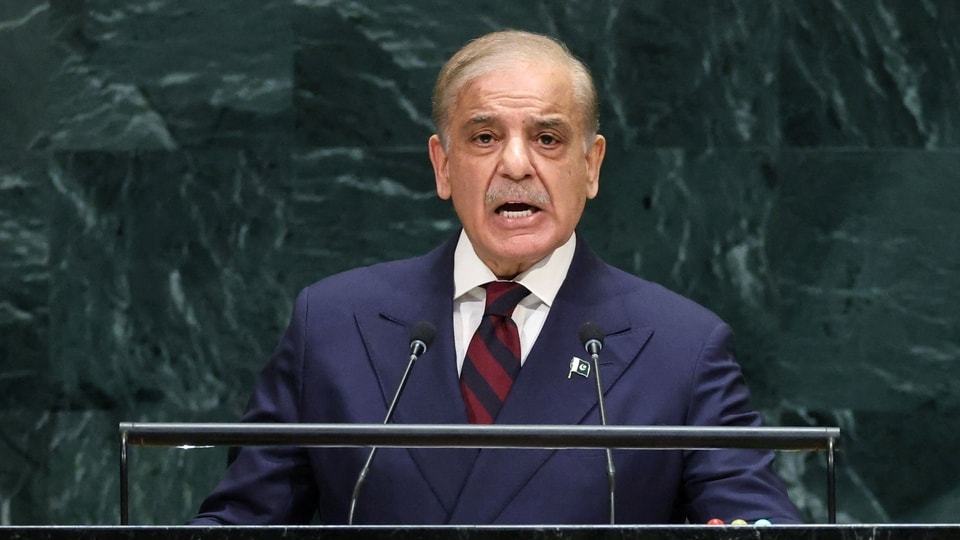
Addressing the 81st United Nations General Assembly (UNGA), Sharif said Trump’s intervention had come at a decisive moment when the two nuclear-armed neighbours were on the brink of a larger conflict.
“His timely intervention came at a decisive juncture when two nuclear-armed neighbors stood at the brink of an all-out war. And, who knows, Mr. President, the extent of devastation that could have taken place had President Trump not stepped in at this critical moment with clarity of thought and action. Mr President, we must therefore ensure that South Asia never reaches that precipice ever again,” Sharif said.
Also Read | ‘Terrorist country asking me’: Jaishankar fires back at Pakistani reporter's attempts to heckle at UNGA
Shehbaz Sharif on Operation Sindoor
New Delhi has consistently maintained that the May 2025 ceasefire between India and Pakistan was reached through direct communication between the two sides, with no role played by any third party.
Sharif also said Pakistan exercised its “inherent right of self-defence” under Article 51 of the United Nations Charter during the confrontation, while praising the country’s armed forces for their response.
"A year ago, Pakistan faced external aggression from India under a false pretext. Pakistan exercised its inherent right of self-defense under Article 51 of the United Nations Charter," he said.
“Our brave and valiant armed forces, under the courageous leadership of Field Marshal Syed Asim Munir, responded with precision and professionalism. They silenced the enemy, repulsed its attack and taught it a lesson it shall never, ever forget,” Sharif said.
Also Read | 9 years of talks, 2 nations, one deal: India, Pakistan signed Indus Waters Treaty on this day in 1960
Sharif on Indus Waters Treaty
Sharif then renewed Pakistan’s warning over the Indus Waters Treaty, criticising India’s decision to hold the 1960 water-sharing agreement in abeyance.
He described the shared waters of the Indus River system as the “lifeblood” not only for Pakistan but for the entire region, and alleged that India’s decision had “no legal basis whatsoever”.
“The shared waters of the Indus River system are the lifeblood not only for the people of Pakistan, but for the entire region. India's unilateral decision to hold the existing treaty in abeyance has no legal basis whatsoever,” Sharif said.
He further claimed that India’s position and actions regarding the treaty had been rejected by UN experts and the Court of Arbitration.
“In fact, both its claims and actions have been rejected by UN experts and, more recently, by the Court of Arbitration. Our legitimate stand that the treaty remains valid, binding and fully operative has been vindicated beyond any ray of doubt,” he said.
“Water must never be weaponised. Rivers should nourish nations, not divide them. Therefore, any attempt to stop, impede or divert Pakistan's share of the waters will be treated as an act of war. India must make no mistake about it,” Sharif added.
The May 2025 military confrontation followed India’s launch of Operation Sindoor in response to the April 22, 2025, Pahalgam terror attack, in which 26 people were killed after attackers targeted civilians.
The Indus Waters Treaty, signed by India and Pakistan on September 19, 1960, governs the utilisation of the waters of the Indus system of rivers.
India's reply
In India's right to reply, the first secretary in New Delhi's Permanent Mission to the UN, Petal Gahlot, accused Pakistan of pursuing a long-standing policy of cross-border terrorism and warned that such acts will have consequences.
“At the heart of the issue is the long-standing practice of cross-border terrorism by Pakistan. We demonstrated last year that terrorists will have nowhere to run and nowhere to hide. Our right to defend ourselves against terrorism will be exercised and continued. Terrorism by Pakistan will have consequences...We are confident that this Assembly will recognise Pakistan and its policies for what they really are, not what its representative mendaciously projects it to be. Reiterating falsehoods year after year does not make them true. Pakistan's terrorism, deceit and duplicity will neither benefit it nor the world," Gehlot said.