
Sign in

Rahul Gandhi says people being fooled about Modi’s caste; BJP hits back

Rahul Gandhi accuses Prime Minister Narendra Modi of falsely claiming to be from an Other Backward Class (OBC) family, says only Congress will conduct a caste-based census.

Updated on: Feb 8, 2024, 16:42:52 IST
By ,
Share
Share via
  • facebook
  • twitter
  • linkedin
  • whatsapp
Copy link
  • copy link

Member of Parliament Rahul Gandhi on Thursday said people were being fooled about the Prime Minister’s caste and that Narendra Modi, who took on the Congress in Parliament a day earlier for being unfair to marginalised communities, was not born into an Other Backward Class (OBC) family.
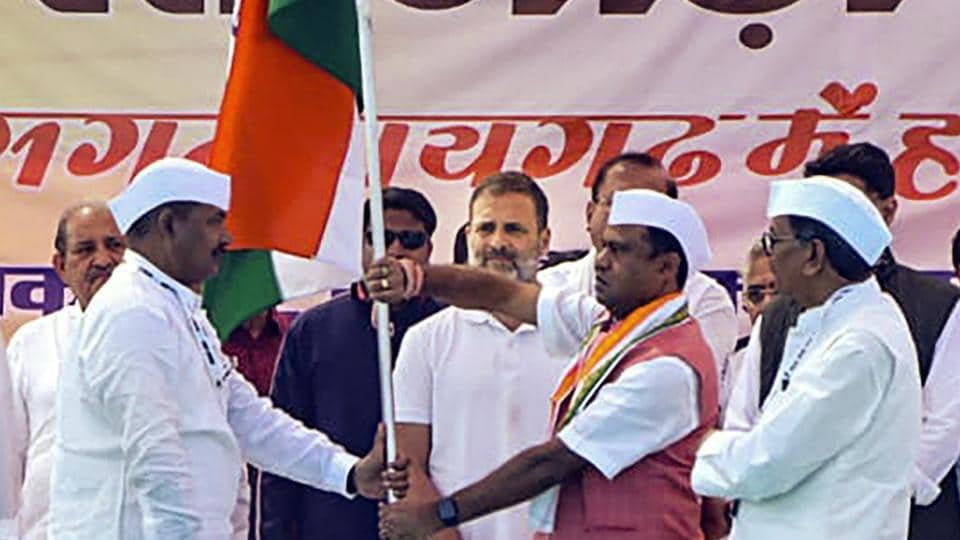
Congress leader Rahul Gandhi during the Bharat Jodo Nyay Yatra on Thursday. (PTI)

“He [Modi] says he was born an OBC...Modi was not born into OBC. You are being fooled,” Gandhi said on the second day of his Bharat Jodo Nyay Yatra in Odisha. He added Modi’s community was included in the OBC category when the Bharatiya Janata Party (BJP) was in power in 2000. “Your Prime Minister was not born into OBC. He was born into a general caste.”

Gandhi said he did not need a birth certificate to say that. “The biggest indicator is he never hugs any OBC person. He does not hold the hands of any labourer. He only holds Adani’s hand. Modi will never conduct a caste census because he was not born into OBC. Only the Congress will do a caste-based census.”

Gandhi has repeatedly demanded a nationwide caste census to understand India’s demographics for an equitable distribution of power and wealth. In the run-up to the polls in states such as Madhya Pradesh, Congress promised a caste census if the party was voted back to power while blaming the ruling BJP for ignoring marginalised castes.

On Wednesday, Modi cited a letter of Jawaharlal Nehru to chief ministers, saying it clearly showed that the first Prime Minister opposed reservation of any kind and believed that it adversely affected the government’s functioning.

He said the Congress never gave complete reservation to OBC, the country’s largest voting bloc. Modi has sought to negate the focus on caste. In December, he called the poor, women, the youth, and the farmer four biggest castes. in her budget speech this month, finance minister Nirmala Sitharaman referred to this as well.

Union minister Dharmendra Pradhan hit back in a post on X, saying either Gandhi is really ignorant or he feels telling lies repeatedly makes them accepted as truth.

BJP leader Surath Biswal, an OBC, said Gandhi’s statement showed his immaturity. “Modi belongs to the OBC. Congress has to answer why the Gandhi family put the recommendations of Kaka Kalelkar and Mandal Commission [for OBC reservation] in cold storage,” he said.

K G Vanzara, a retired social justice and empowerment department official in Gujarat, said neither the BJP nor Modi was in power at the Centre when the Prime Minister’s Ghanchi community was included on the OBC list in 1994. “Modi was not the chief minister when the central government issued the notification regarding the community’s inclusion.” He said Modi took office as the Gujarat chief minister seven years later in October 2001.
  • Debabrata Mohanty
    ABOUT THE AUTHOR
    Debabrata Mohanty

    Debabrata Mohanty is a senior assistant editor of Hindustan Times who works as state correspondent from Odisha covering the state's politics, governance, public policy, natural disasters, environment and its society for close to three decades. With his long years of reporting from the state capital of Bhubaneswar, Mohanty has been known as one of the most experienced and credible journalists covering Odisha for the national English dailies. His reporting combines on-ground detail with deep institutional knowledge detailing the state's changing politics, governance issues, administrative reforms and the functioning of its public institutions. He has regularly reported on issues ranging from legislative developments and public policy implementation. Politics is his core areas of expertise as he closely tracks Odisha's political landscape, including the rise and transformation of the Bharatiya Janata Party (BJP), the Biju Janata Dal (BJD), the two principal political parties in Odisha. His long association with the state's political establishment enables him to write on contemporary developments in a larger political context. Mohanty takes a deep interest in writing human interest stories, environmental issues and documenting the impact of cyclones, floods, heatwaves, and other climate-related events in one of the most disaster-prone states. His coverage extends to public health, governance reforms and stories on accountability of government institutions. Before joining Hindustan Times, Mohanty worked with The Indian Express, Mail Today, and The Telegraph, where he covered at least six general elections and as many assembly elections. In 2007, he was selected for the prestigious Chevening Young Indian Print Journalist Programme at the University of Lincoln, United Kingdom, where he received advanced training in print journalism. In 2009 he won the Press Institute of India-International Committee of Red Cross award on conflict reporting for his on-ground reportage of 2008 Kandhamal riots.Read More

  • Maulik Pathak
    ABOUT THE AUTHOR
    Maulik Pathak

    He is an Ahmedabad-based journalist with more than two decades of experience. His career spans business journalism and general news, with reporting across politics, crime, governance, public policy, business, industry, infrastructure, energy, ports, aviation, the environment, wildlife and social issues. He began his career in feature writing before moving into business journalism, reporting on companies and sectors including energy, infrastructure, pharmaceuticals, automobiles and real estate. Over the years, his work expanded to politics, courts, crime, public policy, civic affairs, the environment and wildlife. His reporting has taken him from government offices and courtrooms to factory floors, ports, forests and remote villages, covering stories that range from industrial investments and financial markets to elections, conservation and issues affecting everyday life. While many assignments demand the pace of the daily news cycle, others require sustained reporting over months and years to follow developments beyond the headlines. He started his journalism career with the Asian Age in Ahmedabad in 2002 as a feature writer and sub-editor. Since 2022, he has been working with Hindustan Times. Earlier, he worked with Business Standard, DNA, The Economic Times, Mint and The Times of India. His longest stint was with Mint, where he spent more than eight years reporting across multiple beats. During his career, he has worked in both reporting and editing roles, contributing to page planning, local editions and special editorial projects as newsrooms evolved from print-first operations to digital publishing. Early in his career, he also worked on media and documentary projects with an NGO and as a copywriter at a communications agency before returning to journalism. Away from work, he sometimes makes time for a pair of binoculars, table tennis, cinema and the occasional poem.Read More

Check India news real-time updates, latest news on Hindustan Times and more across India.