
 E-Paper



Pleas filed by Sena camps raise constitutional questions: Supreme Court
A three-judge bench, headed by Chief Justice of India NV Ramana, said these issues should be ideally adjudicated by a constitution bench with a strength of at least five judges.


Some “important constitutional issues” emanate from the petitions arising out of the split in the Shiv Sena, the Supreme Court observed on Wednesday, musing that a larger bench may be needed to settle the points of law surrounding the dramatic take-over of Eknath Shinde as the Maharashtra chief minister.
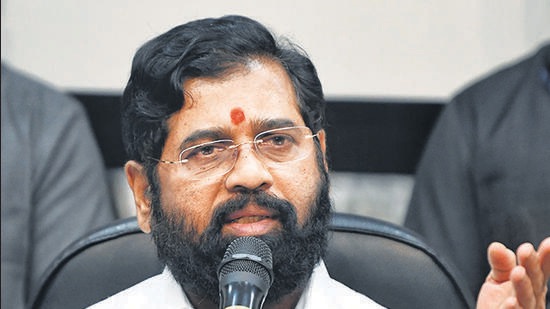
A three-judge bench, headed by Chief Justice of India NV Ramana, said these issues should be ideally adjudicated by a constitution bench with a strength of at least five judges.
“Some of the issues are important constitutional issues which should be settled...Some of the issues such as consequences of removal of Para 3 (of Tenth Schedule which did away with immunity for split in a party) and absence of split concept; whether a minority party leader has right to disqualify majority party leaders...these are some of the issues which will require a decision,” remarked the bench, which included justices Krishna Murari and Hima Kohli.
While the Shiv Sena has not split formally, the faction led by Shinde is supported by a majority of the party’s legislators; it has also claimed that it is the Shiv Sena.
After the 2003 amendment in the Constitution, noted the bench, a split in a party cannot protect legislators from disqualification (they will need to merge with another party) but the consequences of it would require deliberation in the light of the factors such as majority within the legislative party drifting away and claiming to be the original party.
“I strongly feel that some of these issues may require a larger bench,” said the CJI, even as the Shinde-faction argued that this case may not involve seminal issues of constitutional importance, particularly since Uddhav Thackeray has admittedly lost the support of the majority within his own party and chose to resign as chief minister instead of facing the floor-test.
Fixing August 1 as the next date for hearing, the bench also asked Maharashtra Speaker Rahul Narwekar to keep the disqualification proceedings, pending against the MLAs of Shiv Sena belonging to both Shinde and Uddhav factions, in abeyance for the time being. Initially, on July 11, the court asked solicitor general Tushar Mehta, who appeared for the Maharashtra governor, to communicate the court’s mandate to Narwekar, a member of the Bharatiya Janata Party which is part of the Shinde-led coalition government in the state.
The bench was Wednesday hearing a batch of six petitions filed by Shinde and Uddhav factions in relation to disqualification proceedings against the MLAs of both camps, election of Rahul Narwekar as new Speaker of the assembly, recognition of a new party whip for Shiv Sena, and the governor’s directive to Uddhav for proving majority on the floor of the house and subsequently inviting Shinde to form the new government in the state.
While the first two petitions in the Supreme Court were filed by the Shinde faction to stop the deputy speaker (there was no speaker at the time) from disqualifying them as MLAs, the Uddhav-camp also approached the apex court later, challenging the actions of the governor in directing Uddhav to prove the majority on the floor of the House as well as inviting Shinde to form the government in the state. The Uddhav camp further challenged Narwekar’s decision to recognise Shinde as the leader of Shiv Sena and appointment of a new chief whip of the party.
The interim order passed by the Supreme Court on June 27 put in abeyance the disqualification petitions pending against Shinde and 15 other MLAs till July 12. However, after Uddhav resigned on June 29 and the Shinde faction subsequently nominated its chief whip in the assembly, disqualification petitions were also filed against MLAs of the Uddhav-camp for not voting in favour of Shinde during the trust vote on July 4. These MLAs from the Uddhav camp also approached the top court, taking the tally of petitions to six.
Commencing the arguments on behalf of the Uddhav faction, senior advocate Kapil Sibal said that there must be a merger of the rebel camp with another political party if they want protection from the anti-defection law. “If such rebels are allowed to form the government, then every elected government can be toppled, despite the fact that there is no protection under the Tenth Schedule (anti-defection law)… What’s happening is a mockery of democracy,” argued Sibal, requesting the court to itself decide the disqualification petitions since the new Speaker cannot be expected to act fairly.
Senior counsel Abhishek Manu Singhvi, also appearing for the Uddhav faction, supported Sibal, contending that the disqualification petitions should not be sent back to the Speaker for a decision. “Either the Deputy Speaker shouldn’t have been restrained by this court or the floor-test should have been stalled. This court keeps saying that the Tenth Schedule needs to be strengthened but, in this case, it has been made nugatory,” complained Singhvi.
Representing CM Shinde, senior advocate Harish Salve argued about the rationale behind the Uddhav camp’s claims and said the former CM did not enjoy the support of most Sena legislators.
“What’s wrong with internal party democracy? What’s wrong with questioning the leader of your party by not defecting to some other party but instead gathering enough support within the party. That’s not defection. I say the defection law will not apply here because the person concerned resigned before the floor-test,” argued Salve, adding the court would not interfere with the working of a political party.
The senior counsel added that heavens do not fall if a CM is changed because he does not enjoy the confidence of his own party members. “Saying that a CM has lost the majority in the House isn’t voluntarily giving up membership. Raising your voice within your party, without supporting some other party, is not defection. Membership of a party is not an oath of silence...The larger-than-life arguments on democracy in peril don’t square up when a CM has been overthrown by his own party members,” Salve said.
He requested the bench not to take up the role of a tribunal for deciding the disqualification petitions, adding that the Shinde faction will submit a formal counter affidavit in response to the contentions of the other side.
At this point, Sibal and Singhvi urged the bench to speed up the hearing, given the rapid political developments taking place outside the court room. Sibal also said that if Shinde had the support of the majority, he should have gone to the legislative party meeting and had a resolution passed in his favour.
The bench gave both sides around a week to file their replies, written submissions and compilation of relevant judgments, fixing August 1 as the next date.
In 1985, the Constitution was amended to institutionalise the concept of disqualification on the ground of defection and the Tenth Schedule was added, which is commonly referred to as the anti-defection law. The law applied to both the Lok Sabha and state assemblies.
The 1985 amendment recognised splits and mergers as exceptions to the rule of defection. A split takes place when at least a third of the members of a political party form a group of their own, while a merger occurs when two-thirds of the members supported the move for a merger with another political party. However, the 91st amendment of the Constitution in 2003 did away with the concept of a split in a political party, and deleted the impugned provision from the Tenth Schedule. The 2003 amendment resulted in mergers becoming the only exception against the rule of defection.


