
 E-Paper



PM Modi calls for ranking govt depts on basis of pending corruption cases
Prime Minister Narendra Modi on Thursday called for devising a mechanism to rank government departments on the basis of pending corruption cases against officials, on the lines of the Swacchta (cleanliness) rankings, and publishing the related reports on a monthly or quarterly basis.


Prime Minister Narendra Modi on Thursday called for devising a mechanism to rank government departments on the basis of pending corruption cases against officials, on the lines of the Swacchta (cleanliness) rankings, and publishing the related reports on a monthly or quarterly basis.
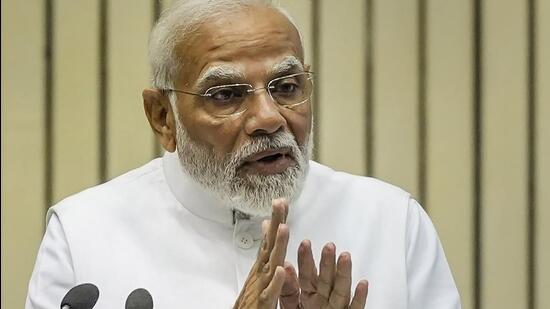
Addressing a programme marking the Vigilance Awareness Week of Central Vigilance Commission (CVC), the government’s anti-corruption watchdog in Vigyan Bhawan in New Delhi, Modi also asked government departments and agencies to ensure the completion of corruption-related disciplinary proceedings in a time-bound manner.
“The entire life of Sardar Vallabhbhai Patel was dedicated to honesty, transparency and the building of a public service system based on these values. The campaign revolving around awareness and alertness is based on these principles. The campaign of Vigilance Awareness Week is taking place to realise the dreams and aspirations of a corruption-free India. All government agencies should work to change the system and tradition of corruption as India is celebrating 75 years of Independence,” Modi said.
“We should have a system where corruption-related disciplinary proceedings are completed in time-bound mission mode. We should devise a way of ranking departments on the basis of pending corruption cases and publishing the related reports on a monthly or quarterly basis, on the lines of the Swachhta (cleanliness) rankings. There is also need to streamline the vigilance clearance process with the help of technology and a need for auditing the data of public grievances so that we can go to the root causes of corruption in the department concerned,” the PM added.
Emphasizing that the institutions acting against the corrupt and corruption, such as CVC, have no need to be “defensive” in any way, the PM said this is not about following a “political agenda” but simply working to make the lives of ordinary citizens simpler.
“Those who have vested interests will try to obstruct the proceedings and defame individuals associated with these institutions”, the PM said, and said he himself has been targeted thus. He added: “But the public are a form of God, they know the truth, and when the time comes, they stand with those in support of the truth”.
“When you take action with conviction, the whole nation stands with you,” the PM told the officials.
Prime Minister Modi’s Bharatiya Janata Party swept to power in 2014 on the back of a development and anti-corruption platform; the second term of the previous United Progressive Alliance government were marked by a series of corruption scandals.
Specifically commenting on corruption in defence deals -- irregularities in a deal to buy choppers for VIPs by the previous government (also scrapped by the same government after they came to light) are now before the courts -- the Prime Minister said India’s growing self-reliance ( Atmanirbharta) in the manufacture of defence equipment has further reduced the chances of these.
“We know how the defence sector was kept dependent on foreign countries, which was a major reason for corruption. Our government’s push towards Atmanirbharta in the defence sector has ended the possibility of scams as India is now moving towards manufacturing its own defence equipment, from rifles to fighter jets to transport aircraft”.
HT reached out to Congress for a comment but did not get one immediately.
The PM also focused on the bureaucracy and said they have to show the same resolve against corruption that the political leadership does. “For a developed India, we have to develop such an administrative ecosystem, which has zero tolerance on corruption.”
Asserting that there is a need to bring in common citizens in the work of keeping a vigil over corruption, Modi said: “No matter how powerful the corrupt may be, they should not be saved under any circumstances, it is the responsibility of organisations like you (he told the hall full of officials from anti-corruption agencies).”
The PM added that the ‘corrupt’ should not get any “political and social” support .
These corrupt people, Modi said, “are often glorified in spite of being jailed even after they are convicted. Some people give arguments in favour of the corrupt who have been found guilty. It is very necessary that such people, such forces, are made aware of their duty by the society. “
Blaming previous governments for their approach to fighting corruption, the PM said the legacy from the long period of slavery, corruption, exploitation and control over resources, was unfortunately amplified after independence and affected the subsequent four generations of Indians.
“For a very long time, the lack of amenities and opportunities was deliberately kept alive and a gap was allowed to widen leading to an unhealthy competition in a zero-sum race. This race fed the ecosystem of corruption. Corruption created by this scarcity affects the poor and middle classes the most. If the poor and middle class spend their energy to arrange for basic amenities, then how will the country progress? That is why we are trying to change this system of scarcity for the last eight years. We are trying to fill the gap between supply and demand. The three ways adopted to achieve this are advancement in technology, taking basic services to the saturation level, and finally heading towards atmanirbharta (self-reliance),” the PM said.
Modi also launched a ‘complaint management system’ portal of the CVC that allows citizens to raise corruption complaints digitally, besides checking their progress in a user-friendly way.
According to CVC’s annual report 2021, maximum number of corruption complaints was received against the officials of the union home ministry, railways and then banks.
Out of total 1,09,214 corruption complaints last year against all category of officers/employees in government departments, highest – 37,670 – were received against the ministry of home affairs (MHA) officials, followed by railways (11,003) and banks (6,330). As many as 4,101 complaints were received against civil aviation employees, 2,691 against those in petroleum sector, 2,216 against defence employees, 2,019 against employees of Central Board of Direct Taxes (CBDT), 1,672 against human resource development and 1,556 against finance ministry personnel.
Former Oil and Natural Gas Corporation (ONGC) chairman R S Sharma said – “Ranking ministries/departments on the basis of pending corruption cases is a very good concept. There has to be Swachhta (cleanliness) not just inside administrative buildings but corrupt activities, image and overall work ethics of the government departments”.


