Prime Minister Narendra Modi urged graduating engineers at IIT-Delhi on Saturday to measure their careers against the country’s needs rather than salary slips or startup valuations, telling students that “the basis of every decision of yours should be what the benefit to the country will be.”
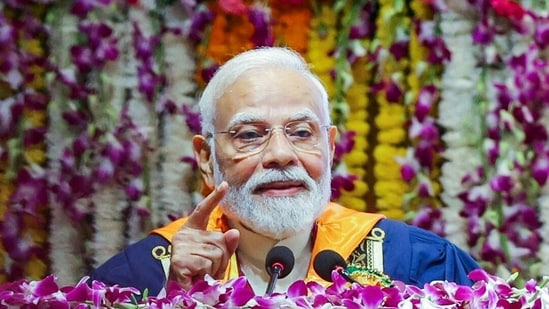
Addressing the 57th convocation ceremony, Modi told the graduating class that an IIT degree was “a mandate to contribute to the nation,” and framed the years ahead as a test distinct from anything the students had faced in the classroom. “Unlike your university exams, life’s most critical challenges are entirely out of syllabus,” he said, urging students to identify “the questions the world has stopped asking” rather than simply answering the ones already set for them.
Also Read | You will influence journey of 'Viksit Bharat': PM Modi's message to Gen Z at IIT-Delhi convocation
Rapidly shifting global landscape
Modi set that challenge against a rapidly shifting global landscape, telling students that the pace of technological change made it impossible to predict with confidence what industries or professions would look like in 20 or 30 years. “The strategic equations of the world are changing rapidly. The global balance of power is shifting every moment. And the biggest force driving these changes is the speed of technology,” he said. “No one can say with certainty what the world will look like 20 or 30 years from now... but remember what I am saying: the one who keeps learning will win.” He drew a distinction between generations, saying the cohort that fought for independence had a single, clearly defined national goal, while today’s graduates would shape India’s development over the next three decades.
{{/usCountry}}Modi set that challenge against a rapidly shifting global landscape, telling students that the pace of technological change made it impossible to predict with confidence what industries or professions would look like in 20 or 30 years. “The strategic equations of the world are changing rapidly. The global balance of power is shifting every moment. And the biggest force driving these changes is the speed of technology,” he said. “No one can say with certainty what the world will look like 20 or 30 years from now... but remember what I am saying: the one who keeps learning will win.” He drew a distinction between generations, saying the cohort that fought for independence had a single, clearly defined national goal, while today’s graduates would shape India’s development over the next three decades.
{{/usCountry}}Appeal to young India
Much of the address doubled as an appeal to young India more broadly, days after Modi released a video on Instagram offering to “forgive” students who had hurled abuse at him during weeks of protests led by the Cockroach Janta Party over the NEET-UG paper leak — remarks the opposition said should have been an apology, not an offer of clemency. Modi did not refer to the protests, the leak or examination reform at IIT Delhi. He instead cast the country’s youth as the driving force behind its economic rise, pointing to India’s startup ecosystem, its growing semiconductor base and a new generation of engineers “designing and launching their own rockets” — themes closely echoing his remarks in Mysuru on August 1, when he credited young Indians with “giving impetus to the development of the world.”
He singled out the pressures of comparison as a threat to student wellbeing, telling the students, “life is absolutely not a leader-board; your real race is not with anyone else, it is with yourself,” and urged them to stay off the scoreboard of salaries and placements that circulates on social media.
Education minister Prahlad Joshi accompanies PM Modi
Modi, who spoke for 34 minutes, was accompanied at the ceremony by education minister Prahlad Joshi, attending his first major public event at an educational institution since he took charge of the ministry on July 26, succeeding Dharmendra Pradhan. Joshi called the appearance a personal milestone. “After taking additional charge as the education minister, this is my first-ever public programme in any education institution alongside the PM,” he said. “I have complete faith in the potential of India’s youth and regard them as the foremost architects of Viksit Bharat 2047. I urge them to innovate with purpose and lead with integrity, recognising that excellence must go hand in hand with strong ethics and moral values.”
Also Read | US Vice President JD Vance dials PM Modi, discusses deepening India-US strategic ties
AI-powered supercomputing facility
Modi inaugurated an AI-powered supercomputing facility, Param Pragya, at IIT Delhi’s Sonipat campus via video conferencing during the ceremony, and pointed to continuing state support for research: the Prime Minister’s Research Fellowship, the Anusandhan National Research Foundation, which carries a funding target of up to ₹1 lakh crore, and the One Nation One Subscription scheme, which extends access to international research journals to institutions beyond the major cities.
He returned to the theme of youth-led growth across sectors including space, semiconductors, startups, digital payments and fintech, and pointed to drones transforming agriculture, medical deliveries and national defence. “Today, that same space sector has beautifully become a sky of new opportunities for thousands of our youth,” he said, adding that “all these revolutions have given millions of youths of the country an incredible opportunity to do something completely new for the first time.” He listed artificial intelligence, data centres, critical minerals, deep-sea exploration, quantum computing and energy security as emerging fields that would depend on the graduating cohort’s research and innovation.
Also Read | ‘A morning I will cherish’: Raghav Chadha meets PM Modi, thanks him for ‘insights and guidance’
More than 3,000 students received degrees at the convocation, including 587 PhD scholars.