
 E-Paper



You will influence journey of 'Viksit Bharat': PM Modi's message to Gen Z at IIT-Delhi convocation
Addressing the convocation ceremony of the IIT, Delhi, Modi said the rapid pace of change means nobody can predict what the next 20 to 30 years will look like.

 Prefer HTon Google


Prime Minister Narendra Modi on Saturday told students at the Indian Institute of Technology (IIT), Delhi, that the decisions they make over the next three to four decades will influence India’s journey towards becoming a ‘Viksit Bharat’.
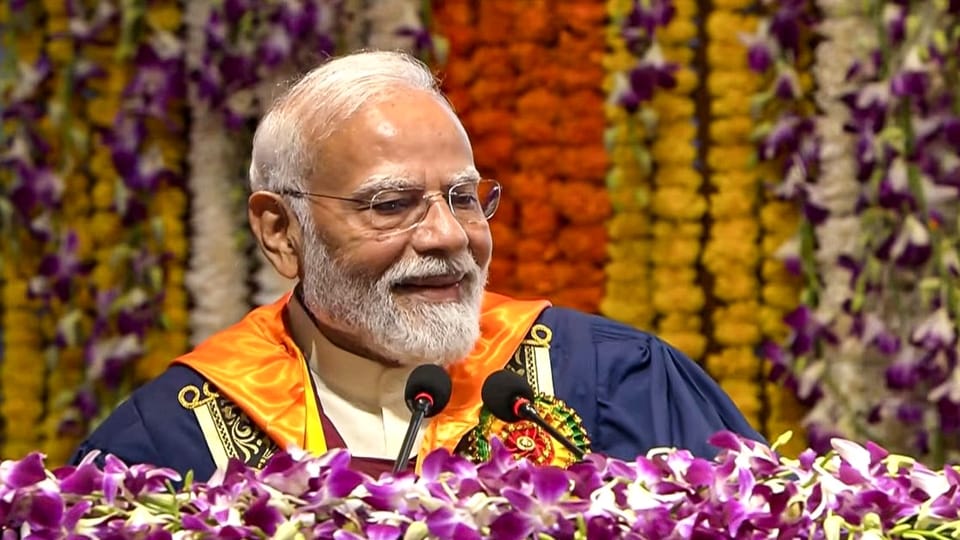
Addressing the 57th convocation ceremony of IIT Delhi, Modi said every generation faces its own challenges and carries a specific national responsibility. He asked the students to consider how their decisions could contribute to the country and address its needs, news agency PTI reported.
“You are all aware that every generation faces the specific challenges of its time and also bears its own national responsibility. Whatever you do over the next 30 to 35 years of your lives will influence our journey towards a 'Viksit Bharat'. Therefore, the basis of every decision you make should also be: how will this benefit the country? Which of the nation's needs will this fulfil?” he said.
‘Those who learn, win’
PM Modi also urged students to keep their curiosity alive and continue learning, saying the world and technology are changing rapidly and that “those who learn, win.”
He said the rapid pace of change means nobody can predict what the next 20 to 30 years will look like. He encouraged students to remain open to new situations and challenges, news agency PTI reported.
"Today, the world is changing rapidly. Nobody can say what will happen 20-30 years from now. Keep your curiosity alive in life... Keep your learning instinct alive. Those who learn, win," he said.
Also Read: ‘A morning I will cherish’: Raghav Chadha meets PM Modi, thanks him for ‘insights and guidance’
The prime minister said challenges can become opportunities for people who dare to find new solutions. He said being receptive to new situations and challenges would help students turn difficult circumstances into opportunities.
Modi said this ability was among the lessons students had learned during their time at IIT Delhi.
"People who are open to new situations and challenges will turn challenges into chances and this is what you have learned at IIT Delhi," Modi said.
He also highlighted India's efforts to become self-reliant across sectors, saying new areas were opening up for young people in the country.
"Today, new sectors are emerging in the country for our youth," he said.
The prime minister also pointed to the rapidly changing global power balance, saying technology was the biggest force driving these changes.
"The global power balance is changing every moment and the biggest force behind it is the speed of technology," Modi said.
Referring to developments in artificial intelligence, Modi said some new initiatives related to AI had also been launched at IIT Delhi.
"I extend my very best wishes to all of you for this as well," he said.
Highlighting India's progress in the semiconductor sector, Modi recalled that questions had been raised when the government began taking steps to develop the industry.
"But today, production has begun at the first semiconductor unit. I firmly believe that from chips to ships, everything will be made here by your hands," the PM said.
More than 3,000 graduating students, including 587 PhD scholars, were conferred their degrees at the convocation ceremony.


