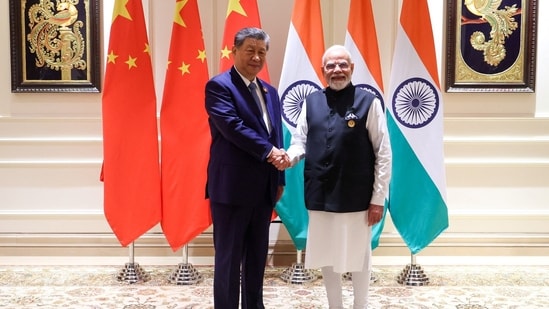
India on Saturday emphasised that peace and tranquillity in the border areas remain the “essential basis” for developing ties with China, as Prime Minister Narendra Modi and President Xi Jinping welcomed “steady progress” in bilateral relations during a meeting on the margins of the Brics Summit in New Delhi.
Track live updates on BRICS Summit
Xi travelled to India for the first time in seven years to attend the Brics Summit, setting up the meeting with Modi to take forward the normalisation of bilateral ties amid lingering tensions on the border. The two leaders last met on the sidelines of the Shanghai Cooperation Organisation Summit in the Chinese city of Tianjin a year ago.
Deep Dive
What measures did Modi and Xi discuss to resolve the India-China border dispute?
Why is peace in border areas essential for India-China relations according to Modi?
How has trade between India and China changed since Xi's last visit?
‘Peace and tranquillity essential for ties’
Modi emphasised that peace and tranquillity in the border areas “remains an essential basis for the continued development of bilateral relations”, the external affairs ministry said in a readout. He also underlined that both sides should “observe existing agreements and understandings on border-related issues”.
The two leaders “expressed commitment to a fair, reasonable, and mutually acceptable resolution of the boundary question proceeding from the political perspective of their overall bilateral relations and the long-term interests of the two peoples”, the ministry said.
{{/usCountry}}The two leaders “expressed commitment to a fair, reasonable, and mutually acceptable resolution of the boundary question proceeding from the political perspective of their overall bilateral relations and the long-term interests of the two peoples”, the ministry said.
{{/usCountry}}Modi’s comments reiterated India’s stated position that the state of the border will determine the overall course of bilateral ties. The Chinese side, however, has argued that the two sides should place the border dispute in an “appropriate place” while taking forward relations in other spheres such as trade and investment.
Meeting amid border tensions
The two leaders met against the backdrop of fresh tensions between Indian and Chinese troops in the remote Taksing region of Arunachal Pradesh, with reports of face-offs during July and August. The two sides reached an understanding in October 2024 on disengaging troops at “friction points” in the Ladakh sector of the Line of Actual Control (LAC), ending a standoff that lasted more than four years and took ties to a six-decade low.
Modi and Xi welcomed the “steady progress” in India-China relations since their last meeting at Tianjin in August 2025, and reaffirmed that both countries should “take a strategic and long-term perspective of their ties”, the readout said.
“Differences should not become disputes. Prime Minister [Modi] highlighted that both sides must be guided by three mutuals – mutual respect, mutual sensitivity and mutual interest,” the readout said.
Modi and Xi also noted progress in people-to-people ties and underscored the need to promote cultural exchanges, business linkages, and greater mobility between the two countries, the statement added.
In the context of economic and trade relations, they underlined the need to “address each other’s concerns, including structural trade imbalance and supply chain issues, and facilitation of meaningful and predictable market access”, it said.
India continues to have a range of concerns in the economic sphere, including China’s visa curbs for Indian businesspeople, export restrictions on critical machinery and commodities such as fertilisers, and the yawning imbalance in two-way trade. Since Xi’s last visit, India-China trade has grown from about $93 billion in 2019 to $127 billion in 2025, while the trade deficit has risen from $57 billion to almost $100 billion in the same period.
The two leaders further agreed that both sides “must continue to expand common ground on regional and global issues, and in addressing challenges”, the readout said without going into details.
Modi appreciated China's support for India's Brics presidency and its contributions towards the success of the Brics Summit.
Xi, who last visited the Indian capital in 2014, was received at the airport by minister of state for commerce Jitin Prasada. The leaders of India and China have not made any bilateral visits since 2020, when relations plummeted to their lowest point since the 1962 border war because of the face-off in Ladakh. Xi last travelled to India in 2019 for an informal summit with Modi, months before the standoff began.
The talks between Xi and Modi also offered an opportunity to take stock of several rounds of dialogue between the Special Representatives on the border issue, the Working Mechanism for Consultation and Coordination (WMCC), and senior military commanders. India and China held the first round of talks between military commanders in the eastern sector in Arunachal Pradesh on September 6 and 7.
The issue of a possible “early and substantial harvest” of boundary delimitation and border management has figured in recent discussions through diplomatic channels, though the two sides have not released any details so far.