
 E-Paper



National policy to reduce pendency a priority: CJI Surya Kant
CJI Surya Kant's first major public interaction after assuming office as the 53rd Chief Justice on November 24

 Prefer HTon Google


NEW DELHI: Chief Justice of India Surya Kant on Saturday declared that a “predictable timeline for deciding cases and a unified national policy for disposing pending matters” will be his first priority, as he laid out an ambitious roadmap for transforming India’s justice-delivery system into one that is swifter, cost-effective, more inclusive and firmly oriented toward the ordinary citizen.
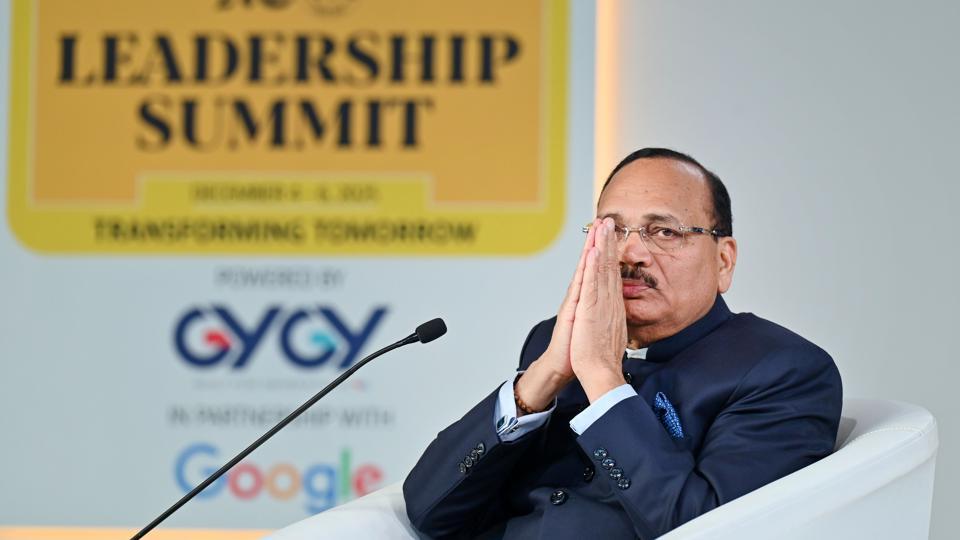
Speaking at the 23rd Hindustan Times Leadership Summit––his first major public interaction after assuming office as the 53rd Chief Justice on November 24––CJI Kant called for urgent judicial reform anchored in accessibility and predictability, coupled with prioritisation of old matters and cases involving the common man.
“My first priority will be a predictable timeline and a unified national judicial policy for early decisions of the pending cases,” he said in a freewheeling conversation with Utkarsh Anand, Hindustan Times’ national legal editor.
The CJI underscored that reducing pendency was not about clearing every case. “I am not saying the elimination of all the cases because that will never happen and that should not happen. Litigation is an ongoing process and people have trust and faith in the judicial system… but the old cases that are staring at our face – we really need to tackle that area,” he said.
The CJI said reforms are already underway in the Supreme Court to restructure listing and docket management. “I am undertaking the exercise of prioritising matters to be listed. This is not something I can do alone – my sister and brother judges have extended full cooperation. With help from domain experts and judicial colleagues, we will meet these challenges,” he noted.
He emphasised that the strength of the judicial system lies in district courts. Addressing concerns that trial judges often fear criticism from appellate courts in high-profile matters, he offered reassurance and encouragement. “The Indian judiciary is a dedicated community. I am absolutely confident about their commitment, integrity, competence and zeal to deliver justice,” he said.
Calling for technology and training-driven reforms, he added: “We need to update our judiciary through periodical training in judicial academies. We must have regular programs to equip officers to deal with new challenges like digital arrests and cybercrime.” He reiterated the need for “optimum utilisation of human resources and recognition of merit”, suggesting that mechanisms to evaluate performance and incentivise excellence are being evolved.
According to statistics from the National Judicial Data Grid (NJDG), more than 48 million cases are pending across the district courts in India while high courts have over 6.3 million cases pending. At the Supreme Court, there are 90,000 pending cases.
Confident that the judiciary has a vibrant future, he said that the judiciary in modern India should be cost-effective, and the justice-delivery system should be predictable so that anyone who comes to courts leaves with the feeling of being treated equally.
Calling his approach a message to the nation, he said he wanted to firmly establish that justice is not only for the privileged. “I want to send a very clear and strong message that the Supreme Court is also meant for the common man. An ordinary litigant will also have sufficient space and time in the Supreme Court,” he said.
CJI Kant placed significant emphasis on mediation as an essential reform tool, describing it as one of the “game changers” needed for India’s judicial future. “I really need to explore mediation as one of the powerful game changers, and as you know that particularly in the last six months, I have launched the ‘Mediation for the Nation’ mission. It is coming up very well,” he said, adding that mediation offers speed, social harmony and dignity in dispute resolution.
Compared to other dispute-resolution mechanisms, he said mediation “creates a win-win situation for both parties. Both parties leave the court with smiling faces. It brings social harmony, it maintains the social fabric, and most importantly, it speaks in the common man’s language.” Mediation would succeed, he insisted, “only when mediators start speaking the language of the consumer of justice” in friendly, accessible environments free of courtroom intimidation.
Highlighting the expansion of community mediation programmes under his leadership at the National Legal Services Authority (NALSA), he said: “On November 8, we launched community mediation. With this model, we will be able to reach villages, streets and houses where disputes already exist or are anticipated, so that people are provided an alternative platform at their doorsteps.”
The Chief Justice recalled that his tenure as executive chairman of NALSA shaped his belief that access to justice must be redefined in modern India. “Access to justice is a very simple expression – how swiftly, in less cost, with a clear and predictable timeline you can ensure justice to the person before the court,” he said.
He highlighted three essential challenges – ensuring quality legal assistance, prioritising cases involving vulnerable groups, and creating environments where every litigant feels respected. “One challenge is how to ensure that those in vulnerable classes get quality legal assistance and their matters are prioritised along with big cases. They must feel that they have been treated equally and with respect,” he said.
Steps are underway to expand the base of legal aid, he added, noting that programmes are being scaled nationally to provide quality representation through district, state and national legal services authorities.
Responding to a question on diversity, the CJI said the judiciary today reflects a far more inclusive character than in previous decades. “You compare the judiciary of early 2000 to 2025 – there is a paradigm change,” he observed. Expansion in judicial strength has enabled broader representation from different regions, communities, genders and professional backgrounds. “That inclusivity, that diversity has brought a very rich culture in the Supreme Court. The court today represents India as a whole,” he said.
On debates around judicial independence, CJI Kant offered a measured and pragmatic view. “The Constitution has beautifully defined the roles of the judiciary, legislature and executive, ensuring there is no overlapping,” he said. At the same time, structural cooperation is indispensable. “There are so many administrative issues where institutions depend on each other – budget, infrastructure. It is a well-oiled machine where all organs work complementary and supplementary to each other while maintaining their independent identity.”
Asked about the necessity for judges and courts to keep learning in an era of rapid technological change, he said: “It is essential for judges and the judiciary to constantly update their knowledge. If courts are not aware of a changing society, it will inevitably create difficulties in the justice-delivery system.”
In today’s world, he said, the judiciary must understand complex online and cross-border crimes. “Unless judges understand how such offences are committed and how these processes work, it will be difficult to deliver justice effectively,” he cautioned.
The first-generation lawyer from a small village in Hisar, who is also the first CJI from Haryana, reflected emotionally on his journey. “Village taught me to be very patient… I must wait for my turn and invest in myself through hard work and commitment,” he said. The years of struggle, he added, shaped his leadership philosophy: “Growth takes its own time.”
CJI Kant closed on a hopeful note. “I am a very optimistic person, and I am absolutely confident that Indian democracy and India’s justice-delivery system have a bright future,” he said. His optimism, he explained, comes from the commitment of citizens to constitutional values and the energy of young legal minds. “Their capacity to face different kinds of challenges ensures that the Indian judiciary is in very safe hands,” he said.


