
 E-Paper



Punjab faces uphill fight to dispose of its farm stubble
Punjab Agricultural University vice-chancellor Dr Satbir Singh Gosal said the state needs an infrastructure push to amplify ex-situ methods

 Prefer HTon Google


Punjab generates an estimated 18.5 million tonnes of paddy straw each year, but the state can dispose of only 1.1 million tonnes by using it as industrial fuel and for generating power, a gap that poses a major challenge to the state’s attempts to cut the quantity of crop residue that is burnt across its fields each year, leading to an air pollution crisis in much of north India, including Delhi.
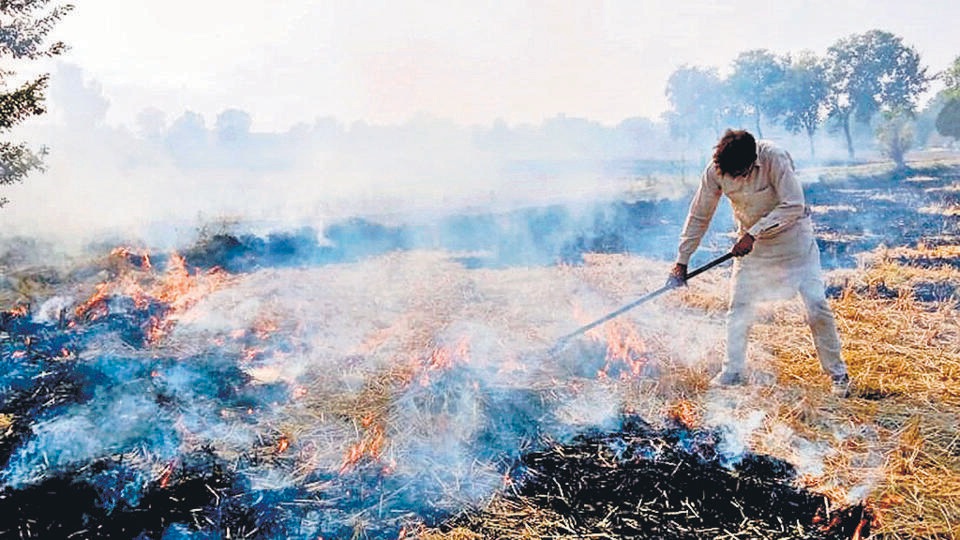
According to state government data, Punjab produces an estimated 185 lakh (18.5 million) tonnes of paddy straw every year. Of this, half is managed in-situ (by being mixed into the soil) and the rest ex-situ (used as fuel) or is set ablaze. The ex-situ methods include using paddy straw in the biomass-based power generation plants, and as fuel in industrial units manufacturing paper, cement, sugar and edible oil.
Officials aware of the matter said that with the state already reporting stubble fire incidents, pressure is mounting on the government to push for ex-situ crop residue management to tackle farm fires this season.
According to Punjab Pollution Control Board (PPCB) data, there are 11 private biomass-based power generation plants in the state, with a total annual capacity of 97.5 megawatts. These plants consume 8.8 lakh (0.8 million) tonne of paddy straw. While Muktsar, Fazilka and Hoshiarpur have two plants each, Jalandhar, Mansa, Moga, Faridkot and Ferozepur districts have one facility each.
According to PPCB, seven industrial units manufacturing paper, cement, sugar and edible oil use stubble as fuel and five more such industries have committed to using 2.75 lakh (0.275 million) tonnes of stubble.
The National Green Tribunal has also asked thermal power plants to use stubble pellets as 5-10% of its total fuel consumption.
However, the owners of these power plants have complained about the poor availability of stubble pellets. “We use stubble in brickets or pellets form, and as per our requirement, the production is insufficient. There is one plant in Ludhiana that produces pellets but the output is poor,” said a manager of a private power plant at Rajpura.
“Though the National Green Tribunal (NGT) and the Commission for Air Quality and Monitoring (CAQM) have been stressing on ex-situ methods for disposing stubble, we are facing serious issues due to lack of infrastructure,” said a government official who asked not to be named.
Punjab Agricultural University vice-chancellor Dr Satbir Singh Gosal said the state needs an infrastructure push to amplify ex-situ methods. “It’s a cheaper proposition but needs infrastructure for which big budget is required,” he said, adding that the state needs more biomass-based power generating plants, pellets making industry, bio-CNG plants, and fast transportation to carry stubble from the farms and storage godowns.
“So far, the state government has largely focused on in-situ crop residue management which is an expensive option. Ex-situ management is the effective way to dispose of paddy stubble. But, in the absence of infrastructure it is difficult to encourage farmers to adopt this system,” asked Sukhdev Singh Kokri Kalan, general secretary Bhartiya Kisan Union (Ugrahan).
“With the Centre and the AAP government in the state dropping the plan to pay incentive to the farmers for not burning stubble, the ex-situ management policy could help the farming community earn some extra bucks by selling crop residue. But for this, the state government should add infrastructure in terms of industry and fuel pellets making facilities,” he added.
PPCB member secretary Krunesh Garg said the ex-situ management of paddy straw is slowly picking up pace in the state, with the farmers realising that they can have an extra income by selling crop residue. He added that around 2 lakh tonne of stubble sold to the industry could add ₹30 crore to the rural economy.
He added that two more biomass-based power generation plants are expected to be operational soon in the state. “Hindustan Petroleum is also setting up a bio-ethanol producing plant in Bathinda district and is expected to consume 2 lakh metric tonnes of paddy every year,” he added.


