
 E-Paper



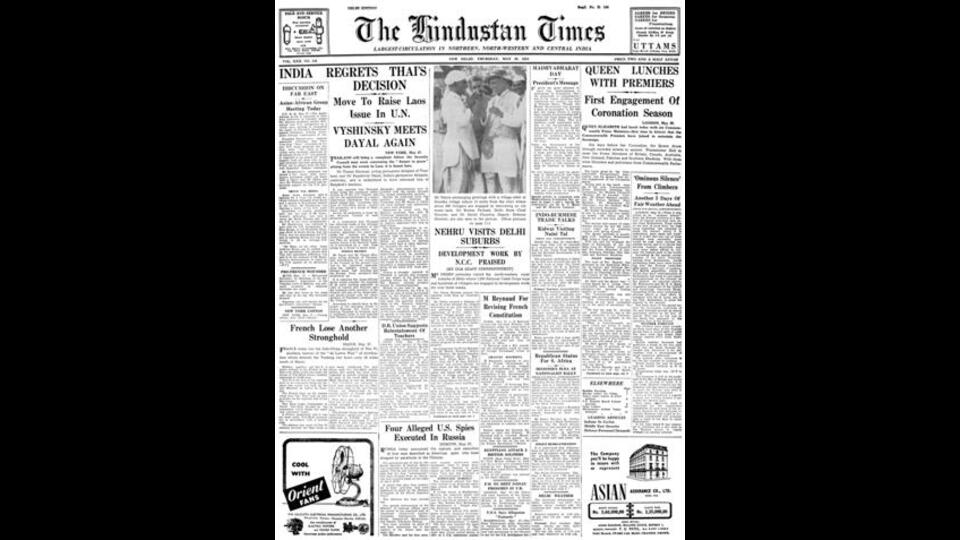
HT This Day: May 28, 1953 -- Queen lunches with premiers
QUEEN ELIZABETH had lunch today with six Commonwealth Prime Ministers-first time in history that the Commonwealth Premiers have joined to entertain the Sovereign.

 Prefer HTon Google


QUEEN ELIZABETH had lunch today with six Commonwealth Prime Ministers-first time in history that the Commonwealth Premiers have joined to entertain the Sovereign.
Six days before her Coronation, the Queen drove through crowded streets to ancient Westminster Hall to meet the Prime Ministers of Britain, Canada, Australia, New Zealand, Pakistan and Southern Rhodesia. With them were Ministers and politicians from Commonwealth Parliaments.
The lunch, given by the Commonwealth Parliamentary Association, was the Queen’s first formal engagement of the Coronation season.
Taking part in the lunch were six of the nine Commonwealth Prime Ministers attending the Coronation: Sir Winston Churchill (Britain), Mr St. Laurent (Canada), Mr Robert Menzies (Australia), Mr Sidney Holland (New Zealand), Mr Mohammed Ali (Pakistan), and Sir Godfrey Huggins (Southern Rhodesia).
Mr Dudley Senanayake (Ceylon) is also in London but was unable to attend. Mr Nehru and Dr Malan are not due here until Friday.
The ancient hall- scene of many dramas during the last 900 years - was today set in gleaming colours with spring flowers.
The Queen presided in accordance with tradition, Westminster Hall being a royal palace.
With her and her husband, the Duke of Edinburgh, at the top table were Sir Winston Churchill and the Prime Ministers of Canada, Australia, Pakistan, New Zealand and Southern Rhodesia.
TOAST PROPOSED
The toast of Her Majesty was proposed by the Australian Minister of Labour and National Service, Mr Holt, who presided in his capacity of Chairman of the General Council of the Commonwealth Parliamentary Association.
Mr Holt said the Queen was “a young Queen for a young Commonwealth, both with bright expectancy-the forward looking quality of youth.”
The Commonwealth was still young and growing up.
“ Your Commonwealth is responding, as you have counselled us, to the spirit of adventure,” he said. “
“We feel the urge to develop our great resources, and as the young countries of our Commonwealth grow in strength, so we strengthen the whole. “
“What a Commonwealth we have within our power to build. We can muster the resources of one-fifth of the world’s land mass; we can harness the skill of some 600 million self-governing people. The greatest days of this Commonwealth are still ahead of us.”
Mr Holt handed the Queen a souvenir book of pictures of the Commonwealth parliaments.
The Queen, who sat down to prolonged cheers, was followed by Sir Winston Churchill who declared: “ Here today in this hall we salute 50 or 60 parliaments and one Queen.”
The Prime Minister said: “It is no longer a case of the Queen versus Parliament but the Queen and Parliament.
“ In our island by trial and error and perseverance across the centuries we have found out a very good plan. Here it is. The Queen can do no wrong.
“ Bad advisers can be changed as often as the people like to use their rights for that purpose. A great battle is lost: Parliament turns out the Government. A great battle is won; crowds cheer the Queen.”
Replying to the toast, the Queen said: “ It is a stirring thought that all these legislatures are descended from the Assembly which first met under this roof nearly seven centuries ago.
“ We stand here in the Palace of Westminster, which is the home of the Mother of Parliaments. Of the many ties linking this family of nations, not the least is that system of parliamentary government which is common to us all.
VIVID MEMORIES
“ I have vivid memories of my visits during my father’s lifetime to Commonwealth parliaments overseas, and I am looking forward with pleasure to seeing others during my forthcoming tour.
“ To this great Association I offer my best wishes for the coming deliberations.” Sir Winston, who proposed a vote of thanks to the Queen, said some people in other countries might say the Commonwealth wanted to have it all ways at once.
“ I see no harm in that,” he said.
“ We are seeking the best of all worlds and certainly we have got the pick of this one.
“ We must be very careful these days what we say about the American Constitution- I perhaps more than any because of my American forebears.”
Amid applause the Prime Minister said, he would say no constitution had been written in better English.
“The key thought alike of the British constitutional monarchy and the republic of the U.S.A. is the hatred of dictatorship.”
Sir John Kotelawala, Vice-Chairman of the Council of the Association and leader of the House of Representatives in Ceylon, recalled Elizabeth.
He said: “ It is a matter of history that the foundations of the British Empire were laid during the reign of - Elizabeth and that it received great support and encouragement from the Sovereign herself. That Empire grew and flourished and it became one of the most powerful the world had ever known.”
Queen Elizabeth II commenced her reign as Queen of the Empire of free nations. Each of its individual choice had accepted her as Sovereign. It was their hope that during her reign the number of those nations would increase.
The nations of the Commonwealth were many of various races and religious division, each having to contend with different conditions and different problems. But the aspirations and purposes of these nations were the same.
The unity of the Commonwealth was characterized by the free and unanimous acceptance of Her Majesty as its head.
UNIFYING FORCE
Mr St. Laurent stressed the unifying force within the Commonwealth of common loyalty to the Crown.
“ To outsiders it is frequently a great source of wonderment how an association like the Commonwealth, whose members are so widely scattered over the globe, who have such diverse interests, who comprise so many ethnic elements, can possibly survive as a harmonious international entity, “ he said.
“ If they, who are perplexed, could have been with us this afternoon they would be better able to understand why this achievement of the Commonwealth has been possible.
“ Of the forces which bind us together none is stronger than our common loyalty to the Crown and devotion to our Sovereign even in those lands where the most formal expression of that devotion has to be found in the recognition of Her Majesty as the head of a Commonwealth broad enough to include a State whose people prefer it to be called a republic.”
Mr St. Laurent recalled that 58 years ago people from all parts of the British Empire assembled in London to pay homage to Queen Victoria during her diamond jubilee. There had been changes in the Empire since that time.
“ Over 90 per cent of the peoples, who formed part of the British world in 1897. have assumed and they exercise full responsibility for the management of all their internal and external affairs. For them even the name of ‘Empire’ has been changed to ‘Commonwealth.”


