
 E-Paper



Quota to communalism: Themes of Lok Sabha polls campaign
The bitter war of words in the 2024 Lok Sabha elections campaign focused on guarantees, wealth redistribution, reservation, Hindutva, and personal remarks.

 Prefer HTon Google


The prolonged campaign for the 2024 Lok Sabha elections, spanning over two months, saw both ruling Bharatiya Janata Party-led National Democratic Alliance (NDA) and opposition Indian National Developmental Inclusive Alliance (INDIA) engaging in a bitter war of words with each of the seven phases of polling.
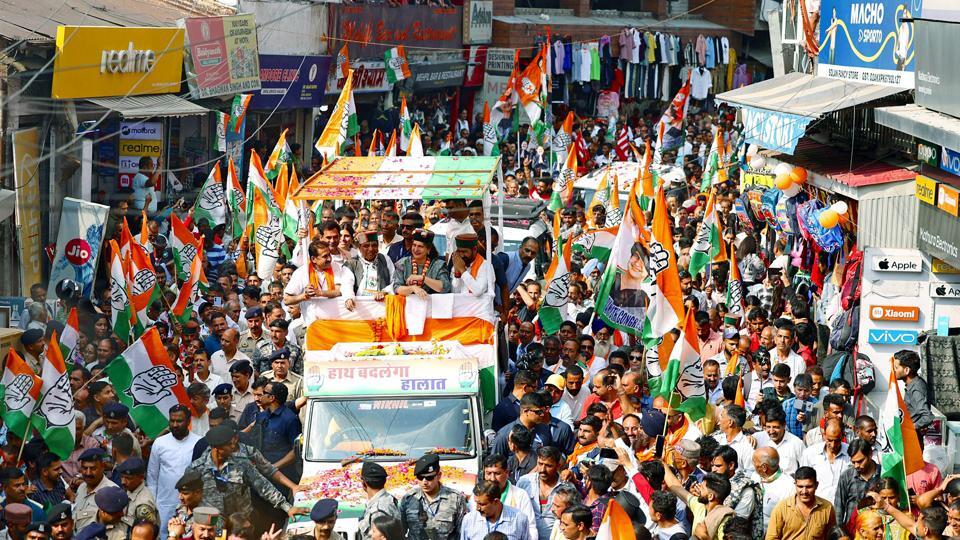
The campaign started off with a pitch for “guarantees” by both the National Democratic Alliance (NDA) and the INDIA bloc. Each side switched gears midway, with the BJP alleging the Congress held “ill intentions” to redistribute the wealth of weaker sections to the Muslim community and fritter away reservations, and the Congress accusing the ruling party of aiming to change the Constitution to snatch quotas guaranteed to scheduled castes, scheduled tribes and other backward classes.
The high-decibel campaign came to a close on Thursday.
The beginning
Prime Minister Narendra Modi launched the BJP’s campaign on March 31 from Meerut in Uttar Pradesh, making a strong pitch for development. “You have seen only a trailer of development so far,” he told the gathering. “This election is not just for electing a government, but to create ‘Viksit Bharat’ (developed India).”
Lok Sabha Election 2024 Phase 7: Voting date, list of constituencies/seats, key candidates | Full schedule
The Congress, eager to reclaim power at the Centre after a decade, picked its 138th Foundation Day on December 28 to kick start its poll outreach from Nagpur, a city home to the RSS headquarters. The party’s poll manifesto, titled Nyay Patra (justice document), drew heavily from Rahul Gandhi’s Bharat Jodo Nyay Yatra. It translated into 25 guarantees, including filling up of three million government jobs, ₹1 lakh for the woman head of all poor households, and removing the 50% cap on reservation after conducting a nationwide caste census.
Some other parties, too, opted for guarantees instead of age-old manifestoes. The Trinamool Congress, part of the INDIA bloc except in West Bengal, emphasised party chief Mamata Banerjee’s promises to revoke the Citizenship (Amendment) Act (CAA) and not allow National Register of Citizens (NRC) and Uniform Civil Code (UCC) in Bengal, besides dole outs in the form of 10 free LPG cylinders, assured MSP for farmers, and scholarships for SC, ST, OBC students.
The Rashtriya Janata Dal (RJD) pledged the creation of 10 million government jobs and ₹1 lakh annually to economically disadvantaged women. Taking a cue from the Congress, RJD leader Tejashwi Yadav turned the manifesto into Parivartan Patra (document for change).
Development and Hindutva
The BJP campaign was hoisted on development and Hindutva. The party’s outreach was designed to leverage Modi’s popularity, highlight his clean image, decisiveness, and acceptance across castes and regions. Modi had instructed the party leaders at a BJP’s National Council meet to use his “clean image” and the governance model to their advantage.
Number Theory: Outliers within the constituencies in Lok Sabha elections
The party put together a long list of fulfilled promises that were part of its manifesto, some for over decades. The list included the construction of Ram Temple in Ayodhya, abrogation of Article 370, fast-tracking citizenship for minorities from three neighbouring countries through CAA.
Polarisation
However, two days after the first phase of polling on April 19, Modi’s speech at Banswara in Rajasthan sparked an uproar after he accused the Congress of wanting to take away people’s hard-earned assets and distribute it among “infiltrators” and “those who have more children”, in an apparent reference to the minority community. The party also labelled the Congress’s manifesto initially as that with the imprint of Muslim League and later akin to Maoist document.
Modi also alleged that his predecessor Manmohan Singh had advocated that Muslims had the first right to country’s resources, a claim vehemently rejected by the Congress, which said Singh spoke of first rights for SC, ST, women and poor Muslims.
“Our manifesto is for every Indian. It talks about equality for all,” Congress chief Mallikarjun Kharge posted on X.
Jayshree M Sundar, who was previously with advertising agency Leo Burnett, said: “I saw the BJP campaign starting with “Is baar 400 paar” and ‘Modi ki guarantee’. After the second phase, with lower percentage of polling, the 400 paar narrative stopped. I must say, most of BJP advertisements were easy for people to understand. Coming to Congress, first part was based on common man raising questions to the government. The Congress also brought its “haath badlega halaat” tagline. This election campaign was also about memes, satires”.
“I always say that 2014 was a Twitter campaign. 2019 was fought on WhatsApp. This campaign was a YouTube campaign by both sides,” she added.
Read Here: Hat-trick at Centre, says PM Modi, wraps up LS campaign in Punjab
The BJP, however, defended Modi’s statement, with party chief JP Nadda in an interview to HT saying: “The PM has exposed what the Congress had tried to stealthily do... disturb the demography and social fabric of the country by honey-coating poison.”
Reservation
The issue of caste-based reservation also became a key issue. The Opposition accused the BJP of wanting to win over 400 of the 543 Lok Sabha seats so that it can change the Constitution and do away with caste-base quotas. Congress leader Rahul Gandhi pitched for a caste-census to do an “X-ray” of the society as the Congress promised to raise the 50% ceiling on reservation for SC, ST, OBCs.
With reports and feedback from its ideological fount, the RSS, the party set about to change the narrative.
Modi in his speeches claimed that even BR Ambedkar, the architect of the Constitution, could not change it. The BJP also claimed that the Congress wanted to take away reservation from the weaker sections and give it to Muslims.
Personal remarks
In the final days of the campaign, a litany of personal comments dominated the campaign.
Read Here | PM Modi mentioned ‘mandir’ 421 times in poll speeches, ‘Modi’ 758 times: Congress
Modi gave a series of interviews, making several remarks about his life and political journey.
“Until my mother was alive, I used to think I was born biologically. After her demise, when I look at my experiences, I am convinced that I was sent by God...” Modi said in one such television interview.
Congress leader Rahul Gandhi took a swipe at Modi over his remarks, quipping that the PM was sent by “parmatma (God)” to help industrialists, Gautam Adani and Mukesh Ambani.”
In all, the campaign threw up issues of caste, quotas, Constitution, communalism, Hindutva and jobs. For the BJP, Modi was its main draw and star campaigner. For the Opposition, it was a bevy of regional leaders and the Congress’s top brass.
“The campaign was disappointing. The very plurality of democracy is lost in the majoritarian process and that is a tragedy. There was little scope of civil society and its role in this campaign. The campaign didn’t hold any promise for the future of India,” academic Shiv Vishwanathan said.
Now it’s over to June 4 for the results.


