Congress MP Rahul Gandhi on Tuesday took a swipe at Prime Minister Narendra Modi over his ‘forgive children’ video message last week, saying the students of the country are in “severe pain” and do not need the latter’s forgiveness.
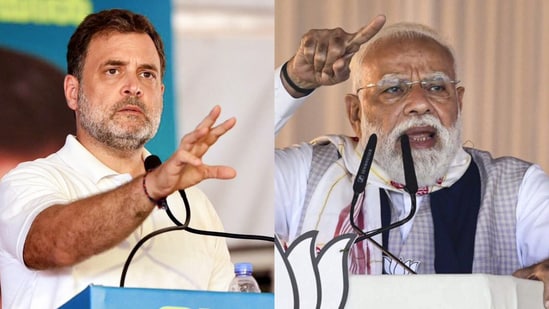
“We are going through a strange time in our country. Students are on the streets, in severe pain. They are asking for fairness in exams and for an education system that works,” the Lok Sabha MP said in reference to the recent nationwide protests, mostly by students, sparked by the cancellation of the NEET-UG exam earlier this year.
“On the other side, we have the Prime Minister who is forgiving them. Who is he to forgive them, don’t know. But that is what he chooses to do,” he added.
Late on Friday, PM Modi said he and even his late mother were subjected to abusive language at Delhi’s Jantar Mantar, where the protests first erupted, but asserted that dragging such “misguided children” into court would not resolve the problem. He said he wanted to forgive such students.The PM’s remarks, through an Instagram reel, came against the backdrop of the registration of a First Information Report (FIR) against a woman by Noida Police over allegedly objectionable comments directed at him.
{{/usCountry}}Late on Friday, PM Modi said he and even his late mother were subjected to abusive language at Delhi’s Jantar Mantar, where the protests first erupted, but asserted that dragging such “misguided children” into court would not resolve the problem. He said he wanted to forgive such students.The PM’s remarks, through an Instagram reel, came against the backdrop of the registration of a First Information Report (FIR) against a woman by Noida Police over allegedly objectionable comments directed at him.
{{/usCountry}}Gandhi was speaking at an event to launch the book of former MP Vaiko when he made the remarks.
Also Read | 'Grateful for a second chance': Mother of teen girl thanks PM Modi for forgiving her over abusive remarks
“Behind the thinking of the Prime Minister and behind the thinking of his colleagues, and particularly the RSS (Rashtriya Swayamsevak Sangh), is a very dangerous and caustic idea. The idea that this country is not an expression of the many,” the Leader of Opposition in Lok Sabha said.
He said every state has the right to be treated fairly and express its own culture and language, but the "RSS wants that only the history subscribed by it should be followed and that is why the fight".
In the Constitution, it is clearly written that India, that is Bharat, is a union of states and the state is an expression of the people of India, Gandhi said. "When you say Tamil Nadu, inside is the history of Tamil people, their pain, suffering, happiness. The Constitution says every state represents one history, tradition, language. Every single state has the right to that, which must be treated fairly. Every state has the right to express itself, its own culture and language,” he said.
"Here are some ignorant people who don't understand Tamil, Marathi, Bengali people and say none of these histories and imaginations are relevant. The only history that is important is the one ascribed by the RSS. This is why this fight is important. This is why the students are out on the streets. India will not tolerate its history being trampled by anybody," Gandhi said at the book launch event,” he added.
Also Read | Day after 'forgive' remark, PM Modi praises youth for powering India's growth
The students’ protest against paper leaks at Jantar Mantar was led by the Cockroach Janata Party. It began on June 20 and ended after 36 days on July 25 following the resignation of Dharmendra Pradhan as the Union education minister and the government's acceptance of the protesters' demands.
The agitation galvanised thousands of students in protests across the country and received the support of major opposition parties. The discontent spilt over into a massive march to Parliament on July 20, which witnessed a strong police response involving lathicharge and the use of tear gas. After three rounds of talks, the CJP and the government reached an agreement on July 25 under which the government accepted its demands, following which the protest was called off.