E-Paper



Rain inundates underpasses in Delhi again
Delhi's underpasses flooded again after heavy rain, causing traffic disruptions.

 Prefer HTon Google


For Delhi residents, one of the many inevitables of life is flooded underpasses when it rains.
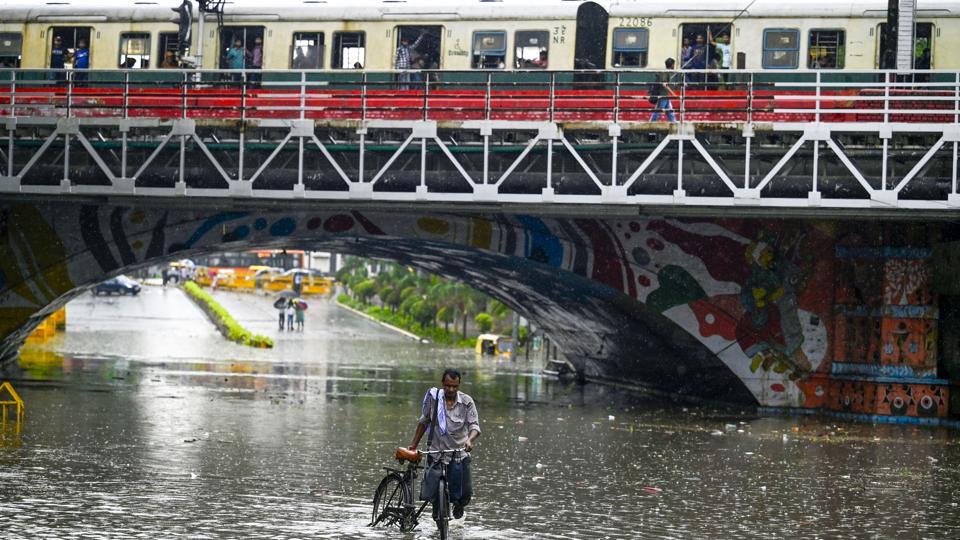
The annual spectre returned again with Tuesday morning’s downpour. At least four underpasses – Minto Bridge, Zakhira, Azadpur and Monkey Bridge – saw flooding heavy enough for civic officials to bar traffic for several hours.
It all started with the usual suspect.
After two years of remaining mostly flooding-free and even being removed from the list of “waterlogging hot spots”, the Minto Bridge underpass was submerged during the heavy spells of rain this monsoon and was inundated again on Tuesday morning. An autorickshaw driver ferrying two children got stuck in the water and had to be rescued from the spot, said police.
The Zakhira underpass was the second to be closed for traffic after heavy waterlogging, with a bus getting stuck in it. Later in the day, the Azadpur and Monkey Bridge underpasses also had to be blocked. Several other underpasses across the city, such as the Ashok Vihar underpass, Lawrence Road underpass, Tilak Bridge underpass and Chatta Rail underpasses were also waterlogged, said officials.
Trying to grapple with the problem, the Public Works Department (PWD) has made a list of “solutions” that can be implemented to prevent waterlogging, officials in the agency said. Some of these include placing barriers to stop people from entering underpasses during heavy rain, creating humps to reduce run-off from the roads, raising the level of existing pumps near the underpasses, and arranging power backup for pumps in case of power cuts.
“One of the suggestions in all areas is that barriers be placed at the entry points of underpasses similar to railway level crossings. These barriers will be brought down as soon as waterlogging starts. In many cases, despite shutting the underpasses for traffic, some people try to wade through the water against instructions leading to vehicles getting stuck inside. In cases where water level is quickly rising, rescue operation also becomes difficult,” said a senior PWD official who asked not to be named.
Another official said that the number of permanent pumps deployed at all underpasses are being reviewed, and will soon be increased. The department is getting more German-made high-powered pumps — already used at Minto Bridge and Pul Prahladpur — that are less likely to break down because of silt, garbage and other material that gets stuck in the engine.
“At some places, we are trying to raise the level of the pumps’ platforms so that these are not easily submerged. At some other underpasses, we are trying to shift the switch system towards the top, so that the staff can easily access and switch on the pumps immediately,” said a second PWD official.
Officials added that, at some places, humps or speed breakers may have to be erected near the entry and exit points of underpasses to raise the level of the road and ensure that water from adjacent stretches does not enter the underpasses. Another measure suggested is covering of the ramps of the underpasses to further prevent rainwater from flooding in.
“We have noticed that at places where ramps are covered like Ashram or the Pragati Maidan tunnel, less rainwater enters the underpasses. However, this will lead to higher costs and is still under consideration,” said the official.
Also read: Active monsoon leads to 36% excess rain over northwest India in August: IMD
Symptomatic solutions for a chronic issue
Experts, however, stress that unclogging drains and improving Delhi’s ageing drainage network are the only solutions that will lead to any success — unlike the measures cited above that seek to address the visible symptoms rather than the larger problem.
“Once an underpass is flooded, authorities block it and re-route traffic. The only solution then is to have some officials deputed to prevent people from entering. However, well-functioning underpasses will not allow flooding in the first place as they have drainage systems under it. The simplest thing is to keep the drains maintained, cleaned and de-silted and all debris and blockage is removed so that flooding does not occur despite heavy rain. Underpasses are, by definition and design, supposed to be low-lying compared to other areas around it. Their drainage must be designed keeping in mind the water run-off even during heavy rainfall,” said Jaya Dhindaw, urban planner and director, WRI India Ross Center.
Another major factor, experts stressed, is the poor management of solid waste. Non-biodegradable plastic waste such as chips wrappers, gutkha packets, plastic bags, they said, are the biggest culprits. Often, these items, thrown on the sides of streets, get washed into drains and end up clogging them.
Other experts noted that poorly maintained drains are only a contributing factor and that the bigger problem is sanctioning development projects while ignoring an area’s land profile.
According to a senior urban designer KT Ravindran, in recent times, these developments have become more aggressive, less scientific and quick to complete. He cites Pragati Maidan and the accompanying infrastructure in the heart of Delhi as a case in point.
“Literally metres away from the Yamuna, waterlogging plagues the city traffic in this area. This remains one of the most ill-informed set of decisions when one realises the fact that Pragati Maidan was once a wetland in the flood plains of Yamuna. Most of the central Delhi area was part of a wetland system and an extension of the riverbed. Having underpasses here is already absurd. The area needs good drainage that is planned as per the profile of the land. Delhi’s geography is well studied, especially after detailed, expensive GIS surveys of the terrain of Delhi were done over a decade ago. However, the plans and surveys never found their way to development decisions in the city,” said Ravindran, dean emeritus at RICS School of Built Environment, Amity University.