
 E-Paper



Rajasthan assembly passes Disturbed Areas Property Bill amid Opposition criticism
The Bill empowers the state government to declare certain areas as “disturbed areas” if public order is affected due to riots or mob violence.

 Prefer HTon Google


Jaipur: The Rajasthan Legislative Assembly on Friday passed the ‘Rajasthan Prohibition of Transfer of Immovable Property and Provision for Protection of Tenants from Eviction from Premises in Disturbed Areas Bill, 2026’, aimed at regulating property transactions in notified disturbed areas and protecting tenants from eviction, even as the opposition criticised the legislation as divisive.
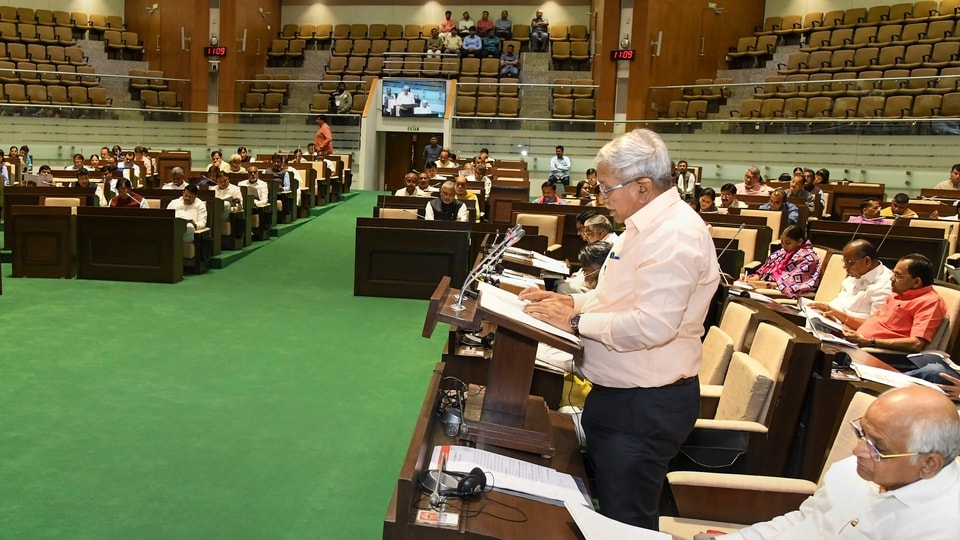
Rajasthan has become the second state after Gujarat to enact such a law.
Replying to the debate on the Bill, Parliamentary Affairs Minister Jogaram Patel said the legislation was brought to maintain social balance and harmony and was not based on any particular religion or community.
He said the law was framed after considering the circumstances and requirements of Rajasthan and after consultation with legal experts. “Have we mentioned Hindu or Muslim in the Bill or made it on that basis?” he asked, adding that the government respects all communities and religions.
Patel said the legislation seeks to ensure that the spirit of communal harmony remains intact and that the government does not remain a mute spectator when tensions or instability arise in any area.
Also read: Appropriation Bill passed in Bihar assembly to clear decks for ₹3.53L-cr withdrawal
The Bill empowers the state government to declare certain areas as “disturbed areas” if public order is affected due to riots or mob violence or if there is a possibility of improper clustering of people from one community in a manner that could disturb the demographic balance of the locality.
Under the provisions of the law, any transfer of immovable property in such notified areas during the specified period will be considered null and void.
Persons intending to transfer property in a disturbed area will have to obtain prior sanction from a competent authority (not below the rank of Sub-Divisional Magistrate). The authority will conduct a formal inquiry to determine whether the transfer is being made with free consent, whether the price reflects fair value and whether the transaction could lead to demographic imbalance in the locality.
The Bill defines “fair value” as the market value of the property or the District Level Committee rate, whichever is higher.
Also read: New L-G for Delhi; Bengal, Tamil Nadu, Bihar get new governors in major rejig
The legislation also provides protection to tenants in riot-affected areas. If a building is destroyed during riots, the landlord will be required to reconstruct it and provide accommodation to the tenant in the new building.
The minister said the law is intended to safeguard demographic equilibrium and social harmony by preventing distress sales of property during communal tensions or violence.
Patel said experience in several parts of the country has shown that after riots or communal tension, people sometimes sell property at prices below market value due to fear and insecurity, leading to rapid changes in the demographic profile of residential areas.
“This is not merely a property issue but a question of social balance,” he said.
The minister said an area will not be declared disturbed arbitrarily. The decision will be taken only after examining facts, reports and administrative inputs.
The Bill also proposes the formation of a monitoring and advisory committee and a special investigation team to help the government identify disturbed areas and maintain public order.
It prescribes strict punishment for violations. Anyone who disobeys or facilitates disobedience of an order issued by the competent authority can face imprisonment ranging from three to five years and a fine of at least ₹one lakh or 10 per cent of the fair value of the property, whichever is higher.
Patel said the government would not allow pressure politics and will protect the rights of citizens while ensuring peace and communal harmony in the state.
After the reply, the house passed the bill by voice vote.
Earlier, while speaking in the debate, Rajasthan Congress chief and MLA Govind Singh Dotasra criticized the bill and accused the state government of attempting to fuel religious polarization and restrict constitutional rights.
Participating in the discussion, Dotasra alleged that the government was trying to replicate the “Gujarat model” by bringing legislation that could create communal tensions and consolidate majority votes. He claimed the bill was aimed at increasing government control over land and property transactions.
“The right to buy and sell property is guaranteed by the Constitution. Government interference in these rights will only promote corruption and is a conspiracy to disturb peaceful areas,” Dotasra said.
He questioned the government on how it would determine which areas would be declared “disturbed” and which communities were being referred to. “Which areas will be termed disturbed and which community are you targeting? If the Congress returns to power in 2028, we will repeal this bill,” he said, adding that political change is a recurring pattern in Rajasthan.
Dotasra further alleged that the bill indirectly targets a particular community and that the government had failed to clearly spell out its intent in the legislation. Referring to provisions under Section 5, he said they could open the door to corruption and limit citizens’ ability to challenge decisions in court.
Accusing the government of trying to disturb otherwise peaceful regions, he said the bill appeared to have been introduced under directions from higher authorities. “Our constitutional rights are being challenged. The double-engine government is trying to dilute constitutional freedoms,” he said, warning that such legislation could damage Rajasthan’s long-standing tradition of communal harmony and its “Ganga-Jamuni tehzeeb.”


