Tunnel experts and rescuers at the Chilime 22 MW hydropower project in Nepal have started using rat-hole mining, a technique adopted during the 2024 Uttarakhand Silkyara tunnel rescue, in order to find and pull out six workers trapped after the devastating floods on August 26.
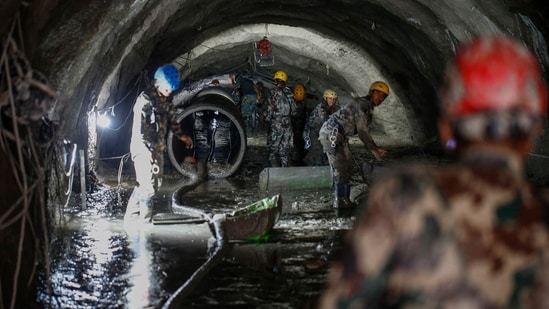
The rescuers have dug almost 35 metres deep into the debris using the method and are hopeful of a breakthrough in their search , officials monitoring the rescue operations said on Monday. Twenty tunnel experts from the Indian Army and the National Disaster Response Force (NDRF), along with 37 Nepalese Army personnel are carrying out the rescue.
Also read: Indian rescuers hope for miracle to save six at Nepal power project following flash floods
Rescue teams turn to high-risk rat-hole mining technique
Rat-hole mining is fraught with dangers and is usually used to extract coal from thin seams, often illegally. It involves digging narrow, unventilated tunnels that fit a single miner to directly access the seam. Data maintained by hydropower companies showed 909 people went missing at 11 sites after the floods.
While the Silkyara tunnel rescue, which spanned nearly 17 days, ultimately succeeded, it contrasts sharply with the situation at Chilime. In Uttarakhand, all 41 trapped workers had managed to communicate with rescuers, who could fortunately deliver food and medicine to them via a roughly 100-meter-long drilled pipe.
{{/usCountry}}While the Silkyara tunnel rescue, which spanned nearly 17 days, ultimately succeeded, it contrasts sharply with the situation at Chilime. In Uttarakhand, all 41 trapped workers had managed to communicate with rescuers, who could fortunately deliver food and medicine to them via a roughly 100-meter-long drilled pipe.
{{/usCountry}}No contact with trapped workers, but rescuers hope they survived
At Chilime, rescuers are yet to make contact with the trapped workers. But rescuers believe the workers are still alive as they were last spotted by survivors at the underground power station, where there was stored drinking water stored for the workers.
A project official said around 90 metres of debris, including large boulders, were cleared using excavators.
The rescuers then created a rat hole and slowly went 35 metres further to a total depth of 125 metres and are removing water that has collected after this point, said Bimal Khadka, deputy manager of the Chilime Hydropower Company Ltd.. “We are all hoping that the water has created a void in the next 100 metres or so which leads to the underground power station. If there is a void and the route is not blocked further, there should be a breakthrough here very soon,” he added.
“Approximately 100 metres of debris has been cleared so far by a joint team using an excavator and a loader. Since water has been found inside the tunnel, work to remove it is underway, and a search and rescue team is attempting to enter using ropes.” the Nepal Army said in a press statement.
Also read: 2 rescued from Nepal hydropower tunnel 9 days after floods, contact established with others
Clearing work to continue as teams target powerhouse
Indian envoy in Nepal Naveen Srivastava said the clearing work is expected to continue on Tuesday to reach the powerhouse.
“There were unexpected challenges including inflow of water from inside the tunnel and presence of big boulders. The teams are using mud pumps to dewater the area. It is expected that clearing work will continue tomorrow (September 15) to reach the powerhouse,” he wrote on X.
Also read: Blasting hillsides, pumping oxygen: Inside the race to reach 600 trapped in Nepal's flooded tunnels
Chilime Hydropower’s information officer, Shree Raj Bajracharya, said that rescuers on Monday morning came across oil mixed with water. “This makes us believe that we are near the power station. Our teams are working round the clock in different shifts to reach the power station. ” he said.