
 E-Paper



Relevance of anti-defection law: Om Birla meets Speakers of other assemblies
The discussion at the meeting called by Birla also assumes importance in the wake of the Supreme Court’s observations about the role of the Speaker.


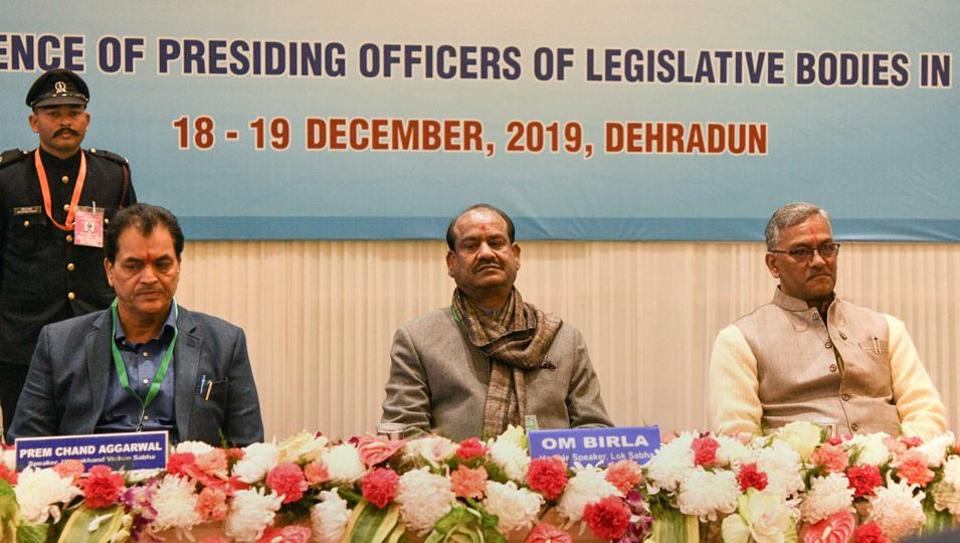
Presiding officers of state assemblies will discuss the Constitution’s 10th schedule introduced in 1985 to check defections on the second day of their two-day meeting with Lok Sabha Speaker Om Birla in Dehradun on Thursday.
The discussion assumes importance in the wake of the Supreme Court’s observation last month about “a growing trend of Speakers of legislative bodies acting against the constitutional duty of being neutral”. The Court made the observation while upholding the disqualification of 17 lawmakers, whose resignations in July toppled the Congress-Janata Dal (Secular), or JD(S), coalition government in Karnataka and allowed the Bharatiya Janata Party (BJP) to return to power in the state. Sixteen of the 17 joined the ruling BJP and 13 of them were fielded in the by-polls in Karnataka this month after the court allowed them to contest the polls. Eleven the 13 were re-elected.
Ahead of the discussion in Dehradun, Rajasthan assembly Speaker CP Joshi noted that the anti-defection law has become irrelevant. “If lawmakers of a party are lured by another party and they resign and shift the way it happened in the Rajya Sabha, then I must say it is sabotaging the 10th schedule,” he said.
He cited the example of Karnataka, where 17 Congress and JD(S) lawmakers resigned and helped the BJP return to power following the JD(S)-Congress government loss of a trust vote in July.
In Rajya Sabha, the Opposition parties have lost at least six lawmakers over the last four months after they suddenly resigned to allow the BJP to renominate them. Four of the six Telugu Desam Party lawmakers in Rajya Sabha switched sides in June and joined the BJP. They did not face disqualification since the anti-defection law allows two-third members of a party to break away.
A three-judge Supreme Court bench spoke at length about the role of a Speaker in its 109-page judgment that allowed the 17 rebel Karnataka lawmakers to contest the December 5 by-elections.
“In any case, there is a growing trend of Speakers acting against the constitutional duty of being neutral,” the court said. “Additionally, political parties are indulging in horse trading and corrupt practices, due to which the citizens are denied of stable governments. In these circumstances, the Parliament is required to reconsider strengthening certain aspects of the Tenth Schedule, so that such undemocratic practices are discouraged.”
The court added said that “the Speaker, being a neutral person, is expected to act independently while conducting the proceedings of the House or adjudication of any petitions”.
It said that the constitutional responsibility endowed upon a Speaker has to be scrupulously followed. “His political affiliations cannot come in the way of adjudication. If Speaker is not able to disassociate from his political party and behaves contrary to the spirit of neutrality and independence, such a person does not deserve to be reposed with public trust and confidence.”
The 10th Schedule was added to the Constitution in 1985 to tackle what was commonly called Aya Ram, Gaya Ram politics. The phrase was coined after Haryana lawmaker Gaya Lal changed his party thrice in the same day in 1967. During Atal Bihari Vajpayee’s term as the Prime Minister, the 91st Constitutional amendment was introduced in 2003 to restrict the size of a council of ministers to not more than 15% of the total strength of the House to discourage defections in the lure of becoming ministers.


