
 E-Paper



SC allows safari with riders, wants new rules for reserves
The judgment came on a petition by environmentalist Gautam Kumar Bansal, challenging widespread illegal tree felling and unauthorised “permanent” constructions.


The Supreme Court rejected the central government’s plan to allow zoo animals inside tiger reserves for proposed tiger safaris, terming it “completely contrary” to conservation aims” and paved the way for entirely new set of guidelines for how tiger safaris are established and maintained.

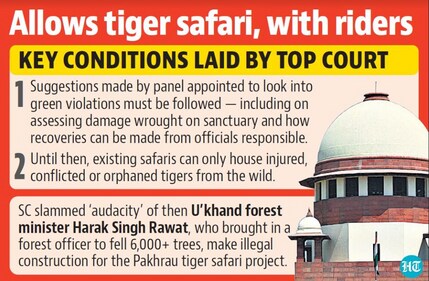
The order pertained to the controversial Pakhrau tiger safari in the Corbett Tiger Reserve, which the court allowed to be set up but with conditions. Main among these was that the recommendations by a committee it appointed to look into environmental violations are followed, including on the issue of assessing how much damage has been wrought on the sanctuary and the ways recoveries can be made from officials responsible.
The new guidelines that the court ordered to be drawn up will be by a four-member committee consisting of representatives from the National Tiger Conservation Authority (NTCA), Wildlife Institute of India, the court-appointed central empowered committee (CEC) and an officer not below Joint Secretary rank in the ministry of environment, forest and climate change (MoEFCC). It will need to submit its first report in three months, the court ordered.
Until then, existing safaris can only house injured, conflicted or orphaned tigers from the wild. Uttarakhand was told to relocate or establish a rescue centre near the proposed Pakhrau safari in the Corbett Tiger Reserve.
“The safaris that are already existing and the one under construction at Pakhrau will not be disturbed. However, insofar as the safari at Pakhrau is concerned, we direct that the State of Uttarakhand to relocate or establish a rescue centre in the vicinity of the tiger safari. The direction of this court with respect to the establishment and maintenance of tiger safaris, upon receipt of the recommendations of the committee proposed to be appointed, will also be applicable to the existing safaris, including the safari to be established at Pakhrau,” said the order.
The judgment came on a petition by environment activist and lawyer Gautam Kumar Bansal, challenging widespread illegal tree felling and unauthorised “permanent” constructions at Pakhrau for the safari, even before final approvals were put in place. The petitioner also contested the 2019 NTCA guidelines allowing sourcing of zoo animals.
The bench headed by Justice BR Gavai quashed those “contrary provisions”, noting earlier 2012 and 2016 guidelines emphasised rehabilitating only certain non-releasable tigers at such safari facilities.
“The 2019 guidelines...provide for sourcing of animals from zoos in the tiger safaris. In our view, this would be totally contrary to the purpose of tiger conservation... To that extent the contrary provisions in the 2019 Guidelines stand quashed,” the bench said.
While the Centre argued safaris in buffer zones would provide employment and promote wildlife-human coexistence, the court maintained they can only serve the limited 2016 mandate of housing non-releasable felines.
The court was informed that the work on the Pakhrau tiger safari was 80% complete. It directed the state of Uttarakhand to “relocate” the existing ‘rescue centre’ at Corbett near to the proposed tiger safari, and held that the provisions of the 2016 guidelines be scrupulously followed while undertaking construction of ‘tiger safaris’.
The bench also criticised vesting final authority over safari animals with the Central Zoo Authority instead of the tiger conservation body NTCA as “not in harmony” with the Wildlife Protection Act.
The judges underscored that without protecting tigers, the entire ecosystem revolving around them cannot be secured. Though the Centre cited reduced poaching and rising tiger numbers nationwide, the bench deemed this “not sufficient.”
In a 159-page order, Justice Gavai noted the “ground realities” of rampant illegal activities like large-scale felling in Corbett “cannot be ignored”, necessitating expert intervention for better reserve management.
The committee will examine if tiger safaris should be allowed in reserve buffer/fringe areas at all. If permitted, it must frame eco-centric guidelines ensuring minimal environmental damage, with safaris near rescue centers as mandated earlier.
Its broader mandate includes pan-India measures for effective tiger reserve protection and determining permissible activities in buffer zones, construction norms, capping resort numbers and noise pollution controls, given rampant commercialization.
A separate investigation by the Central Bureau of Investigation, ordered by the high court, is underway into the Corbett tree felling case, with prima facie findings implicating then state forest minister Harak Singh Rawat and then forest officer Kishan Chand for brazenly disregarding laws.
The agency was directed to complete its parallel probe against errant officials within six months and a status report in three months.
The Court asserted the state “cannot run away from its responsibilities to restore the damage done to the forest” and must undertake damage assessment, determine valuation and recover costs from those responsible.
Examining provisions of the Wildlife Protection Act, the Supreme Court noted the pivotal tiger conservation role of NTCA and the higher statutory standing of tiger reserves over sanctuaries/parks. It highlighted buffer areas as critical for absorbing poaching shocks and fostering dispersing tiger populations.
Corbett’s notified area spans 1,288 sq.km, including over 800 sq.km of core critical habitat, while the remaining 466 sq.km constitutes crucial buffer.
The reserve has highest tiger population in the country with 260 tigers among the country’s 53 tiger reserves, according to the tiger census report released last year.


